
Short Information About Maharashtra
Maharashtra is a state in the western and central peninsular region of India occupying a substantial portion of the Deccan Plateau. The centre of India is in this state. Maharashtra is the second-most populous state in India as well as the third-most populous country subdivision in the world. It was formed on 1 May 1960 by splitting the bilingual Bombay State, which had existed since 1956, into majority Marathi-speaking Maharashtra and Gujarati-speaking Gujarat. Thus Maharashtra is a Marathi linguistic state. The state is divided into 6 divisions and 36 districts, with the state capital being Mumbai, also the most populous urban area in India and Nagpur serving as the winter capital. The Godavari and the Krishna are the two major rivers in the state. Marathi is the most widely spoken language and is also the official language of the state. The forest cover in the state is 16.47% of the state's geographical area. Out of the total cultivable land in Maharashtra, about 60% is used for grain crops with Jowar being the dominating crop.Spread over 307,713 km , it is the third-largest state by area in India. Maharashtra is bordered by the Arabian Sea to the west, the Indian states of Karnataka and Goa to the south, Telangana to the southeast and Chhattisgarh to the east, Gujarat and Madhya Pradesh to the north, and the Indian union territory of Dadra and Nagar Haveli and Daman and Diu to the northwest. Nagpur hosts the winter session of the state legislature. The state has three international airports, Chhatrapati Shivaji Maharaj International Airport (Mumbai), Dr. Babasaheb Ambedkar International Airport (Nagpur), and Pune Airport (Lohegaon, Pune). The state is home to three railways headquarters viz. Central Railway (Chhatrapati Shivaji Maharaj Terminus), Konkan Railway (CBD Belapur) and Western Railway (Churchgate). The High Court of the state viz. Bombay High Court is located in Mumbai. The state contributes 48 seats and 19 seats to the lower house Lok Sabha and to the upper house Rajya Sabha, respectively. President's rule has been imposed in Maharashtra three times since 1980, for different reasons and for a total of 156 days. Hinduism is practised by more than three-fourths of the population, followed by Islam and Buddhism. The predominant ethnolinguistic group of the Maharashtra is Marathi people, who speak the Marathi language.
The state is home to four UNESCO World Heritage Sites: Ajanta, Ellora and Elephanta caves and the Chhatrapati Shivaji Maharaj Terminus (formerly Victoria Terminus). Pune is known as the 'Oxford of the East' due to the presence of several well-known educational institutions. Nashik is known as the 'Wine Capital of India' as it has the largest number of wineries and vineyards in the country. Maharashtra provides legal protection to its tiger population through six dedicated tiger reserves under the precincts of the National Tiger Conservation Authority.
Maharashtra is the most industrialised state in India and the state's capital, Mumbai is India's financial and commercial hub. The state has played a significant role in the country's social and political life and widely considered a leader in terms of agricultural and industrial production, trade and transport, and education. Maharashtra is among the most developed Indian states and continues to be the single largest contributor to the national economy with a share of 12% in the country's GDP. The economy of Maharashtra is the largest in India, with a gross state domestic product (GSDP) of ₹21.61 trillion (US$300 billion) and GSDP per capita of ₹185,000 (US$2,600). Maharashtra is the fifteenth-highest ranking among Indian states in human development index.
Land
Maharashtra occupies the western and central part of the country and has a long coastline stretching 720 kilometres along the Arabian Sea. One of the more prominent physical features of Maharashtra is the Deccan plateau, which is separated from the Konkan coastline by 'Ghats'. The Ghats are a succession of steep hills, periodically bisected by narrow roads. Most of the famous hill stations of the state are at the Ghats. The Western Ghats (or the Sahyadri Mountain range) provide a physical backbone to the state on the west, while the Satpura Hills along the north and Bhamragad-Chiroli-Gaikhuri ranges on the east serve as its natural borders. The state is surrounded by Gujarat to the north west, Madhya Pradesh to the north, Chhattisgarh to the east, Telangana to the south east, Karnataka to the south and Goa to the south west.
Bramhagiri hills in Sahyadri mountain range (Western Ghats)
Maharashtra is the third largest state by area in India. Maharashtra has 36 districts, 355 talukas, 535 cities, 63,663 villages, 6 administrative divisions. The Western Ghats better known as Sahyadri, are a hilly range running parallel to the coast, at an average elevation of 1,200 metres (4,000 ft). Kalsubai, a peak in the Sahyadris, near Nashik city is the highest elevated point in Maharashtra. To the west of these hills lie the Konkan coastal plains, 50–80 kilometres in width. To the east of the Ghats lies the flat Deccan Plateau. Forests comprise 17% of the total area of the state. A majority of the forests are in the eastern and Sahyadri regions of the state. The main rivers of the state are Krishna, Bhima, Godavari, Tapi-Purna and Wardha-Wainganga. Since the central parts of the state receives low rainfall, most of the rivers in the region have multiple dams. Maharashtra has around 1821 notable large dams.

Dried up Godavari at Puntamba, Ahmadnagar district after a poor Monsoon
Maharashtra is divided into five geographic regions. Konkan is the western coastal region, between the Western Ghats and the sea. Kandesh is the north-western region lying in the valley of the Tapti River. Nashik,malegaon Jalgaon, Dhule and Bhusawal are the major cities of this region. Desh is in the centre of the state. Marathwada, which was a part of the princely state of Hyderabad until 1956, is located in the southeastern part of the state. Aurangabad and Nanded are the main cities of the region. Vidarbha is the easternmost region of the state, formerly part of the Central Provinces and Berar. Nagpur, where the winter session of the state assembly is held, Akola, Amravati and Chandrapur are the main cities in the region. Sahyadri range, with an elevation of 1,000 meters, is known for its crowning plateaus. Lying between the Arabian Sea and the Sahyadri Range, Konkan is narrow coastal lowland, just 50 km wide and with an elevation below 200 meters. The third important region is the Satpura hills along the northern border, and the Bhamragad-Chiroli-Gaikhuri ranges on the eastern border, which form physical barriers preventing easy movement. These ranges also serve as natural limits to the state.

Wainganga River near Bhandara district.
Relief, drainage, and soils
Maharashtra presents a complex range of physical diversity. To the west is the narrow Konkan coastal lowland, which reaches its widest extent near Mumbai. Numerous minor hills dominate the relief. There are many small, swift, west-flowing streams, most of them less than 50 miles (80 km) long. The biggest, the Ulhas, rising in the Bhor Ghat, joins the sea after an 80-mile (130-km) course.A major part of Maharashtra is covered in black soils derived from decomposed lava rocks that are commonly called “black cotton soils” (because cotton often is grown in them). Drifts along the slopes have eroded into medium brown and light-coloured sandy soils. Saline soils in the river valleys are the results of impeded soil drainage followed by intense evaporation.
Rivers and Lakes
Out of the five major rivers in India, three flow through the state of Maharashtra. The Godavari , Krishna and Tapti. The other four major rivers of India are the Ganga, the Yamuna, the Narmada, and the Saraswati Rivers. River Narmada also flows through the state but is not the major river of the state. These rivers form river basins in the regions towards which they drain and cover maximum fertile of the state.The Rivers of Maharashtra are:
1)Godavari:
The river is considered to be holy and is taken to be a place of pilgrimage. Originating in Trimbakeshwar (one of the 12 jyotirlingas) in Nashik, it flows a distance of 1450 km, south-east across the Deccan Plateau and through the states of Central India into the Bay of Bengal. It is also called the Dakshina Ganga. As per legend, Sage Gautam was granted a boon by Lord Shiva to bring Ganga down to his ashram near Triambakeshwar as atonement to accidentally hurting/ killing a cow. The Ganges is said to have washed away the cow and gave rise to the Godavari River in Nashik. Traditionally, the tributaries are named after the seven rishis of Hindu mythology before it falls into the ocean. The river rises at an altitude of 1067 m and extends for over 9.5% of the total geographical area of India.
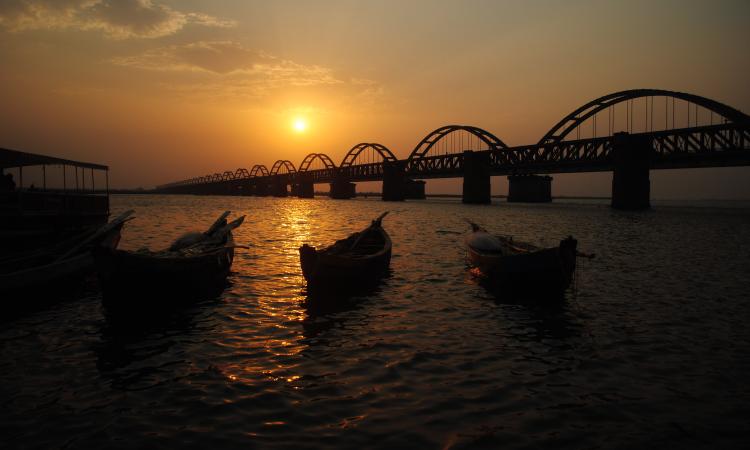
Godavari River
The river basin has an average annual water surface potential of 110.5 cubic km. The main tributaries of the river are:
1)Indravati River
2)Wardha - Wainganga Rivers
3)Manjira River
4)KInnerasani River
5)Pranahita River
6)Parvara River
7)Purna River
8)Penganga River
9)Kolab River
10)Sabari and Sileru Rivers
The most important tourist places near the river are: Trimbakeshwar, Nasik, Nanded, Bhadrachalam and Pattiseema. Asia's largest Lift irrigation project, the Vishnupuri Prakalp has been constructed on the river at a distance of 5km from the city of Nanded.
2)Krishna River:
The river is one of the longest rivers in the country. The origin of this river is at Mahabaleshwar in Maharashtra. The length of the river is 1300 km and it flows through the city of Sangli. It flows through the states of Maharashtra, Karnataka and Andhra Pradesh; forming the most fertile delta of India; into the Bay of Bengal. The mythology connected with the river is that the source of the river is a fountain rising from the mouth of the statue of a cow. The statue is in a temple of Lord Shiva in the city of Mahabaleshwar. The tributaries Venna and Koyana are said to be Siva and Brahma themselves. The other tributaries of the Krishna River are Ghataprabha, the Malaprabha, the Bhima, the Tungabhadra, the Musi, Koyna Rivers. The river basin of the Krishna stretches for an area of 258, 948 square km. the river has an average annual surface water potential of 78.1 cubic km and covers 8% of the total geographical area of India.
3)Tapi River:
Covering a total geographical area of 2%, and a river basin which extends to an area of 65,145 square km, the Tapi/ Tapti originates from the Multai region in the eastern Satpura range in Madhya Pradesh. This westward flowing River empties into the Gulf of Cambay of the Arabian Sea. Its main tributaries are: Purna, the Girna, the Panjhra, the Vaghur, the Bori and the Aner. The Average annual surface water potential is 18 cubic km
The Lakes of Maharashtra are:
Maharashtra has a number of lakes. Out of all the cities which are famous for the lakes, Thane stands out. The city has been named the 'city of lakes' having a reservoir of 30 lakes. The important lakes which are situated in the state are:Talao Pali Lake , also known as the Masunda Talao, is the most beautiful lake of the state and the most crowded one too. There are facilities of boating provided in the lake.
Lonar Lake is a meteoric crater and is believed to be 50,000 years old; testimony to a direct hit by outwardly rocks crashing into the Earth. Lonar Lake is a 1.8 km wide and 150 m deep exceptional 'bowl of biodiversity', located in Buldhana District of Maharashtra. Formed in Basalt Rock, this water body is both alkaline and saline and supports micro-organisms rarely found elsewhere on earth which has even NASA intrigued about its mystery. Lonar Lake is a notified National Geo-heritage Monument.
Mastani Lake has a historical legend associated with it. Constructed 280 years ago in the reign of Bajirao, it is believed that when in Pune, Mastani used to go for bath there.

Mastani Lake
Venna Lake is a man-made lake constructed by the Raha of Satara and is a tourist attraction near Mahabaleshwar. Upvan Lake, which is located in Thane is the second most important lake of the city. The lake belongs to a pollution free zone and is a recreational area. It is a major source of water for Thane City.
Rankala lake in Kolhapur is considered to be the oldest of all the lakes in Maharashtra. In Hindu mythology, it is believed that there is a golden temple submerged under its waters Temple of Rankabhairav lies at the centre of the lake. It is believed that the lake was initially a stone quarry which filled up with water after an earthquake when underground water filled up the quarry.
The Ramkund Lake is situated in Nashik. There is a mythological belief that during their exile, Lord Rama and Shiva took bath in this lake.
The Khindsi Lake in Nagpur district,
Ambazari Lake in Nagpur is a picturesque lake surrounded by mango trees,
Shivsagar Lake is a reservoir of the Koyna Dam in Satara, Maharashtra.
Pashan Lake, Pune is a british era artificial lake attracting migratory birds.
Tansa Lake, Thane also has a wildlife sanctuary close by.
Vihar Lake meets the drinking water needs of South Mumbai and
Powai Lake, an artificial lake in Mumbai.
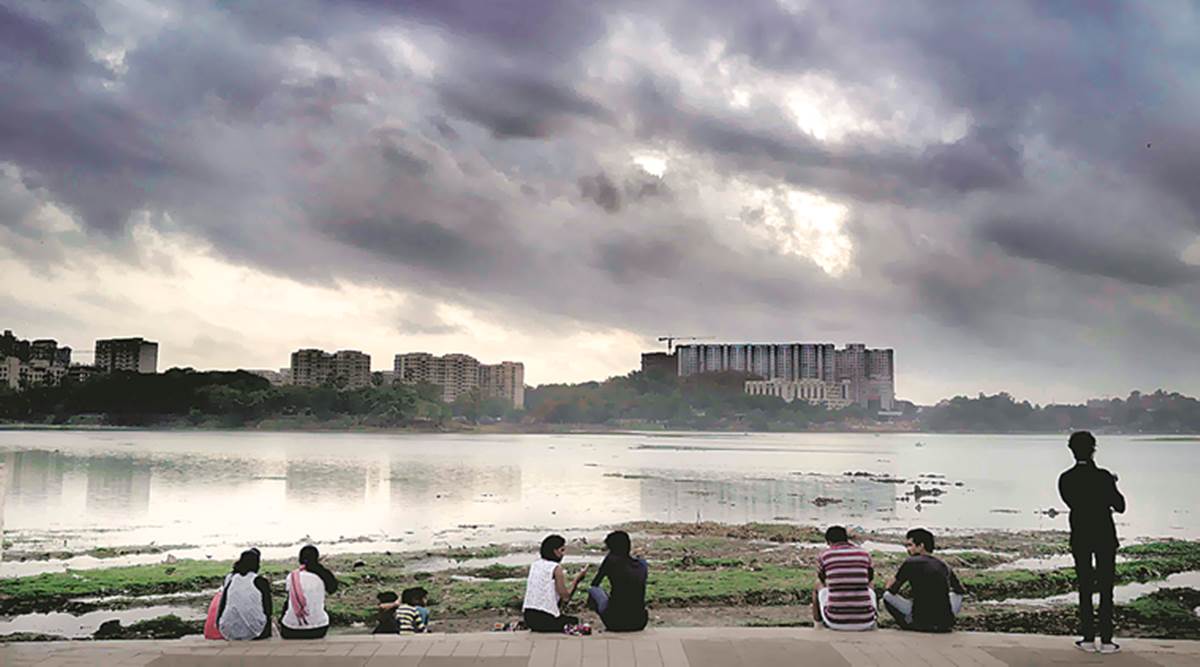
Powai Lake
Dr Salim Ali sarovar/ talab in Aurangabad was known as Khiziri talab during Mughal rule.
Tulsi Lake, located inside Sanjay Gandhi National Park, Mumbai is a crocodile park.Gorewada Lake, Nagpur
Futala Lake, Nagpur is almost 200 years old and is surrounded by forests on three sides.
Shukhrawari Lake or Jumma Lake is also an ancient lakes; almost 275 years old. Also known as Gandhisagar Lake.
Railadevi Lake in Thane is one of the 35 lakes in the "city of lakes".
Modak Sagar Lake is a fresh water reservoir in Thane.
Nakane Lake, the reservoir providing water to Dhule.
Charlotte Lake is a scenic lake at Matheran Hill station.
Dhampur Lake is a man-made lake with scenic hill ranges on two sides and mango, coconut and areca palm plantations.
Khadakwasla Lake/ Dam near Pune is a man-made lake.
Sakkardara Lake is an 18th century lake in Nagpur with picturesque surroundings and famous for sunrise and sunset viewing.
Tadoba Lake inside the Tiger Reserve of the same name is in Chandrapur District. Home to crocodiles, around 200 species of birds can be seen here.
Climate
The climate is subtropical to tropical (depending on elevation) and characteristically monsoonal
(i.e.,
wet-dry), with local variations. India’s southwest monsoonal rains break on the Mumbai coast usually
in the
first week of June and last until September, during which period they account for about four-fifths
of the
annual rainfall. Four seasons are normal: March–May (hot and dry), June–September (hot and wet),
October–November (warm and dry), and December–February (cool and dry).
The Western Ghats and the ranges on the northern borders greatly influence the climate and separate
the wet
Konkan Coast from the dry interior upland, an area called the Desh. Rainfall is extremely heavy in
Konkan,
averaging about 100 inches (2,540 mm), with some of the wettest spots receiving up to 250 inches
(6,350 mm),
but rapidly diminishes to one-fifth of that amount east of the Ghats. Rainfall increases again in
the
eastern areas, reaching about 40 to 80 inches (1,000 to 2,000 mm) in the extreme east.

The coastal regions enjoy equable temperatures; monthly averages at Mumbai are in the low 80s F
(about 27–28
°C). A change of more than about 13 °F (7 °C) between day and night temperatures is unusual. Pune
(Poona),
higher up on the plateau, benefits from cooler temperatures throughout the year. In the interior,
average
summer temperatures reach into the low 100s F (about 38–41 °C), and winter temperatures average in
the low
70s F (about 21–23 °C).
Maharashtra has a tropical climate, with three distinct seasons: summer (March–May), monsoon
(June–September),
and winter (October–February). However, dew and hail also occur sometimes, depending on seasonal
weather. The
winter between October to February is followed by summer between March and May and the monsoon
season between
June and September. Summers (March, April and May) are extremely hot, temperatures rising from 22 °C
to as high
as 43 °C. Rainfall starts normally in the first week of June. July is the wettest month in
Maharashtra, while
August also gets substantial rain. The rainy season starts its retreat with the coming of September
to the
state. Rainfall in Maharashtra differs from region to region. Thane, Raigad, Ratnagiri and
Sindhudurg districts,
receive heavy rains of an average of 200 centimetres annually. But the districts of Nashik, Pune,
Ahmednagar,
Dhule, Jalgaon, Satara, Sangli, Solapur and parts of Kolhapur less than 50 centimetres. Rainfall is
particularly
high in areas adjacent to the Sahyadri mountains such as coastal Konkan on the west and foothills of
the
mountain range on the eastern side. Central Maharashtra receives less rainfall. However, under the
influence of
the Bay of Bengal, eastern Vidarbha receives good rainfall in July, August and September. In winter,
a cool dry
spell occurs, with clear skies, gentle air breeze, and pleasant weather prevails from October to
February. But
the eastern part of Maharashtra sometimes receives some rainfall. Temperature rise from 12 °C to 34
°C during
this season.
Plant and animal life
State Symbols Of Maharashtra
| Group | Species |
|---|---|
| Animal | Indian Giant Squirrel |
| Bird | Yellow-footed green pigeon |
| Tree | Mango Tree |
| Flower | Jarul |
| Butterfly | Blue mormon |
Forests cover less than one-fifth of the state and are confined to the Western Ghats, mainly their transverse ranges, the Satpura Range in the north, and the Chandrapur region in the east. On the coast and adjoining slopes, plant forms are rich with lofty trees, variegated shrubs, and mango and coconut trees. The forests yield teak, bamboo, myrobalan (for dyeing), and other woods.
Flora of Maharashtra is heterogeneous in composition. In 2012 the recorded thick forest area in the state was 61,939 km (23,915 sq mi) which was about 20.13% of the state's geographical area. There are three main Public Forestry Institutions (PFIs) in the Maharashtra state: the Maharashtra Forest Department (MFD), the Forest Development Corporation of Maharashtra (FDCM) and the Directorate of Social Forestry (SFD). The Maharashtra State Biodiversity Board, constituted by the Government of Maharashtra in January 2012 under the Biological Diversity Act, 2002, is the nodal body for conservation of biodiversity within and outside forest areas in the State.
According to the Champion and Seth classification, Maharashtra has five types of forests:
1. Southern Tropical Semi-Evergreen Forests:These are found in the western ghats at height of 400–1000 meters. Some of the species of trees found in this type of forests are Anjani, Hirda, Kinjal, and Mango.
i) Moist Teak bearing Forests:These forests are found in Melghat, other districts in Vidarbha and Thane district. Commercially important Teak, Shishum and bamboo are found here.
ii) Moist Mixed deciduous Forests:In addition to evergreen Teak, some of the other tree species found in this type of forests include Jambul, Ain, and Shisam.
i) Dry Teak Bearing Forests
ii) Moist Mixed deciduous Forests

In addition to the above forest types, Maharashtra harbours significant mangrove, coastal and marine biodiversity, with 304 km (117 sq mi) of area under mangrove cover as per the India State of Forest Report (ISFR) of the Forest survey India. Some of the forest areas have been converted into wildlife reserves, thus preserving their biodiversity. Western ghats of Maharashtra are included in the 34 global Biodiversity hotspots owing to its extraordinarily rich biodiversity. The biodiversity includes more than five hundred species of birds. Similarly a study in the Amravati region found 171 species of birds. Both regions include resident as well as migrant species.The state has three game reserves, as well as several national parks and bird sanctuaries. The six tiger reserves located in the state cover a total area of 9,133 km (3,526 sq mi). Wildlife sanctuaries in the state include Bhimashankar Wildlife Sanctuary, Kalsubai Harishchandagad Sanctuary, Radhanagari Wildlife Sanctuary, Bor Wildlife Sanctuary, Koyna Wildlife Sanctuary, Chandoli National Park, Sanjay Gandhi National Park, Nagzira Wildlife Sanctuary, Tadoba Andhari Tiger Reserve, part of Pench National Park, Navegaon National Park and Mhadei Wildlife Sanctuary. The most common animal species present in the state are tiger, leopard, gaur, sloth bear, sambar, four-horned antelope, blue bull, chital, barking deer, mouse deer, small Indian civet, golden jackal, jungle cat, and hare. Other animals in the state include reptiles such as lizards, cobras and kraits. The national parks of Maharashtra possess a variety of plant species that include jamun, palash, shisam, neem, teak, dhawa, kalam, ain, bija, shirish, mango, acacia, awala, kadamba, moha, hedu and ficus.
Thorny savanna-like vegetation occurs in areas of lesser rainfall, notably in upland Maharashtra. Subtropical vegetation is found on higher plateaus that receive heavy rain and have milder temperatures. Bamboo, chestnut, and magnolia are common. In the semiarid tracts, wild dates are found. Mangrove vegetation occurs in marshes and estuaries along the coast.
Wild animals include tigers, leopards, bison, and several species of antelope. The striped hyena, wild hog, and sloth bear are common. Monkeys and snakes occur in great variety, as do ducks and other game birds. The peacock is indigenous. Many of those animals can be viewed at the state’s national parks at Tadoba, Chikhaldara, and Borivli. The state’s abundant marine life in the waters off the western coast remains largely unexploited.
Regions, divisions and districts
Divisions of Maharashtra, along with their respective districts (With Palghar district formed in
2014 from the
northern part of Thane district)
Maharashtra consists of six administrative divisions:
1. Amravati
2. Aurangabad
3. Konkan
4. Nagpur
5. Nashik
6. Pune
The state's six divisions are further divided into 36 districts, 109 sub-divisions and 358 talukas.
Maharashtra's top five districts by population, as ranked by the 2011 Census, are listed in the
following table:
| Rank | Name | District |
|---|---|---|
| 1 | Mumbai | Mumbai City district |
| 2 | Pune | Pune |
| 3 | Nagpur | Nagpur |
| 4 | Nashik | Nashik | >
| 5 | Aurangabad | Aurangabad |
| 6 | Solapur | Solapur |
| 7 | Jalgaon | Jalgaon |
| 8 | Amravati | Amravati |
| 9 | Kolhapur | Kolhapur |
| 10 | Nanded | Nanded |
Each district is governed by a district collector or district magistrate, appointed either by the Indian Administrative Service or the Maharashtra Civil Service. Districts are subdivided into sub-divisions (Taluka) governed by sub-divisional magistrates, and again into blocks. A block consists of panchayats (village councils) and town municipalities. Talukas are intermediate level panchayat between the Zilla Parishad (district councils) at the district level and gram panchayat (village councils) at the lower level.
People of Maharashtra
Etymology
The modern Marathi language developed from the Maharashtri Prakrit, and the word Marhatta (later
used for the
Marathas) is found in the Jain Maharashtri literature. The term Maharashtra (Marathi: महाराष्ट्र)
along with
Maharashtri, Marathi, and Maratha may have derived from the same root. However, their exact
etymology is
uncertain.
The most widely accepted theory among the linguistic scholars is that the words Maratha and
Maharashtra
ultimately derived from a combination of Maha (Marathi: महा) and rashtrika (Marathi: राष्ट्रिका),
the name of a
tribe or dynasty of chiefs ruling in the Deccan region. Another theory is that the term is derived
from Maha
("great") and ratha / rathi (chariot / charioteer), which refers to a skilful northern fighting
force that
migrated southward into the area.
An alternative theory states that the term derives from the word Maha ("great") and Rashtra
("nation/dominion").
However, this theory is somewhat controversial among modern scholars who believe it to be the
Sanskritised
interpretation of later writers.
Population composition
Maharashtrians are ethnically heterogeneous. The Bhil, Warli, Gond, Korku, Govari, and dozens of
other
tribal communities—all officially designated as Scheduled Tribes—live on the slopes of the Western
Ghats and
the Satpura Range. Marathas and Kunbis (descendants of settlers who arrived from the north about the
beginning of the 1st century CE) make up the majority of the remainder of the people of Maharashtra.
The
state also has a significant population of those who were once called “untouchables” but are now
officially
classed as Scheduled Castes, most of whom live in rural areas.
Marathi, the official state language, is spoken by more than four-fifths of the population. Other
languages
spoken in the state are Gujarati, Hindi, Telugu, Kannada, Sindhi, Urdu, Bengali, Malayalam, and
English.
There are also many local languages, including Konkani on the west coast and Gondi, Varhadi, and
Mundari in
the eastern and northern forests.
Maharashtra’s religious diversity reflects that of India as a whole. Hindus predominate, followed by
Muslims
and Buddhists. There are many Christians in the metropolitan areas. Jewish and Parsi (a religious
minority
adhering to Zoroastrianism) groups have settled mostly in urban areas; Parsis live mainly in Mumbai
and its
environs. Other religious minorities include Jainas and Sikhs, whose small communities are
widespread.
Settlement patterns
More than half of the population is rural and lives in villages. The urban-rural ratio has been changing, however, especially since the late 20th century, when some two-thirds were rural dwellers. Mumbai, the largest city in the state, is also the most populous metropolis in India. Nagpur, Pune, and Solapur are other major cities. Of particular historical interest is the Mughal city of Aurangabad, in the northwest-central part of the state, which contains several monuments and other historic buildings.
Demographics
Religion in Maharashtra (2011)
| Religion | Followers in percentage |
|---|---|
| Hinduism | 79.83% |
| Islam | 11.54% |
| Buddhism | 5.81% |
| Jainism | 1.25% |
| Christianity |
0.96% |
| Sikhism | 0.2% |
| Other | 0.41% |
According to the provisional results of the 2011 national census, Maharashtra is the richest state in India and second most populous state in India with a population of 112,374,333 (9.28% of India's population) of which male and female are 58,243,056 and 54,131,277, respectively. The total population growth in 2011 was 15.99 per cent while in the previous decade it was 22.57 per cent. Since independence, the decadal growth rate of population has remained higher (except in the year 1971) than the national average. For the first time, in the year 2011, it was found to be lower than the national average. The 2011 census for the state found 55% of the population to be rural with 45% being urban based. Bihari, Gujarati, Sindhis, Punjabis, Parsis, Marwari, Kannada, Mannerwarlu, Telugu and Tamil minorities are scattered throughout the state. There are also a substantial number of migrants from the states of Uttar Pradesh, Rajasthan, West Bengal and Kerala. The 2011 census found scheduled castes and scheduled tribes to account for 11.8 and 8.9% of the population, respectively. The scheduled tribes include adivasis such as Thakar, Warli, Konkana and Halba.

Siddhivinayak Temple in Mumbai
According to the 2011 census, Hinduism was the principal religion in the state at 79.8% of the total population, while Muslims constituted 11.5% of the total population. Buddhism accounted for 5.8% in Maharashtra's total population, with 6,531,200 followers, which is 77.36% of all Buddhists in India. Sikhs, Christians and Jains constituted 0.2%, 1.0%, 1.2% of the population, respectively.
The state contributes 9.28% to India's population. The sex ratio in Maharashtra was 929 females per 1000 males, which was below the national average of 943. The density of Maharashtra was 365 inhabitants per km which was lower than national average 382 per km. Since 1921, the populations of Ratnagiri and Sindhudurg shrank by −4.96% and −2.30%, respectively, while the population of Thane grew by 35.9%, followed by Pune at 30.3%. The literacy rate rose to 83.2%. Of this, male literacy stood at 89.82% and female literacy 75.48%.
Language
The official language is Marathi, although different regions have their own dialects. It is native to the Maharashtra state, and is its main language. Marathi including its dialects is around 73.5% of the population. About 83.1 million people mainly speak Marathi, making it the third-most spoken language in India, and 10th most-spoken native language in the world.| Language | Speakers in percentage |
| Marathi | 70.34% |
| Hindi | 10.70% |
| Urdu | 6.71% |
| Gujarati | 2.06% |
| Khandeshi | 1.44% |
| Lambadi | 1.36% |
| Bhili | 1.08% |
| Others | 7.72% |
Spoken Marathi language varies by district, area or locality in its tone and a few words. Major dialects include Varhadi spoken in the Vidarbha region and Dangi spoken near the Maharashtra-Gujarat border. The sound /l/ is abundantly used in many verbs and nouns in Marathi. It is replaced by the sound /j/ in the Varhadi dialect, which makes it quite distinct. According to the economic survey of Maharashtra (2008–09), the percentage of the state's population that names Marathi as its mother tongue has declined to 70.34% from 76.5% over the past three decades, while there has been a sharp rise in the Hindi-speaking population (11% from 5%) in the same period. Hindi language is also spoken in the state. The largest number of Hindi-speakers are in the Mumbai metropolitan area, and other urban centres of Pune and Nagpur. Gujarati and Sindhi speakers, mainly mercantile, also are mainly found in Mumbai.
Urdu is also spread throughout the urban areas of the state and is mainly spoken by Muslims. In areas outside Mumbai, they generally use Deccani Urdu – a variant of Urdu specific to the Deccan region and South India. Various other languages are region-specific. The various Bhil languages are spoken throughout the northwest of the state by the Bhils, in Palghar, Nashik, Dhule and Nandurbar districts. Parts of Nashik, as well as Dhule, Nandurbar and Jalgaon districts, are in the Khandesh region where Khandeshi is the main language. In the far south of Konkan bordering Goa, transitional dialects between Marathi and Konkani such as Malvani are spoken. Kannada is spoken along the Karnataka border in Kolhapur. Telugu is also spoken on the Telangana border, and its dialect Vadari is spoken by the Waddars - a nomadic tribe mainly living in the Marathwada region. Another itinerant language in Marathwada is Kaikadi, spoken by the Kaikadi tribe, which is a dialect of Tamil.
In the far-northeast of Vidharbha such as Gondiya district, various Hindi dialects like Powari and Lodhi are spoken. Korku is spoken in the Melghat area of Amravati district. Gondi is spoken throughout Vidharbha, but most concentrated in Gadchiroli district adjoining the Bastar region of Chhattisgarh.
Economy
The national and state governments have promoted both improved agricultural techniques and increased industrialization of the economy. As a result, Maharashtra has become one of the most developed and prosperous Indian states. Mumbai, one of India’s most important ports, handles an enormous foreign trade. It is a hub of manufacturing, finance, and administration but also a national centre for motion-picture production. Pune has developed many industries because of its proximity to Mumbai. Nagpur and Solapur have textile and other agriculturally based industries.
| Year | Net State Domestic Product |
| 2004-2005 | ₹3.683 trillion (US$52 billion) |
| 2005-2006 | ₹4.335 trillion (US$61 billion) |
| 2006-2007 | ₹5.241 trillion (US$73 billion) |
| 2007-2008 | ₹6.140 trillion (US$86 billion) |
| 2008-2009 | ₹6.996 trillion (US$98 billion) |
| 2009–2010 | ₹8.178 trillion (US$110 billion) |
| 2013–2014 | ₹15.101 trillion (US$210 billion) |
| 2014-2015 | ₹16.866 trillion (US$240 billion) |
The economy of Maharashtra is driven by manufacturing, international trade, Mass Media (television, motion pictures, video games, recorded music), aerospace, technology, petroleum, fashion, apparel, and tourism. Maharashtra is the most industrialised state and has maintained the leading position in the industrial sector in India. The State is pioneer in small scale industries. Mumbai, the capital of state and the financial capital of India, houses the headquarters of most of the major corporate and financial institutions. India's main stock exchanges and capital market and commodity exchanges are located in Mumbai. The state continues to attract industrial investments from domestic as well as foreign institutions. Maharashtra has the largest proportion of taxpayers in India and its share markets transact almost 70 per cent of the country's stocks.
Maharashtra contributes 25% of the country's industrial output and is the most indebted state in the country. Industrial activity in state is concentrated in Seven districts: Mumbai City, Mumbai Suburban, Thane, Aurangabad, Pune, Nagpur, and Nashik. Mumbai has the largest share in GSDP (21.5 per cent), both Thane and Pune districts contribute about same in the Industry sector, Pune district contributes more in the agriculture and allied activities sector, whereas Thane district contributes more in the Services sector. Nashik district shares highest in the agricultural and allied activities sector, but is far behind in the Industry and Services sectors as compared to Thane and Pune districts. Industries in Maharashtra include chemical and chemical products (17.6%), food and food products (16.1%), refined petroleum products (12.9%), machinery and equipment (8%), textiles (6.9%), basic metals (5.8%), motor vehicles (4.7%) and furniture (4.3%). Maharashtra is the manufacturing hub for some of the largest public sector industries in India, including Hindustan Petroleum Corporation, Tata Petrodyne and Oil India Ltd.
Maharashtra has an above average knowledge industry in India with the Pune Metropolitan area being the leading IT hub in the state. Approximately 25% of the top 500 companies in the IT sector are situated in Maharashtra. The state accounts for 28% of the software exports of India. The state houses important financial institutions such as the Reserve Bank of India, the Bombay Stock Exchange, the National Stock Exchange of India, the SEBI and the corporate headquarters of numerous Indian companies and multinational corporations. It is also home to some of India's premier scientific and nuclear institutes like BARC, NPCL, IREL, TIFR, AERB, AECI, and the Department of Atomic Energy.
The banking sector comprises scheduled and non-scheduled banks. Scheduled banks are of two types, commercial and co-operative. Scheduled Commercial Banks (SCBs) in India are classified into five types: State Bank of India and its associates, nationalised banks, private sector banks, Regional Rural Banks and others (foreign banks). In 2012, there were 9,053 banking offices in the state, of which about 26 per cent were in rural and 54 per cent were in urban areas. Maharashtra has a microfinance system, which refers to small scale financial services extended to the poor in both rural and urban areas. It covers a variety of financial instruments, such as lending, savings, life insurance, and crop insurance. Three largest urban cooperative banks in India are all based in Maharashtra.
With more than half the population being rural, agriculture and allied industries play an important role in the states's economy. The agriculture and allied activities sector contributes 12.9% to the state's income. Staples such as rice and millet are the main monsoon crops. Important cash crops include sugarcane, cotton, oilseeds, tobacco, fruit, vegetables and spices such as turmeric. Animal husbandry is an important agriculture related activity. The State's share in the livestock and poultry population in India is about 7% and 10%, respectively. Maharashtra was a pioneer in the development of Agricultural Cooperative Societies after independence. In fact, it was an integral part of the then Governing Congress party's vision of ‘rural development with local initiative’. A ‘special’ status was accorded to the sugar cooperatives and the government assumed the role of a mentor by acting as a stakeholder, guarantor and regulator, Apart from sugar, Cooperatives play a crucial role in dairy, cotton, and fertiliser industries.

Mumbai is major contributor to the economy of Maharashtra
The Service sector dominates the economy of Maharashtra, accounting for 61.4% of the value addition and 69.3% of the value of output in the state. The state's per-capita income is 40% higher than the all-India average. The gross state domestic product (GSDP) at current prices for 2011–12 is estimated at 11,995.48 billion and contributes about 14.4% of the GDP. The agriculture and allied activities sector contributes 12.9% to the state's income. Net State Domestic Product (State Income), as per the first revised estimates was 10,827.51 billion and Per Capita State Income was 95,339 during 2011–12. The percentage of fiscal deficit to GSDP was 1.7 per cent and debt stock to GSDP was 18.4 per cent during 2012–13, well within Consolidated Fiscal Reform Path stipulated by the Thirteenth Finance Commission. In 2012, Maharashtra reported a revenue surplus of ₹1524.9 million (US$24 million), with a total revenue of ₹1,367,117 million (US$22 billion) and a spending of ₹1,365,592.1 million (US$22 billion). Maharashtra ranks first in FDI equity and percentage share of total FDI inflows is 32.27%. Total FDI inflows into Maharashtra are US$53.48 billion. Top countries that invested FDI equity in Maharashtra (from January 2000 to December 2011) were Mauritius (39%), Singapore (10%), United Kingdom (10%), United States (7%) and Netherlands (5%).
Agriculture

Freshly grown sugarcane, agriculture is the second leading occupation in Maharashtra
Insufficient rainfall in much of Maharashtra constitutes the main obstacle to agriculture in the state. Measures to combat food deficits have included the electrification of irrigation pumps, the use of hybrid seeds, more efficient cultivation, and incentives offered to farmers. Maharashtra is the largest producer of sugarcane in India. Jowar (grain sorghum), millet, and pulses (legumes) dominate the cropped area. Rice grows where rainfall exceeds 40 inches (1,000 mm), and wheat is a winter crop in fields that retain moisture. Cotton, tobacco, and peanuts (groundnuts) are major crops in areas with heavy rainfall. Mangoes, cashew nuts, bananas, and oranges are popular orchard crops.
Resources and power
Most of Maharashtra’s known mineral resources—including manganese, coal, iron ore, limestone,
copper,
bauxite, silica sand, and common salt—occur in the eastern districts, with some deposits in the
west. The
Bhandara, Nagpur, and Chandrapur regions are particularly rich in bituminous coal. Undersea
petroleum
deposits were discovered near Mumbai in the 1970s and have since been exploited, enhancing the
city’s
economic importance nationally. The mountainous areas of the state possess significant timber
reserves.
Hydroelectric and thermal stations provide most of the state’s power. Large thermal power plants,
which burn
coal, are located near Nagpur and Chandrapur. The nuclear power facility at Tarapur, 70 miles (113
km) north
of Mumbai, was India’s first nuclear power plant.
Energy

Chandrapur Super Thermal Power Station, the state's power production source
Although its population makes Maharashtra one of the country's largest energy users, conservation mandates, mild weather in the largest population centres and strong environmental movements have kept its per capita energy use to one of the smallest of any Indian state. The high electricity demand of the state constitutes 13% of the total installed electricity generation capacity in India, which is mainly from fossil fuels such as coal and natural gas. Mahavitaran is responsible for distribution of electricity throughout the state by buying power from Mahanirmiti, captive power plants, other state electricity boards and private sector power generation companies.
As of 2012, Maharashtra was the largest power generating state in India, with installed electricity generation capacity of 26,838 MW. The state forms a major constituent of the western grid of India, which now comes under the North, East, West and North Eastern (NEWNE) grids of India. Maharashtra Power Generation Company (MAHAGENCO) operates thermal power plants. In addition to the state government-owned power generation plants, there are privately owned power generation plants that transmit power through the Maharashtra State Electricity Transmission Company, which is responsible for transmission of electricity in the state.
Plastics
The Maharashtra Plastic and Thermocol Products ban became effective as law on 23 June 2018, subjecting plastic users to fines and potential imprisonment for repeat offenders.Manufacturing
The manufacture of cotton textiles is the oldest and largest industry in Maharashtra. Mumbai, Nagpur, Solapur, Akola, and Amravati are the main factory centres; woolen goods are produced especially in and around Nagpur and Solapur. Other hubs of traditional agriculturally based industry include Jalgaon and Dhule (edible oils processing) and Kolhapur, Ahmadnagar, and the industrial complex of Sangli and Miraj (sugar refining). Fruit canning and preservation are important in Nagpur, Bhusawal, Ratnagiri, and Mumbai. Processed forest products include timber, bamboo, sandalwood, and tendu leaves—the latter used for rolling bidi (Indian cigarettes). Small-scale agroprocessing of food grains and other crops is virtually ubiquitous in the state.The Mumbai-Pune complex boasts the state’s greatest concentration of heavy industry and high technology. The petrochemical industry has developed rapidly since the installation of India’s first offshore oil wells near Mumbai in 1976. Oil refining and the manufacture of agricultural implements, transport equipment, rubber products, electric and oil pumps, lathes, compressors, sugar-mill machinery, typewriters, refrigerators, electronic equipment, and television and radio sets are important. Automobiles are also assembled there.
The eastern area around Nagpur, Chandrapur, and Bhandara supports major coal-based industries, along with plants that process ferroalloys, manganese and iron ores, and cement. Aurangabad and Thane are also important industrial hubs.
Transportation

Chhatrapati Shivaji International Airport(Mumbai)
The state has a large, multi-modal transportation system with the largest road network in India. In 2011, the total length of surface road in Maharashtra was 267,452 km; national highways comprised 4,176 km and state highways 3,700 km. The Maharashtra State Road Transport Corporation (MSRTC) provides economical and reliable passenger road transport service in the public sector. These buses, popularly called ST (State Transport), are the preferred mode of transport for much of the populace. Hired forms of transport include metered taxis and auto rickshaws, which often ply specific routes in cities. Other district roads and village roads provide villages accessibility to meet their social needs as well as the means to transport agricultural produce from villages to nearby markets. Major district roads provide a secondary function of linking between main roads and rural roads. Almost 98% of villages are connected via the highways and modern roads in Maharashtra. Average speed on state highways varies between 50 and 60 km/h (31–37 mi/h) due to heavy presence of vehicles; in villages and towns, speeds are as low as 25–30 km/h (15–18 mi/h).
Mumbai-Pune Intercity Express train
The first passenger train in India ran from Mumbai to Thane on 16 April 1853. Rail transportation is run by Central Railway, Western Railway, South Central Railway and South East Central Railway zones of the Indian Railways with the first two zones being headquartered in Mumbai, at Chhatrapati Shivaji Maharaj Terminus (CSMT) and Churchgate respectively and Konkan Railway which is headquartered in Navi Mumbai. The Mumbai Rajdhani Express, the fastest rajdhani train, connects the Indian capital of New Delhi to Mumbai. Thane and CSMT are the busiest railway stations in India, the latter serving as a terminal for both long-distance trains and commuter trains of the Mumbai Suburban Railway.

A container ship at Jawaharlal Nehru Port Trust
The two principal sea ports, Mumbai Port and Jawaharlal Nehru Port, which is also in the Mumbai region, are under the control and supervision of the government of India. There are around 48 minor ports in Maharashtra. Most of these handle passenger traffic and have a limited capacity. None of the major rivers in Maharashtra are navigable and so river transport does not exist in the state.
Almost all the major cities of Maharashtra have airports. CSIA (formerly Bombay International Airport) and Juhu Airport are the two airports in Mumbai. The two other international airports are Pune International Airport, and Dr. Babasaheb Ambedkar International Airport at Nagpur. Aurangabad Airport is a domestic airport operated by Airports Authority of India. Flights are operated by both private and government airline companies. Most of the State's airfields are operated by the Airports Authority of India (AAI) while Reliance Airport Developers (RADPL), currently operate five non-metro airports at Latur, Nanded, Baramati, Osmanabad and Yavatmal on a 95-year lease. The Maharashtra Airport Development Company (MADC) was set up in 2002 to take up development of airports in the state that are not under the AAI or the Maharashtra Industrial Development Corporation (MIDC). MADC is playing the lead role in the planning and implementation of the Multi-modal International Cargo Hub and Airport at Nagpur (MIHAN) project. Additional smaller airports include Akola, Amravati, Chandrapur, Dhule, Gondia, Jalgaon, Karad, Kolhapur, Nashik Road, Ratnagiri, and Solapur.
Government and society
Constitutional framework
Maharashtra has a parliamentary system of government with two democratically elected houses, the
Legislative
Assembly and the Legislative Council. The Maharashtra Legislative Assembly (Vidhan Sabha) consists
of 288
members who are elected for five-year terms. The Maharashtra Legislative Council (Vidhan Parishad)
is a
permanent body of 78 members with a third of members replaced every two years. The government of
Maharashtra is
headed by the Chief Minister, who is chosen by the party or coalition holding the majority in the
Legislative
Assembly. The Chief Minister, along with the council of ministers, drives the legislative agenda and
exercises
most of the executive powers. However, the constitutional and formal head of the state is the
Governor, who is
appointed for a five-year term by the President of India on the advice of the Union government.
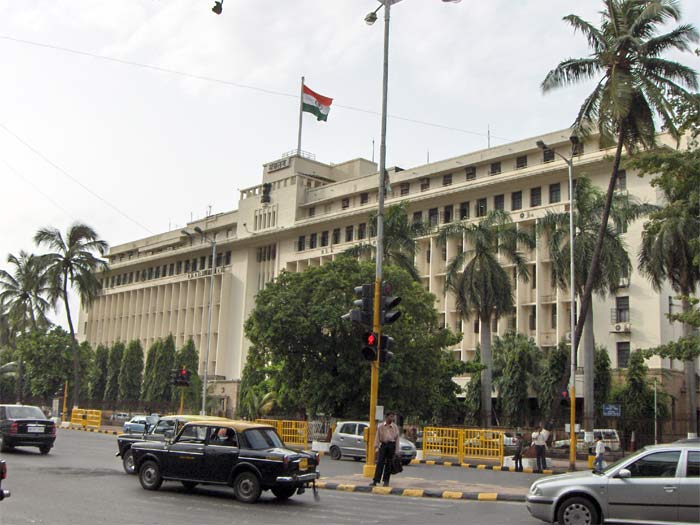
Mantralaya or administrative headquarters of Maharashtra state government in South Mumbai
Executive authority in the state is exercised by the cabinet, headed by the chief minister, who is chosen from the members of the ruling party in the Vidhan Sabha. The district collector and chief executive officer—responsible for the collection of land revenue and special taxes and for coordinating the work of other departments—are the key figures within the local administrative areas.
The judiciary, a High Court headed by the chief justice and a panel of judges, is based in Mumbai. There are branches of that court at Nagpur and at Aurangabad.
Maharashtra comprises three conventional regions: western Maharashtra, Vidarbha, and Marathwada. Each is divided administratively into districts, which are further divided into talukas (townships). Local administrations consist of zilla parishads (district councils), panchayat samiti (township councils), and gram panchayats (village councils). Cities and towns have corporations and municipal councils as elected bodies.
The Public Service Commission and a State Selection Board select candidates for appointment to all state services. That process is carried out largely by means of competitive examinations.
Politics
| Minister Name | Place-holding |
| Shri Nitin Gadkari Ji | Minister of Road Transport and Highways , Micro. Small & Medium Enterprises |
| Shri Prakash Javadekar Ji | Minister of Information and Broadcasting, Environment, Forests & Climate Change |
| Shri Piyush Goyal Ji | Minister of Commerce & Industry, Railway |
| Shri Ramdas Athwale Ji | Hon. Union Minister of State for Social Justice |
| Shri Raosaheb Danve Patil Ji | Minister of State of Consumer Affairs, Food and Public Distribution |
| Shri Sanjay Dhotre Ji, | Minister of State of Electronics and Information Technology, Communications, Human Resource Development |
The politics of the state in the first decades after its formation in 1960 were dominated by the Indian National Congress party or its offshoots such as the Nationalist Congress Party.
But the father of Maharashtra Politics was Shiv Sena Pramukh Balasheb Thackeray, He formed Shiv Sena in 1966 and started to fight for the justice for Marathi people. He was recognised as the most powerful person in Maharashtra.
In the early years, politics of Maharashtra was dominated by Congress party figures such as Yashwantrao Chavan, Vasantdada Patil, Vasantrao Naik and Shankarrao Chavan. Sharad Pawar, who started his political career in the Congress party, has been a towering personality in the state and national politics for over forty years. During his career, he has split the Congress twice with significant consequences for the state politics. The Congress party enjoyed a near unchallenged dominance of the political landscape until 1995 when the Shiv Sena and the Bharatiya Janata Party (BJP) secured an overwhelming majority in the state to form a coalition government. After his second parting from the Congress party in 1999, Sharad Pawar founded the NCP but then formed a coalition with the Congress to keep out the BJP-Shiv Sena combine out of the Maharashtra state government for fifteen years until September 2014.
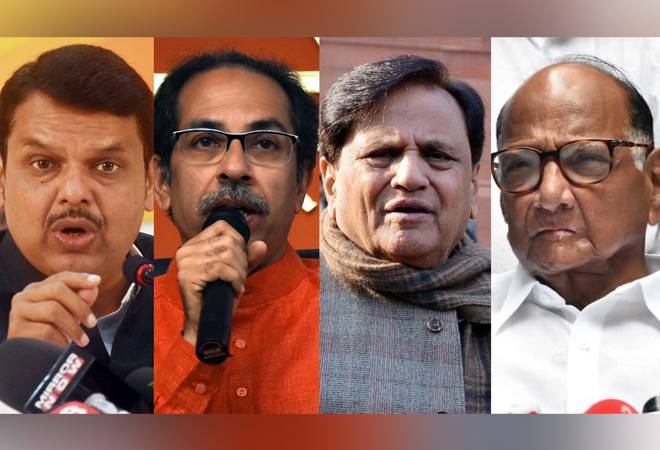
Prithviraj Chavan of the Congress party was the last Chief Minister of Maharashtra under the Congress / NCP alliance. For the 2014 assembly polls, the two alliances between NCP and Congress and that between BJP and Shiv Sena respectively broke down over seat allocations. In the election, the largest number of seats went to the Bharatiya Janata Party, with 122 seats. The BJP initially formed a minority government under Devendra Fadnavis. The Shiv sena entered the Government after two months, and provided a comfortable majority for the alliance in the Maharashtra Vidhansabha for the duration of the assembly. In 2019 Lok sabha elections, the BJP-Shiv Sena alliance secured 41 seat out 48 from the state. Later in 2019, the BJP and Shiv Sena alliance fought the assembly elections together but the alliance broke down after the election over the post of chief minister. Uddhav Thackeray of Shiv Sena then formed an alternative governing coalition under his leadership with his erstwhile opponents from NCP, INC, and a number of independent members of legislative assembly. On 28 November 2019, Thackeray took oath as 19th Chief minister of Maharashtra after being elected as the president of the newly formed coalition named Maha Vikas Aghadi.
State representation in Indian Parliament
The people of Maharashtra also elect 48 members to the Lok Sabha, the lower house of the Indian Parliament. In the 2014 general elections, the National Democratic Alliance (NDA), consisting of the Bharatiya Janata Party, the Shiv Sena, and Swabhimani Paksha, won 23, 18, and 1 seats, respectively. The NDA retained its dominance in the state by winning 41 out of the 48 seats in the 2019 Lok Sabha elections. The members of the state Legislative Assembly elect 19 members to the Rajya Sabha, the upper house of the Indian Parliament.Local government
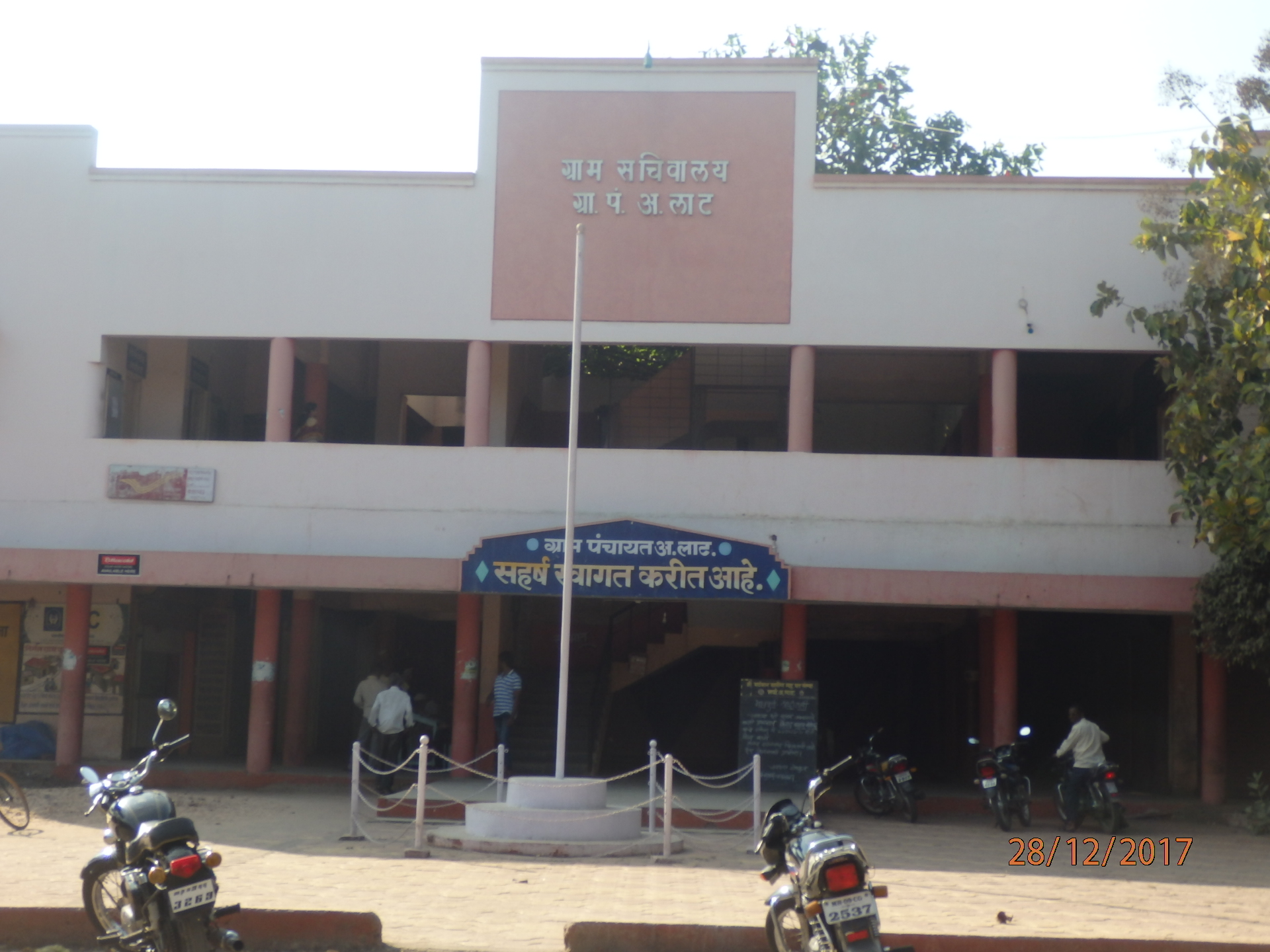
A Gram panchayat office in a Abdul Lat village, Kolhapur district
The state has a long tradition of highly powerful planning bodies at district and local levels. Local self governance institutions in rural areas include 34 zilla parishads (district councils), 355 Taluka Panchayat samitis (district Sub-division councils) and 27,993 Gram panchayats (village councils). Urban areas in the state are governed by 27 Municipal Corporations, 222 Municipal Councils, four Nagar Panchayats and seven Cantonment Boards. Although Maharashtra had Gram panchayat with elected members since 1961, the 73rd amendment to the Indian constitution of 1993 put in place a statutory requirement of 33% of seats on the panchayats reserved for women. In addition, 33% of the sarpanch (panchayat chief) positions were also reserved for women. Although the amendment boosted the number of women leaders at the village level, there have been cases of harassment by male members of the panchayat towards the female members of the organisations. The administration in each district is headed by a District Collector, who belongs to the Indian Administrative Service and is assisted by a number of officers belonging to Maharashtra state services. The Superintendent of Police, an officer belonging to the Indian Police Service and assisted by the officers of the Maharashtra Police Service, maintains law and order in addition to other related issues in each district. The Divisional Forest Officer, an officer belonging to the Indian Forest Service, manages the forests, environment, and wildlife of the district, assisted by the officers of Maharashtra Forest Service and Maharashtra Forest Subordinate Service. Sectoral development in the districts is looked after by the district head of each development department, such as Public Works, Health, Education, Agriculture and Animal Husbandry.Judiciary

The Bombay High Court, one of the most distinguished high courts in India
The judiciary in the state consists of the Maharashtra High Court (The High Court of Bombay), district and session courts in each district and lower courts and judges at the taluka level. The High Court has regional branches at Nagpur and Aurangabad in Maharashtra and Panaji which is the capital of Goa. The state cabinet on 13 May 2015 passed a resolution favouring the setting up of one more bench of the Bombay high court in Kolhapur, covering the region. The President of India appoints the chief justice of the High Court of the Maharashtra judiciary on the advice of the chief justice of the Supreme Court of India as well as the Governor of Maharashtra. Other judges are appointed by the chief justice of the high court of the judiciary on the advice of the Chief Justice. Subordinate Judicial Service is another vital part of the judiciary of Maharashtra. The subordinate judiciary or the district courts are categorised into two divisions: the Maharashtra civil judicial services and higher judicial service. While the Maharashtra civil judicial services comprises the Civil Judges (Junior Division)/Judicial Magistrates and civil judges (Senior Division)/Chief Judicial Magistrate, the higher judicial service comprises civil and sessions judges. The Subordinate judicial service of the judiciary is controlled by the District Judge.Health and welfare
In 2011, the health care system in Maharashtra consisted of 363 rural government hospitals, 23
district
hospitals (with 7,561 beds), 4 general hospitals (with 714 beds) mostly under the Maharashtra
Ministry of Health
and Family Welfare, and 380 private medical establishments; these establishments provide the state
with more
than 30,000 hospital beds. It is the first state in India to have nine women's hospitals serving
1,365 beds. The
state also has significant number of medical practitioners who hold the Bachelor of Ayurveda,
Medicine and
Surgery qualifications. These practitioners primarily use the traditional Indian therapy of Ayurveda
but can use
modern western medicine as well.
In Maharashtra as well as in rest of India, Primary Health Centre (PHC) are part of the
government-funded public
health system and are the most basic units of the healthcare system. They are essentially
single-physician
clinics usually with facilities for minor surgeries, too. The government of India in 2018 launched
the Ayushman
Bharat Yojana scheme, however, Maharashtra declined to join because the state had its own state
healthcare
programme. That program called Mahatma Jyotiba Phule Jan Arogya Yojana was already functioning well.
The state
later joined Ayushman Bharat Yojana with special exceptions to make it part of its existing
infrastructure. the
initiative has two components- the National Health Protection Scheme and the Health and Wellness
Centres (HWCs).
Under the scheme, PHC have been converted to HWC and presently there are 248 in the state.
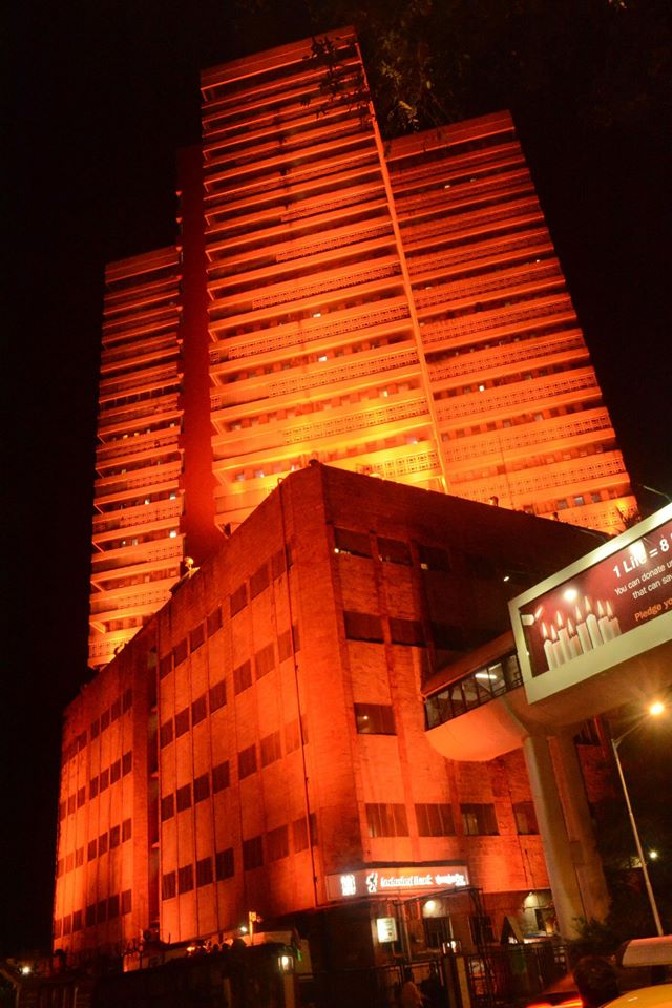
Hinduja National Hospital, Mumbai
Maharashtra has a life expectancy at birth of 67.2 years in 2011, ranking it third among 29 Indian states. The total fertility rate of the state is 1.9. The Infant mortality rate is 28 and the maternal mortality ratio is 104 (2012–2013), which are lower than the national averages. Public health services are governed by the Ministry of Health and Family Welfare (MoHFW), through various departments. The Ministry is divided into two departments: the Public Health Department, which includes family welfare and medical relief, and the Department of Medical Education and Drugs.In Maharashtra, health insurance includes any program that helps pay for medical expenses, whether through privately purchased insurance, social insurance or a social welfare program funded by the government. In a more technical sense, the term is used to describe any form of insurance that provides protection against the costs of medical services. This usage includes private insurance and social insurance programs such as National Health Mission, which pools resources and spreads the financial risk associated with major medical expenses across the entire population to protect everyone, as well as social welfare programs such as National Rural Health Mission (NRHM) and the Health Insurance Program, which provide assistance to people who cannot afford health coverage.
Scores of hospitals and clinics, including general hospitals, women’s hospitals, and mental health institutes, are in Maharashtra. Medical personnel mainly consist of allopathic (traditional Western) and Ayurvedic (ancient Indian) practitioners. Unanī (traditional Muslim) and homeopathic systems of medicine are also popular. The state is a leader in the prevention and control of malaria and parasites such as guinea worms and the nematodes that cause filariasis, in the immunization of children and expectant mothers, and in the treatment of tuberculosis, goitre, leprosy, cancer, and HIV/AIDS. Regional blood banks are in Mumbai, Pune, Aurangabad, and Nagpur, and emergency centres are found in all districts. The state has repeatedly received national recognition for its family-planning program. In Mumbai the Haffkine Institute, a leading bacteriologic research centre specializing in tropical diseases, and the Cancer Research Institute (affiliated with the Tata Memorial Hospital) are well known.
Education
Maharashtra’s literacy rate is one of the highest of all the Indian states, with more than
four-fifths of
the population able to read and write. The discrepancy between male and female literacy has been
reduced
since the beginning of the 21st century. The state provides free compulsory education for children
between
ages 6 and 14. Vocational and multipurpose high schools also have grown in importance.
Larger institutions for higher education include the University of Mumbai (founded 1857) and
Shreemati
Nathibai Damodar Thackersey Women’s University (1916) in Mumbai, Rashtrasant Tukadoji Maharaj Nagpur
University (1923) in Nagpur, the University of Pune (1949) in Pune, Shivaji University (1962) in
Kolhapur,
and Yashwantrao Chavan Maharashtra Open University (1989) in Nashik. There are other universities in
Aurangabad, Ahmadnagar, Akola, Amravati, Jalgaon, and Kolhapur. Some prominent institutions in the
state
include the Central Institute of Fisheries Education, the Indira Gandhi Institute of Development
Research,
the International Institute for Population Sciences, and the Tata Institute of Social Sciences—all
in
Mumbai—and the Deccan College Postgraduate and Research Institute and the Gokhale Institute of
Politics and
Economics in Pune.

IIT Bombay
Several medical, dental, and Ayurvedic colleges are in Mumbai, Nagpur, and Pune. Most district hospitals maintain nursing schools. Technical education is provided by engineering colleges and polytechnic and industrial institutes. Almost every taluka (township) has a technical school.
An important adjunct to education in the state is training courses run by the country’s security establishment. The National Defence Academy near Pune is a premier institution that provides cadet training for India’s defense forces. The College of Military Engineering at Pune is run by the Indian Army Corps of Engineers. Sainik schools (competitive secondary schools that prepare students to serve in the National Defence Academy) and the voluntary National Cadet Corps provide military training. There are also institutes in Maharashtra for research and development in explosives, armament technology, vehicle research, and naval, chemical, and metallurgical laboratories.
History
Scottish missionary John Wilson, Indian nationalists such as Vasudev Balwant Phadke and Bal Gangadhar Tilak, social reformers such as Jyotirao Phule, Dhondo Keshav Karve and Bhaurao Patil all played a leading role in the setting up of modern schools and colleges during the British colonial era. The forerunner of Deccan College Post-Graduate and Research Institute was established in 1821. The Shreemati Nathibai Damodar Thackersey Women's University, the oldest women's liberal arts college in south Asia, started its journey in 1916. College of Engineering Pune, established in 1854, is the third oldest college in Asia. Government Polytechnic Nagpur, established in 1914, is one of the oldest polytechnic in India.Primary and Secondary School
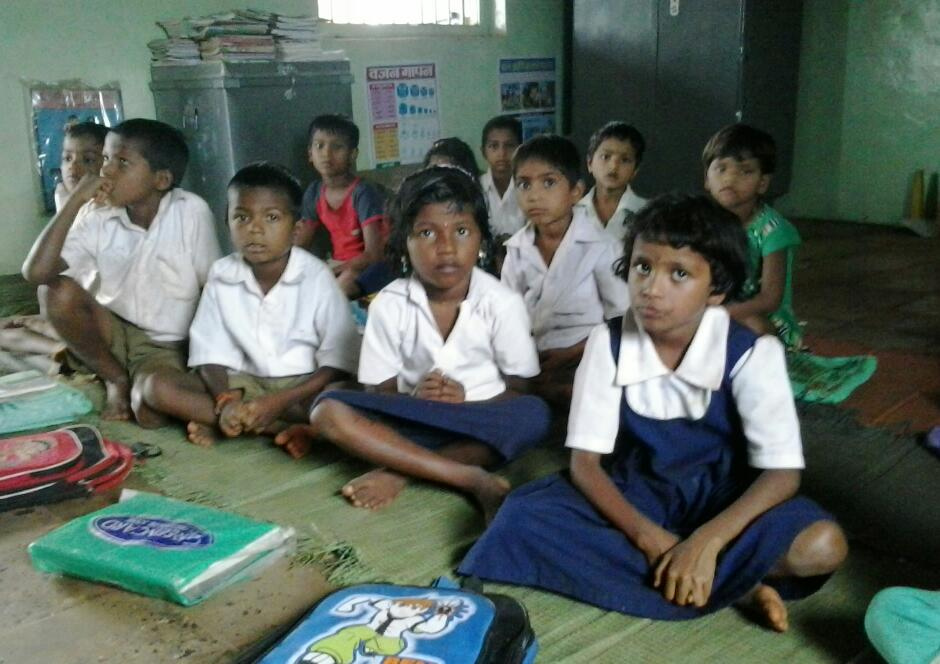
Students at a state-run primary school in Raigad district.
Maharashtra schools are run by the state government or by private organisations, including religious institutions. Instruction is mainly in Marathi, English or Hindi, though Urdu is also used. Physical education is mandatory. The secondary schools are affiliated with the Council for the Indian School Certificate Examinations (CISCE), the Central Board for Secondary Education (CBSE), the National Institute of Open School (NIOS) or the Maharashtra State Board of Secondary and Higher Secondary Education. Under the 10+2+3 plan, after completing secondary school, students typically enroll for two years in a junior college, also known as pre-university, or in schools with a higher secondary facility affiliated with the Maharashtra State Board of Secondary and Higher Secondary Education or any central board. Students choose from one of three streams, namely liberal arts, commerce or science. Upon completing the required coursework, students may enroll in general or professional degree programs.Tertiary level

Armed Forces Medical College, Pune, was one of the institutions established after the Indian independence movement
Maharashtra has 24 universities with a turnout of 160,000 Graduates every year. Maharashtra has played a pioneering role in the development of the modern education system in India. The University of Mumbai, is the largest university in the world in terms of the number of graduates and has 141 affiliated colleges. According to prominent national rankings, 5 to 7 Maharashtra colleges and universities are ranked among the top 20 in India. Maharashtra is also home to such notable autonomous institutes as Indian Institute of Technology Bombay, College of Engineering Pune (CoEP), Dr. Babasaheb Ambedkar Technological University, Institute of Chemical Technology, Homi Bhabha National Institute, Walchand College of Engineering, Visvesvaraya National Institute of Technology (VNIT) and Veermata Jijabai Technological Institute (VJTI), Sardar Patel College of Engineering (SPCE). Most of these autonomous institutes are ranked the highest in India and have very competitive entry requirements. The University of Pune (now Savitribai Phule Pune University), the National Defence Academy, Film and Television Institute of India, Armed Forces Medical College and National Chemical Laboratory were established in Pune soon after the Indian independence in 1947. Mumbai has an IIT, has National Institute of Industrial Engineering and Nagpur has IIM and AIIMS.Some of the notable institutes in the state are: Maharashtra National Law University, Nagpur (MNLUN), Maharashtra National Law University, Mumbai (MNLUM), Maharashtra National Law University, Aurangabad (MNLUA), Government Law College, Mumbai (GLC), ILS Law College, and Symbiosis Law School (SLS).
Maharashtra has hundreds of other private colleges and universities, including many religious and special-purpose institutions. Most of the private colleges were set up in the last thirty years after the State Government of Vasantdada Patil liberalised the Education Sector in 1982. Politicians and leaders involved in the huge cooperative movement in Maharashtra were instrumental in setting up the private institutes There are also local community colleges with generally more open admission policies, shorter academic programs, and lower tuition.
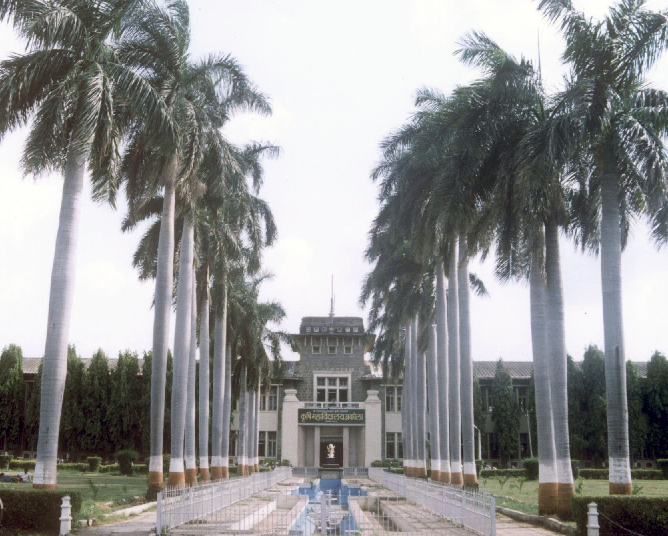
Panjabrao Deshmukh Krishi Vidyapeeth (Agricultural university) at Akola
The state also has four agricultural universities namely Vasantrao Naik Marathwada Agricultural University, Mahatma Phule Krishi Vidyapeeth, Dr. Panjabrao Deshmukh Krishi Vidyapeeth and Dr. Balasaheb Sawant Konkan Krishi Vidyapeeth, besides these, there are other regional universities like Sant Gadge Baba Amravati University, Dr. Babasaheb Ambedkar Marathwada University, North Maharashtra University, Shivaji University, Solapur University, Swami Ramanand Teerth Marathwada University and Rashtrasant Tukadoji Maharaj Nagpur University, all well established and nationally renowned, to cover the educational needs at the district levels of the state. Apart from this, there are a number of deemed universities in Maharashtra, including Symbiosis International University, Tata Institute of Social Sciences, and Tilak Maharashtra University.Vocational training
The state has many post-secondary school industrial training institutes (ITIs) run by the government and private trusts that offer vocational training in numerous trades such as construction, plumbing, welding, automobile mechanic etc. Successful candidates receive the National Trade Certificate.History
Chalcolithic sites belonging to the Jorwe culture (circa 1300–700 BCE) have been discovered
throughout the
state.

Carved Jain tirthankaras inside Indra Sabha, Ellora Caves (7th Century)
Maharashtra was ruled by the Maurya Empire in the fourth and third centuries BCE. Around 230 BCE, Maharashtra came under the rule of the Satavahana dynasty for 400 years. The greatest ruler of the Satavahana dynasty was Gautamiputra Satakarni. In 90 CE, Vedishri, son of the Satavahana king Satakarni, the "Lord of Dakshinapatha, wielder of the unchecked wheel of Sovereignty", made Junnar, 30 miles north of Pune, the capital of his kingdom. The state was also ruled by Western Satraps, Gupta Empire, Gurjara-Pratihara, Vakataka, Kadambas, Chalukya Empire, Rashtrakuta Dynasty, and Western Chalukya before finally, the Yadava rule. The Buddhist Ajanta Caves in present-day Aurangabad display influences from the Satavahana and Vakataka style. The caves were possibly excavated during this period.
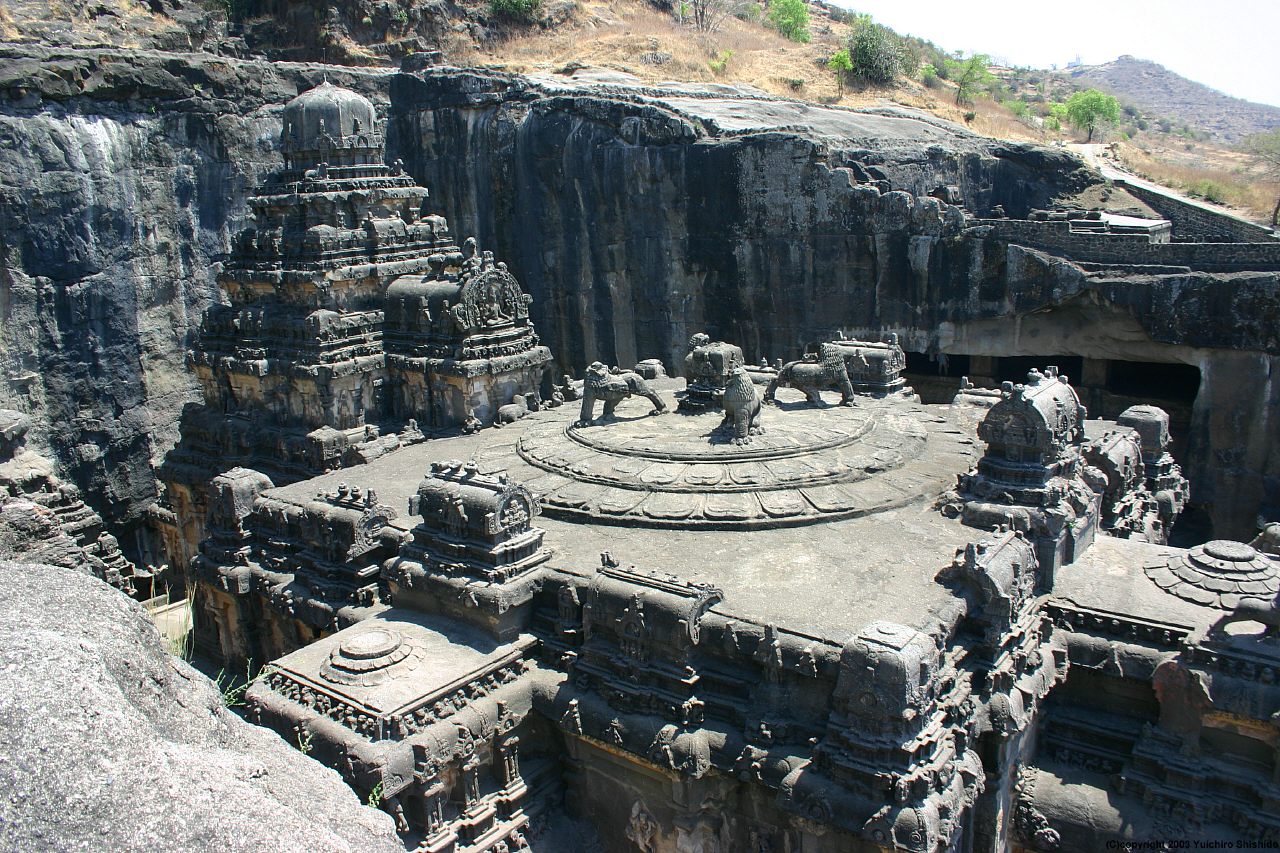
Kailasanatha temple, remarkably carved out of one single rock was built by Rashtrakuta king Krishna I (r. 756–773 CE)
The Chalukya dynasty ruled from the sixth to the eighth centuries CE, and the two prominent rulers were Pulakeshin II, who defeated the north Indian Emperor Harsha, and Vikramaditya II, who defeated the Arab invaders in the eighth century. The Rashtrakuta dynasty ruled Maharashtra from the eighth to the tenth century. The Arab traveller Sulaiman al Mahri described the ruler of the Rashtrakuta Dynasty Amoghavarsha as "one of the four great kings of the world". Shilahara dynasty began as vassals of the Rashtrakuta dynasty which ruled the Deccan plateau between the eighth and tenth centuries. From the early 11th century to the 12th century, the Deccan Plateau, which includes a significant part of Maharashtra, was dominated by the Western Chalukya Empire and the Chola dynasty. Several battles were fought between the Western Chalukya empire and the Chola dynasty in the Deccan Plateau during the reigns of Raja Raja Chola I, Rajendra Chola I, Jayasimha II, Someshvara I, and Vikramaditya VI.
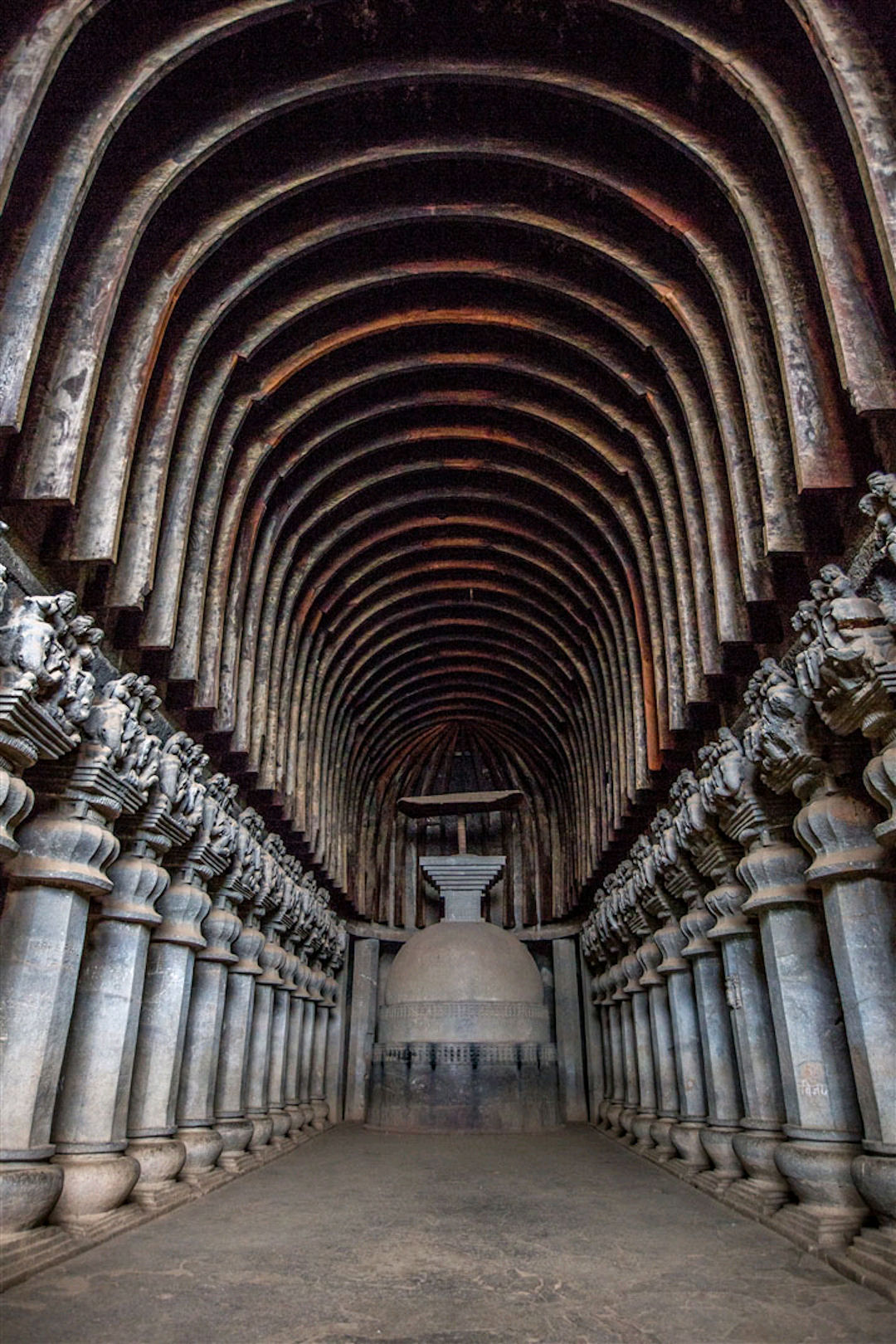
2nd Century BC Karla Caves are group of Buddhist caves near Lonavala
In the early 14th century, the Yadava Dynasty, which ruled most of present-day Maharashtra, was overthrown by the Delhi Sultanate ruler Ala-ud-din Khalji. Later, Muhammad bin Tughluq conquered parts of the Deccan, and temporarily shifted his capital from Delhi to Daulatabad in Maharashtra. After the collapse of the Tughluqs in 1347, the local Bahmani Sultanate of Gulbarga took over, governing the region for the next 150 years. After the break-up of the Bahamani sultanate in 1518, Maharashtra split into five Deccan Sultanates: Nizamshah of Ahmednagar, Adilshah of Bijapur, Qutubshah of Golkonda, Bidarshah of Bidar and Imadshah of Elichpur. These kingdoms often fought with each other. United, they decisively defeated the Vijayanagara Empire of the south in 1565. The present area of Mumbai was ruled by the Sultanate of Gujarat before its capture by Portugal in 1535 and the Faruqi dynasty ruled the Khandesh region between 1382 and 1601 before finally getting annexed by the Mughal Empire. Malik Ambar, the regent of the Nizamshahi dynasty of Ahmednagar from 1607 to 1626, increased the strength and power of Murtaza Nizam Shah II and raised a large army. Malik Ambar is said to have been a proponent of guerrilla warfare in the Deccan region. Malik Ambar assisted Mughal emperor Shah Jahan in Delhi against his stepmother, Nur Jahan, who had ambitions of seating her son-in-law on the throne.
By the early 17th century, Shahaji Bhosale, an ambitious local general who had served Ahmadnagar Sultanate, the Mughals and Adil Shah of Bijapur at different periods during his career, attempted to establish his independent rule. His son Shivaji succeeded in establishing the Maratha Empire which was further expanded during the 18th century by the Bhat family Peshwas based in Pune, Bhonsle of Nagpur, Gaekwad of Baroda, Holkar of Indore, Scindia of Gwalior. At its peak, the empire covered much of the subcontinent, encompassing a territory of over 2.8 million km. The Marathas are credited to a large extent for ending the Mughal rule in India. The Marathas defeated the Mughals and conquered large territories in northern and central parts of the Indian subcontinent. After their defeat at the hand of Ahmad Shah Abdali's Afghan forces in the Third Battle of Panipat in 1761, the Maratha suffered a setback. However, the Marathas soon regained lost influence and ruled central and north India including New Delhi until the end of the eighteenth century. The Third Anglo-Maratha War (1817–1818) led to the end of the Maratha Empire and East India Company ruled the country in 1819. The Marathas also developed a potent Navy circa 1660s, which at its peak, dominated the territorial waters of the western coast of India from Mumbai to Savantwadi. It would engage in attacking the British, Portuguese, Dutch, and Siddi Naval ships and kept a check on their naval ambitions. The Maratha Navy dominated till around the 1730s, was in a state of decline by the 1770s, and ceased to exist by 1818.

The Ramayana panel at Ellora Caves, a UNESCO World Heritage Site 756–773 CE)
India contains no more than two great powers, British and Maratha, and every other state acknowledges the influence of one or the other. Every inch that we recede will be occupied by them. Charles Metcalfe, one of the ablest of the British Officials in India and later acting Governor-General, wrote in 1806
The British East India Company controlled Mumbai beginning in the 17th century, and used it as one of their main trading posts. The Company slowly expanded areas under its rule during the 18th century. Their conquest of Maharashtra was completed in 1818 with the defeat of Peshwa Bajirao II in the Third Anglo-Maratha War. The British governed western Maharashtra as part of the Bombay Presidency, which spanned an area from Karachi in Pakistan to northern Deccan. A number of the Maratha states persisted as princely states, retaining autonomy in return for acknowledging British suzerainty. The largest princely states in the territory were Nagpur, Satara and Kolhapur; Satara was annexed to the Bombay Presidency in 1848, and Nagpur was annexed in 1853 to become Nagpur Province, later part of the Central Provinces. Berar, which had been part of the Nizam of Hyderabad's kingdom, was occupied by the British in 1853 and annexed to the Central Provinces in 1903. However, a large part called Marathwada remained part of the Nizam's Hyderabad State throughout the British period.
The British ruled for more than a century and brought huge changes in every aspect of life for the people of the Maharashtra region. However, at the turn of the 20th century, the struggle for independence took shape, led by Pune-based radical nationalist Bal Gangadhar Tilak and the moderates like Justice Mahadev Govind Ranade, Gopal Krishna Gokhale, Pherozeshah Mehta and Dadabhai Naoroji. Jyotirao Phule was the pioneer of social reform in Maharashtra region in second half of the 19th century. His work for social justice was continued by Shahu, Raja of Kolhapur, at turn of the century and later by Dr. B. R. Ambedkar. After the partial autonomy given to the states by the Government of India Act 1935, B. G. Kher became the first Chief Minister of the Congress party-led Government of tri-lingual Bombay Presidency. The ultimatum to the British during the Quit India Movement was given in Mumbai, and culminated in the transfer of power and independence in 1947.
After Indian independence, princely states and Jagirs of the Deccan States Agency, were merged into Bombay State, which was created from the former Bombay Presidency in 1950. In 1956, the States Reorganisation Act reorganised the Indian states along linguistic lines, and Bombay Presidency State was enlarged by the addition of the predominantly Marathi-speaking regions of Marathwada (Aurangabad Division) from erstwhile Hyderabad state and Vidarbha region from the Central Provinces and Berar. The southernmost part of Bombay State was ceded to Mysore. In the 1950s, Marathi people strongly protested against bilingual Bombay state under the banner of Samyukta Maharashtra Samiti. The notable leaders of the samiti included Keshavrao Jedhe, S.M. Joshi, Shripad Amrit Dange, Pralhad Keshav Atre and Gopalrao Khedkar. The key demand of the samiti called for a Marathi speaking state with Mumbai as its capital. In the Gujarati speaking areas of the state, a similar the Mahagujarat Movement demanded a separate Gujarat state for majority Gujarati areas. After many years of protests, which also saw 106 deaths amongst the protestors, and electoral success of the samiti in 1957 elections, the government of Nehru yielded to public pressure to create on 1 May 1960, a separate Marathi-speaking state of Maharashtra by dividing earlier Bombay State into the new states of Maharashtra and Gujarat. The state continues to have a dispute with Karnataka regarding the region of Belgaum and Karwar.
Cultural life
Maharashtra is a distinct cultural region. Its long artistic tradition is manifested in the ancient cave paintings found at Ajanta and Ellora just north of Aurangabad, both of which were designated UNESCO World Heritage sites in 1983, in a number of medieval architectural masterpieces, in its classical and devotional music, and in its theatre. Pune, where numerous organizations sustain those great traditions, is the state’s undisputed cultural capital.
Cuisine
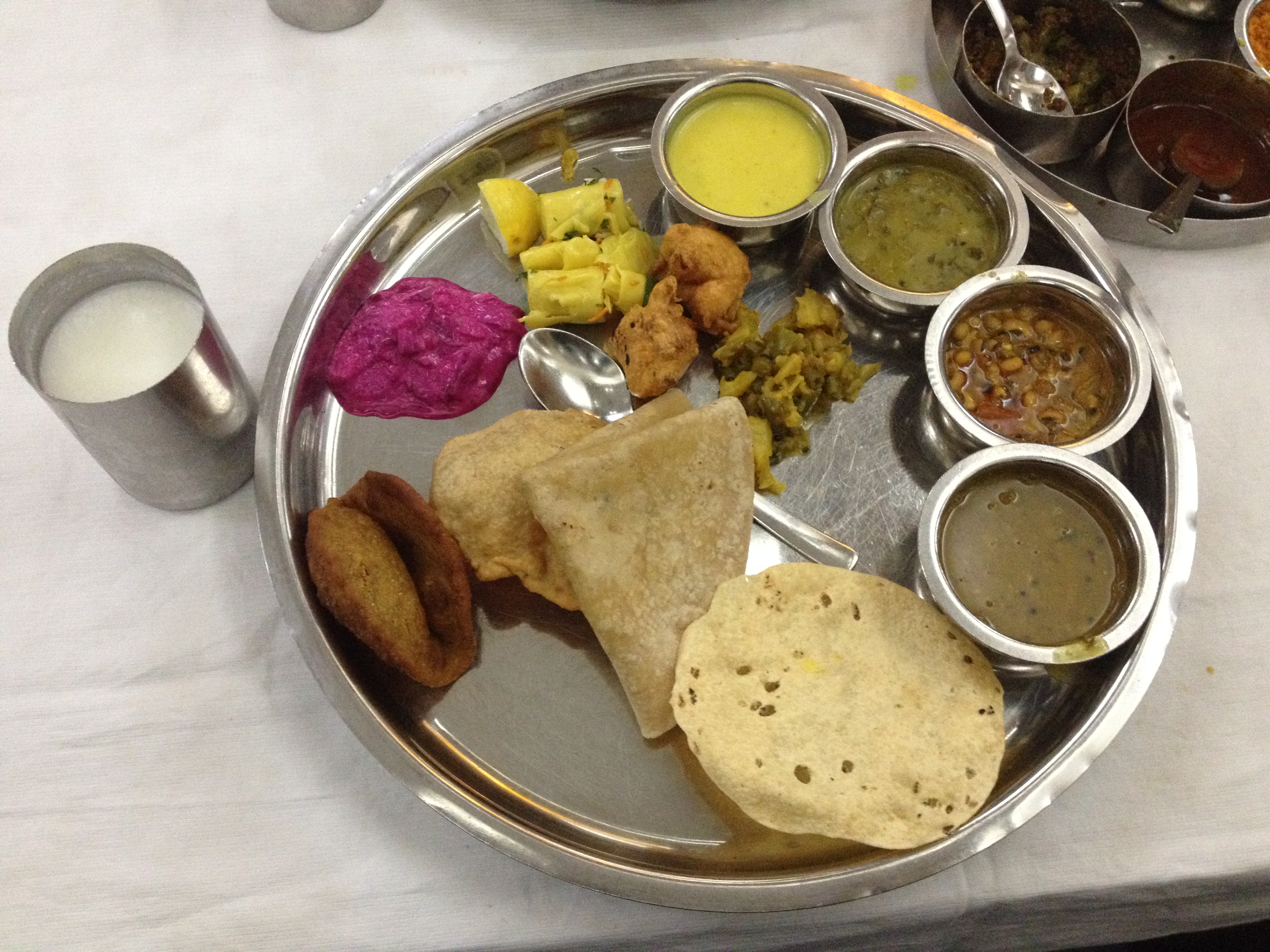
Maharashtrian Thali
Maharashtra cuisine covers a range from mild to very spicy dishes. Wheat, rice, jowar, bajri, vegetables, lentils and fruit form staple food of the Maharashtrian diet. Some of the popular traditional dishes include puran poli, ukdiche modak, Thalipeeth and fast food items such as batata wada, Misal Pav, Pav Bhaji and Vada pav are dishes that became very popular in the last fifty years. Meals (mainly lunch and dinner) are served on a plate called thali. Each food item served on the thali has a specific place. In some households, meals begin with a thanksgiving offering of food (Naivedya) to the household Gods. Maharashtrian cuisine has many regional varieties including Malvani (Konkani),Kolhapuri and Varhadhi. Though quite different, both use a lot of seafood and coconut. The staple foods of the Konkani people are rice and fish

Misal Paav, a popular dish from Maharashtra
The bhaajis are vegetable dishes made with a particular vegetable or a combination. They require the use of goda (sweet) masala, essentially consisting of some combination of coconut, onion, garlic, ginger, red chilli powder, green chillies and mustard. Depending on the caste or specific religious tradition of a family, onion and garlic may not be used in cooking. A particular variant of bhaaji is the rassa or curry. Vegetarians prepare rassa or curry of potatoes and or cauliflower with tomatoes or fresh coconut kernel and plenty of water to produce a soup-like preparation rather than bhaaji. Varan is nothing but plain dal, a common Indian lentil stew. Aamti is variant of the curry, typically consisting of a lentil (tur) stock, flavoured with goda masala, tamarind or amshul, and jaggery (gul).
Among seafood, the most popular fish is bombil or the Bombay duck. All non-vegetarian and vegetarian dishes are eaten with boiled rice, chapatis or with bhakris, made of jowar, bajra or rice flours. Special rice puris called vada and amboli, which is a pancake made of fermented rice, urad dal, and semolina, are also eaten as a part of the main meal.
Attire
Traditionally, Marathi women commonly wore the sari, often distinctly designed according to local cultural customs. Most middle aged and young women in urban Maharashtra dress in western outfits such as skirts and trousers or shalwar kameez with the traditionally nauvari or nine-yard lugade, disappearing from the markets due to a lack of demand. Older women wear the five-yard sari. In urban areas, the five-yard sari, especially the Paithani, is worn by younger women for special occasions such as marriages and religious ceremonies. Among men, western dressing has greater acceptance. Men also wear traditional costumes such as the dhoti, and pheta on cultural occasions. The Gandhi cap is the popular headgear among older men in rural Maharashtra. The Kurta (a long shirt) is worn by men on special occasions. Women wear traditional jewelries derived from Maratha and Peshwa dynasties. Kolhapuri saaj, a special type of necklace, is also worn by Marathi women. In urban areas, many women and men wear western attire.Performing arts

Lavani performance
Maharashtrian artists have made major contributions to Indian Classical music. Its vibrant folk form includes Powada, Bharuds and Gondhals. Cities like Kolhapur and Pune have been playing a major role in preservation of music like Bhavageet and Natya Sangeet, which are inherited from Indian classical music. The songs from Hindi films and Marathi films are popular in urban areas
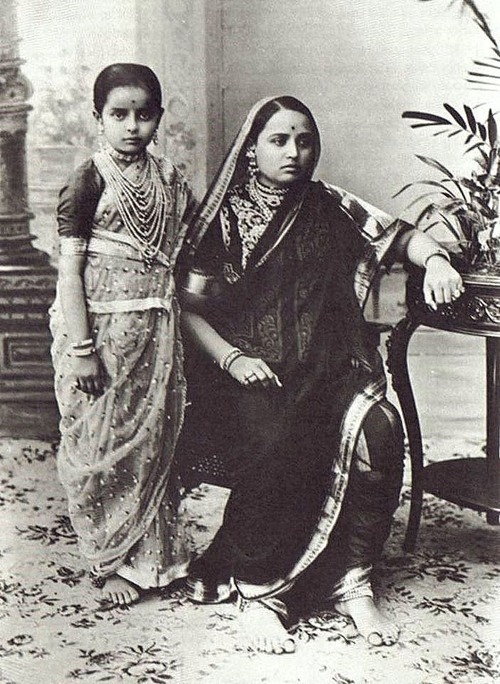
Girl and Women dressed in traditional Maharashtrian Nauvari (nine-yard sari)
Marathi dance forms draw from folk traditions. Lavani is popular form of dance in the state. The Bhajan, Kirtan and Abhangas of the Warkari sect (Vaishanav Devotees) have a long history and are part of their daily rituals. Koli dance (as called 'Koligeete') is among the most popular dances of Maharashtra. As the name suggests, it is related to the fisher folk of Maharashtra, who are called Kolis. Popular for their unique identity and liveliness, their dances represent their occupation. This type of dance is represented by both men and women. While dancing, they are divided into groups of two. These fishermen display the movements of waves and casting of the nets during their koli dance performances.
Literature

P L Deshpande (in centre), one of the most popular authors in Marathi language
Maharashtra's regional literature is about lives and circumstances of Marathi people in specific parts of the state. The Marathi language, which boasts a rich literary heritage, is written in the Devanagari script. The earliest instances of Marathi literature is by Sant Dnyaneshwar with his Bhawarthadeepika (popularly known as Dnyaneshwari). The compositions, written in the 13th century, are spiritually inclined. Other compositions are by Bhakti saints such as Tukaram, Eknath, Namdev, Ramdas, and Gora Kumbhar. Their compositions are mostly in poetic form, which are called Abhang. Maharashtra has a long tradition in spiritual literature, evidenced by the Amrutanubhav, Bhavarth Deepika, Bhagavata Purana, Eknathi Bhagwat and Bhavarth Ramayan.
19th century Marathi literature includes the works of authors such as Balshastri Jambhekar, Gopal Ganesh Agarkar, Bal Gangadhar Tilak, Gopal Hari Deshmukh, Mahadev Govind Ranade, Jyotirao Phule, Babasaheb Ambedkar, Vinayak Damodar Sawarkar, Ram Ganesh Gadkari, Tryambak Bapuji Thombre, Hari Narayan Apte, Vishnushastri Chiplunkar and Keshavsuta. 20th century notable writers include Mahadevshastri Joshi, Kusumagraj, Pu La Deshpande, Va Pu Kale, Vyankatesh Digambar Madgulkar, Vishnu Sakharam Khandekar, Prahlad Keshav Atre, B. S. Mardhekar, Sane Guruji, Vinoba Bhave, Chintamani Tryambak Khanolkar, Bahinabai Chaudhari and Laxmanshastri Joshi. Vishwas Patil, Ranjit Desai, Shivaji Sawant, Narayan Surve, Vinda Karandikar, Shanta Shelke, Durga Bhagwat, Suresh Bhat, Ratnakar Matkari, Varjesh Solanki, Manya Joshi, Hemant Divate, Mangesh Narayanrao Kale, Avinash Dharmadhikari, Bhalchandra Nemade, Narendra Jadhav and Saleel Wagh are some of the more recent authors. Regional languages spoken in Maharashtra are Kokani, Koli, Malvani, Varhadi and Khandeshi.
Films
Maharashtra is a prominent location for the Indian entertainment industry, with many films, television series, books, and other media being set there. Mainstream Hindi films are popular in Maharashtra, especially in urban areas. Mumbai is the largest centre for film and television production and a third of all Indian films are produced in the state. Multimillion-dollar Bollywood productions, with the most expensive costing up to ₹1.5 billion (US$21 million), are filmed there. The Marathi film industry, previously located in Kolhapur, has spread throughout Mumbai. Well known for its art films, the early Marathi film industry included acclaimed directors such as Dadasaheb Phalke, and V. Shantaram. Dada Kondke is the most prominent name in Marathi film. The Dadasaheb Phalke Award is India's highest award in cinema, given annually by the Government of India for lifetime contribution to Indian cinema.Theatre

Playwright Vijay Tendulkar
Modern Theatre in Maharashtra can trace its origins to the British colonial era in the middle of the 19th century. It is modelled mainly after the western tradition but also includes forms like Sangeet Natak (musical drama). In recent decades, Marathi Tamasha has been also been incorporated in some experimental plays. Today, theatre continues to have a marked presence in Mumbai and Pune with an educated loyal audience base, when most theatre in other parts of India have had a tough time facing the onslaught of cinema and television. Its repertoire ranges from humorous social plays, farces, historical plays, musical, to experimental plays and serious drama. Marathi Playwrights such as Vijay Tendulkar, P. L. Deshpande, Mahesh Elkunchwar and Satish Alekar have influenced theatre throughout India. Besides Marathi theatre, Maharashtra and particularly, Mumbai, has had a long tradition of theatre in other languages such as Gujarati, Hindi and English.Media
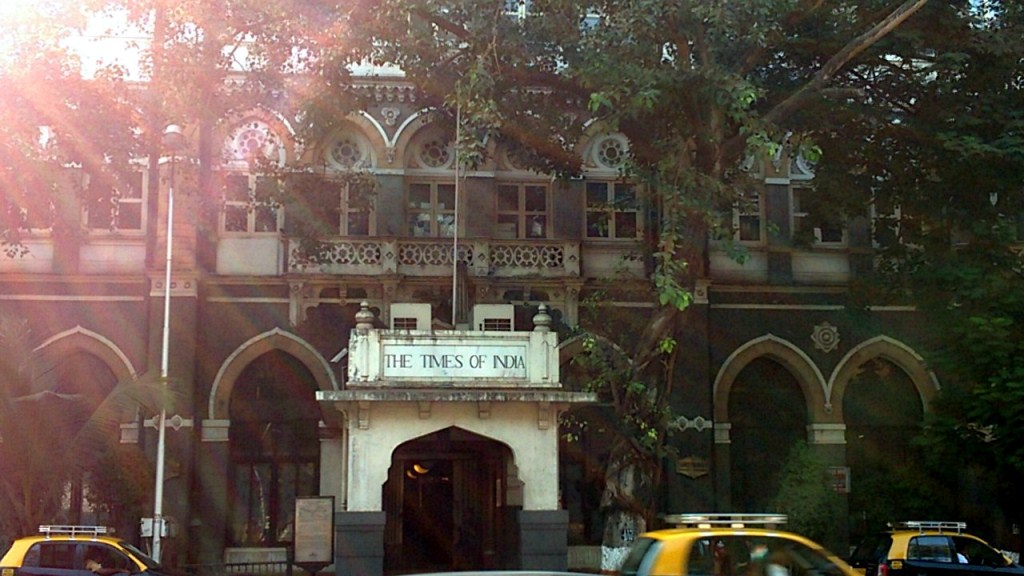
Times of India building in Mumbai
More than 200 newspapers and 350 consumer magazines have an office in this state and the book-publishing industry employs about 250,000 people. Sakal published from Pune and other major Maharashtrian cities, has the largest circulation for Marathi Newspaper in Maharashtra as of December 2016. Other major Marathi newspapers are Maharashtra Times, Loksatta, Nava Kal, Pudhari and Lokmat. Tarun Bharat and Kesari, two newspapers that once were quite influential during the colonial and the post-independence era have stopped the print edition and are now published only digitally. Popular Marathi language magazines are Saptahik Sakal, Grihashobhika, Lokrajya, Lokprabha and Chitralekha. Major English language newspapers which are published and sold in large numbers are Daily News & Analysis, The Times of India, Hindustan Times, The Indian Express, Mumbai Mirror, Asian Age, MiD-DAY and The Free Press Journal. Some prominent financial dailies like The Economic Times, Mint, Business Standard and The Financial Express are widely circulated. Vernacular newspapers such as those in Hindi, Kannada, Gujarati, Tamil and Urdu are also read by a select readership.
The television industry developed in Maharashtra and is a significant employer in the state's economy. Numerous Indian and international television channels can be watched in Maharashtra through one of the Pay TV companies or the local cable television provider. The four major India broadcast networks are all headquartered in Maharashtra: The Times, STAR India, CNN-IBN and ZEEL. Doordarshan is the state-owned television broadcaster and provides two free terrestrial channels. Multi system operators provide a mix of Marathi, Bengali, Nepali, Hindi, English and international channels via cable. The wide range of cable channels available includes sports channels like ESPN, Star Sports, National entertainment channels like Colors, Sony, Zee TV and Star Plus, Business news channels like CNBC Awaaz, Zee Business, ET Now and Bloomberg UTV. Marathi 24-hour television news channels include ABP Majha, News18 Lokmat, Zee 24 Taas, Saam, TV9 Marathi and Jai Maharashtra. Also, Marathi Entertainment Channels includes Zee Marathi, Zee Yuva, Colors Marathi, Star Pravah, Sony Marathi and Fakt Marathi.
All India Radio is a public radio station. Private FM stations are available in all major cities. Airtel, BSNL, Jio and VI are available cellular phone operators. Maharashtra has the highest share of the internet market at 18.8% of total households internet users in India. Broadband internet is available in all towns, villages and cities, provided by the state-run MTNL and BSNL and by other private companies. Dial-up access is provided throughout the state by BSNL and other providers.
Sports
The most popular sports in Maharashtra are kabaddi and cricket.

Children playing cricket in Mumbai
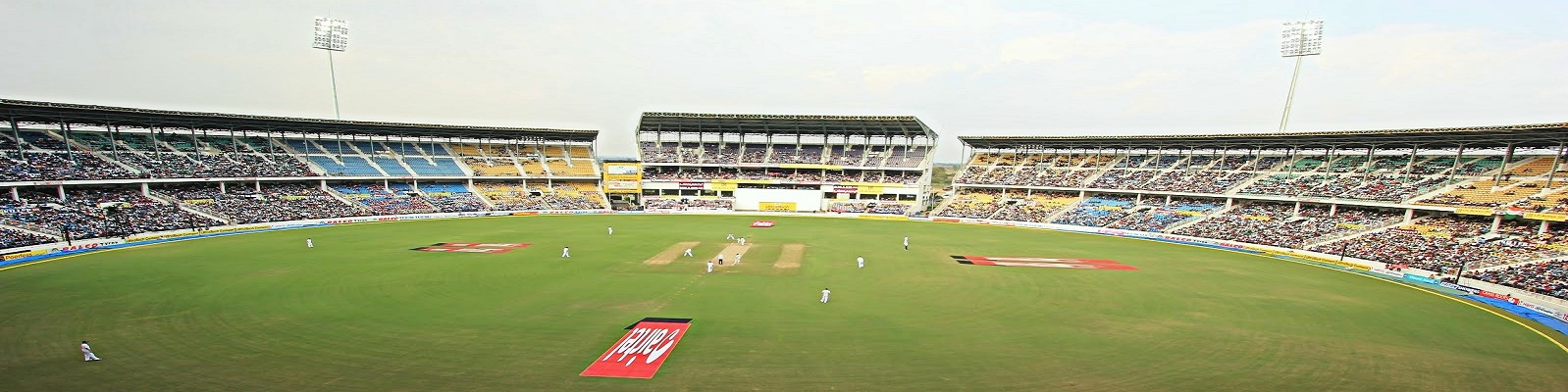
A Cricket match at Vidarbha Cricket Association Stadium in Nagpur
As in the rest of India, cricket is popular in Maharashtra and is played on grounds and in streets throughout the state. Maharashtra has various domestic level franchise-based leagues for field hockey, chess, tennis and badminton. The state is home to top national football clubs such as Mumbai Tigers F.C., Kenkre F.C., Bengal Mumbai FC and Air India FC. Adventure sports such as paragliding, water sports, rock climbing, backpacking, mountaineering and scuba diving are also popular in the state. Other notable sports played in the state include Kho kho, fencing, archery and shooting.
Mahrashtra has ATP 250 Maharashtra Open tennis championship. It is the elite tennis tournament of India and only ATP 250 level Tennis championship of South Asia. It annually helds at Balewadi, Pune. Every year India's top singles and doubles players complete in it. Solapur Open, the women's 25000 $ tennis tournament held at Solapur. It is a grade T2 tournament. ITF Women's $25K tennis tournament held at Pune. It is a hard court, grade T2 tournament. Maharashtra has an Indian Premier League franchise known as the Mumbai Indians and also had the now defunct Rising Pune Supergiant and Pune Warriors India; The state has three cricket associations viz. Mumbai Cricket Association which is the governing body for cricket in Mumbai, Greater Mumbai and Thane districts, Vidarbha Cricket Association which is the governing body for cricket in Vidarbha Region and Maharashtra Cricket Association (MCA) which is the governing body for cricket for rest of Maharashtra. Maharashtra has three domestic cricket teams: the Mumbai cricket team, Maharashtra cricket team and Vidarbha cricket team. Wankhede Stadium which has a capacity of around 33,000 hosted the final match of the 2011 ICC Cricket World Cup. It is home to the Mumbai Indians and Mumbai cricket team while the MCA Stadium in Pune is home to the Maharashtra cricket team and Vidarbha Cricket Association Stadium in Nagpur is home to the Vidarbha cricket team.
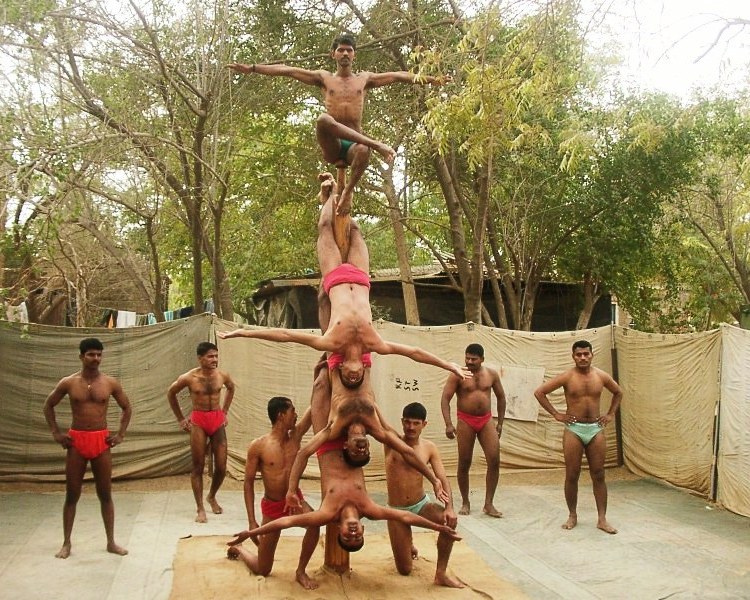
A mallakhamba team of the Indian Army's Bombay Sappers performs on the pole.
Maharashtra football team represents the state in competition for the Santosh Trophy. Pune FC and Mumbai FC were the football clubs from the state that played in I-League. Maharashtra has two teams in the Indian Super League (ISL), FC Pune City and Mumbai City FC representing the two cities respectively.
The state has two club franchises playing in American football's Elite Football League of India. Mumbai Gladiators and Pune Marathas are teams based in Mumbai and Pune respectively.
Mumbai and Pune hold derby races at the Mahalaxmi Racecourse and Pune Race Course respectively. The wrestling championships Hind Kesari and Maharashtra Kesari are widely popular in the rural regions and are affiliated with the All India Amateur Wrestling Federation (AIAWF). Maharashtra Chess Association is the apex body for the game of chess in Maharashtra. Maharashtra Tennis League is India's first league format in tennis.
Notable athletes from Maharashtra include India's first individual Olympic Medalist- wrestler Khashaba Jadhav, retired cricket legends and former captains of the Indian national cricket team, Sachin Tendulkar and Sunil Gavaskar, Dilip Vengsarkar;, Indian national cricket team player Rohit Sharma, Ajinkya Rahane, Kedar Jadhav, Commonwealth Games gold medalists – shooters Anjali Bhagwat, Rahi Sarnobat and Tejaswini Sawant, Asian Games silver medalist Hiranna M. Nimal, chess player Rohini Khadilkar, tennis player Gaurav Natekar, former hockey players Dhanraj Pillay, Viren Rasquinha and badminton players Nikhil Kanetkar and Aparna Popat.
Indigenous sports
A number of Indian sports either originated in Maharashtra or were formalised here. These include Badminton (previously known as Poona game), Kabaddi, Kho kho, and Mallakhamba. In rural areas of Maharashtra, Kusti (Indian mud wrestling) and bullock cart competitions are regular fixtures during the annual jatra (carnival). The government of Maharashtra has in the past supported Kusti by building two permanent akhara (Indian training centers) in the Kolhapur area.Tourism
Mumbai, the biggest and the most cosmopolitan city in India attracts tourists from all over the
world for its
many attractions including colonial architecture, beaches, movie industry, shopping, and an active
nightlife.
Pune, called the cultural capital of Maharashtra, also attracts many visitors during the annual
Ganeshotsav
festival. According to a survey, most tourists visiting places in Maharashtra are from the state.
Two other
states, Gujarat and Andhra Pradesh send the largest number of domestic visitors to Maharashtra.
Foreign visitors
to Maharashtra account for just 2% of the tourists. Visitors from the US, UK, Germany, and UAE each
form a
significant percentage of foreign tourists.
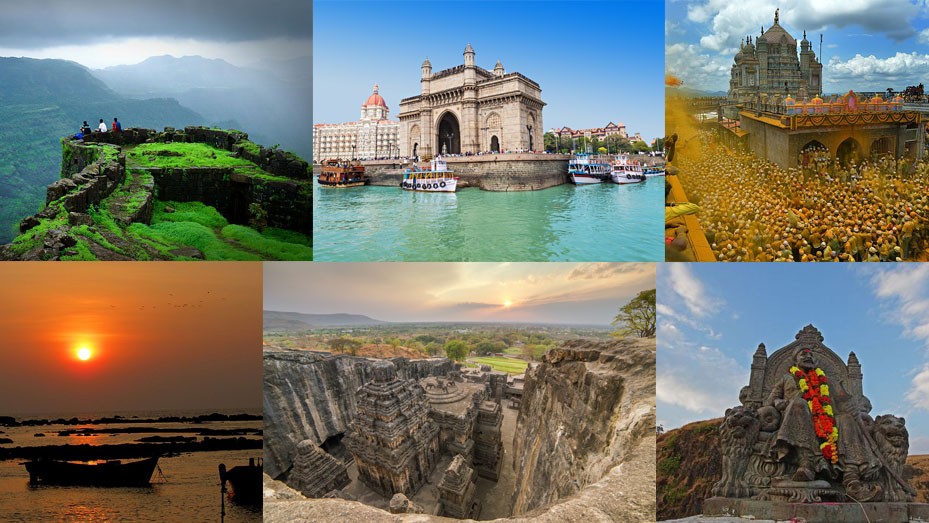
Tourism in Maharashtra
The area around Aurangabad has many ancient and medieval sites including the UNESCO World Heritage Sites of Ajanta and Ellora caves, the Daulatabad Fort, and the Bibi Ka Maqbara in Aurangabad. The mountainous districts of Western Maharashtra are dotted with the ruins of hundreds of mountain forts from the Deccan Sultanate and the Maratha empire eras respectively. These forts and the surrounding hills are popular with people interested in trekking, hiking and Heritage tourism related to Chatrapati Shivaji. The British built many hill-stations during the colonial era for government officials to escape from the heat of Indian summers. These places have been magnets for tourism for a long time. The important hill stations in Western Maharashtra are Mahabaleshwar, and Matheran. In Vidarbha region, Chikhaldara is the hill station popular with visitors.
Places of worship that attract pilgrims from other parts of India and beyond include the Sikh Gurudwara of Hazur Sahib at Nanded, Khandoba temple at Jejuri in Pune district where worshipers shower each other with Bhandar and the shrine of Saibaba at Shirdi. The places associated with the Warkari sect such as Pandharpur, Dehu and Alandi attract pilgrims from all over Maharashtra throughout the year but particularly during religious observations at these places.
The Vidarbha region of Maharashtra has numerous nature reserve parks. These include, Melghat Tiger Reserve in Amravati district, Tadoba-Andhari Tiger Reserve in Chandrapur district, Umred Karhandla Wildlife Sanctuary in Nagpur district, the Nagzira wild life sanctuary and Navegaon National Park (bird sanctuary) of Gondia District. The state government has established Maharashtra Tourism Development Corporation (MTDC) for systematic development and promotion of tourism in the state. MTDC has, since its inception, been involved in the development and maintenance of the various tourist locations of Maharashtra. MTDC owns and maintains resorts at all key tourist centers and having more resorts is on the plan.
The arts
Music in Maharashtra, like Marathi literature, has an ancient tradition. It became allied with
Hindustani
music about the 14th century. In more recent times Vishnu Digambar Paluskar and Vishnu Narayana
Bhatkhande
greatly influenced Indian classical music. Contemporary vocalists include Bhimsen Joshi and Lata
Mangeshkar.
In rural Maharashtra the foremost diversion is tamasha, a performance form that combined music,
drama, and
dance. The typical tamasha troupe comprises seven artists, including a female dancer for featured
roles and
a bawdy clown.
The theatre and the cinema are popular in urban areas of Maharashtra. Leading playwrights V.
Khadilkar and
Vijay Tendulkar and actor Bal Gandharva raised the status of the Marathi drama as an art form. The
Indian
movie industry, known as Bollywood, began in Mumbai in the 1930s, and by the early 21st century its
films
had gained popularity among international audiences. Prabhat Film Company in Pune is one of the
country’s
leaders in cinema; some of its best-known productions are Sant Tukaram (1936) and Sant Dnyaneshwar
(1940).
Maharashtrian film pioneers are Dadasaheb Phalke and Baburao Painter, and artists of Hindi cinema
include
Nana Patekar and Madhuri Dixit.
Recreation
Many festivals are held throughout the year in Maharashtra. Holi and Ranga Panchami are spring festivals. Dussehra (also spelled Dashahara) is an autumn event celebrating the triumph of good over evil. During Pola in August, farmers bathe, decorate, and parade their bulls through the streets, signifying the start of the sowing season. The festival Ganesh Chaturthi, celebrating the birth of Hindu deity Ganesha, is held during the rainy season and is by far the most popular in Maharashtra. Its public celebration was first sponsored by the nationalist political leader Bal Gangadhar Tilak in 1893. Clay idols of Ganesha are sold throughout the state. Unique to Maharashtra is the Hurda party, in which a farmer invites neighbouring villagers to partake of fresh ears of jowar (grain sorghum). ʿĀshūrāʾ, observed on the 10th day of Muḥarram (the first month of the Islamic calendar), honours the martyrs of Islam, although Hindus also participate. Folk songs and traditional dances accompany all those celebrations.
Saints
The following points highlight the four great saints of Maharashtra who participated in the bhakti movement. The saints are: 1. Nam Dev (1270—1350 A.D.) 2. Tuka Ram (1601—1649) 3. Ram Dass (1608—1681 A.D.) 4. Bahina Bai.Saint # 1. Nam Dev (1270—1350 A.D.):
. According to Dr. Tare Chand, “The first of the saintly array of men who changed the faith of this region (Maharashtra) and turned the mind of men from the priest-ridden ceremonial of a narrow creed to freedom and love was Nam- Dev. He is remembered by every saint of Maharashtra, Hindustan, Rajputana and Punjab as the great historic name in the long list of Bhaktta.”

Saint Nam Dev
Nam Dav was born ‘ in 1270 and was the disciple of Vishoba Khechar. He preached the sublime gospel of love and devotion and liberated the peoples from the shackles of rituals and caste system.
He was opposed to idol worship and religious intolerance. He held that salvation could be achieved through Bhakti or devotion to God.
Emphasizing the inefficacy of the external acts of religion Nam Dev said: “Vows, fasts and austerities are not all necessary; nor is it necessary for you to go on a pilgrimage. Be you watchful in your hearts and always sing the name of Hari, it is not necessary to give up eating food or drinking water; fix your mind on the feet of Hari. Yoga or sacrificial ceremonies or giving up objects of desire is not wanted. Realise a fondness for the feet of Hari”
Saint # 2. Tuka Ram (1601—1649):
One of the most prominent saints of Maharashtra was Tuka Ram. He was born in Shudra family, which was devoted to the worship of Vithoba. He led a normal life during childhood and took to trade at the age of fourteen.
Due to death of his father and losses in business he became disgusted with the worldly life and devoted himself to contemplation and devotion. He soon became popular with the people because of his life of piety and service. Even Shivaji had great admiration for Tukaram. The teachings of Tukaram are contained in his numerous Abhanjas.
Tukaram insisted that it was not possible to combine both spiritual joy and the activity in the world. A person who tries to achieve both in the end achieves neither. Tukaram’s conception of God is almost identical to that of Kabir.
He says – “He has neither form nor name, nor place of abode; He is present wherever we go, Vitthal our mother and sister. He knows neither form nor change of form. He pervades the moving and immovable world. He is neither with nor without attributes, who, indeed can know Him ? He will turn to none, says Tuka, who has not faith in him.”
Tukaram rejects ceremonies, Vedic sacrifices, visits to holy places, worship of stones, putting on saints guise, fasts and other types of austerities. He also tried to reconcile Hindu and Muslim faiths.
In one of his hymns he says:
“What Allah wishes that is accomplished, O! my friend (Baba), the Maker is the sovereign of all. Cattle and friends, gardens and goods all depart. My mind dwells, O! friend, on my Lord (Sahib) who is the Maker I ride there on the back of the horse (mind). O ! friend, mediate (zikr) on Allah, who is in the guise of all, Says Tuka, the man who understands this becomes a Darwesh.
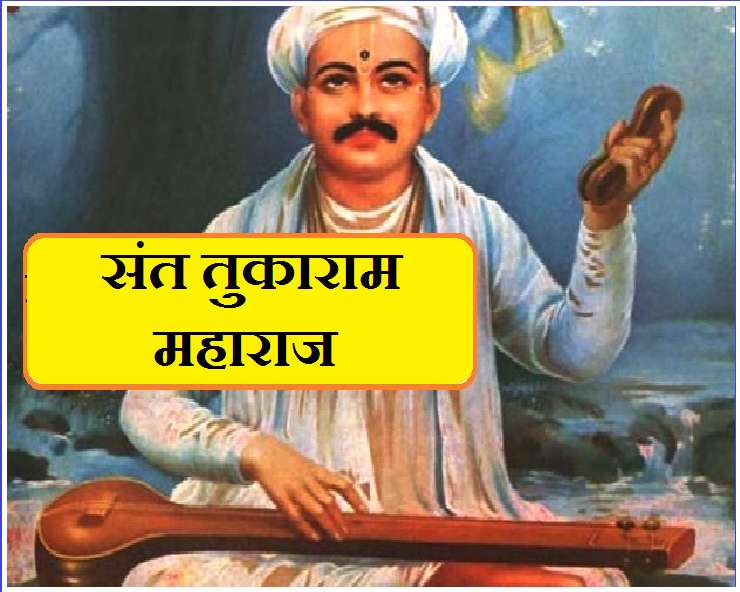
Tourism in Maharashtra
Saint # 3. Ram Dass (1608—1681 A.D.):
Another great saint of Maharashtra was Ram Dass. Unlike Tukaram, Ram Dass believed that only success in Samsara can lead to success in Para Martha and the former was a necessary condition for the latter.
Ram Dass tried to integrate the different sciences and arts of life with religious quest and the monumental work in which he right to accomplish this is entitled Dasabodha Shivaji was greatly inspired by the teachings, of Ram Dass. He advised Shivaji “to adorn his body not with clothes and ornaments but with shrewdness and wisdom.”
According to Swami Ramdas the essential qualification of a good ruler included the following:
“To spread the message of God, to protect the poof, the pious and the helpless, to strive for the well-being of his subjects and to remain eternally vigilant and to practice the virtue of forbearance and tolerance.”
Saint # 4. Bahina Bai:
Bahina Bai was another great saint of Maharashtra. She received her Mantra ‘Rama-Krishna-Hari’ in a vision from Tukaram and accepted Tukaram as her Guru. Initially her husband did not like her devotion to Tukaram, but subsequently he changed his stand.
Bahina also produced outstanding poetry in the style and meter of Tukaram. She exercised great control over her sexual appetite. Talking of the duties of a wife Bahina Bai says- “a wife must make her domestic life happy by accepting her husband’s wishes in a noble spirit, and, though it may even mean death to her, she should not transgress them. Bless is she, her caste and her family.”
It may be noted that all the saints of Maharashtra were devoted to the deity named Pandurang, Vithoba or Vitthal, and the Bhakti movement in Maharashtra centred round the shrines of Vithoba or Vishnu at Pandharpur on the banks of Bhima. These religions reformers and saints made an ardent appeal to God Almighty to intervene on behalf of the oppressed people and bring them relief from Muslims persecution. Making an assessment of the commendable work done by the saints of Maharashtra in the field of social and political life of the people Mahadeo Govind Ranade says, “The saints come out well in their struggles with their foreign rulers, and they prevailed not by fighting, not by resistance, but by quite resignation to the Will of God. There was a tendency perceptible towards a reconciliation of the two races in mutual reconciliation of the essential unity of Allah with Rama, and by the time Shivaji appeared on though, this reconciliation seems to have been almost complete, though occasional outbursts of Muhammedan fanaticism were not altogether unknown even then.”
As a result of the teachings of these saints certain changes in the society were also effected. They Subordinated the importance of the rites and ceremonies, and of pilgrimages and fasts, and of learning and contemplation, to the higher excellence of worship by means of love and faith. It cheeked the excesses of polytheism.”
Saint #5 Dynaneshwar
Born : AD 1275 Died : 1296
Child prodigy Saint Gyaneshwar was a great scholar like his father. He was deeply interested in the study of scriptures and in religious practices. His extra-ordinary brilliance caught the eye of everybody. He tried to remove the social disparities by educating people through his experiences and anecdotes of life. He came to Newa in 1288. In 1289, he composed Gyaneshwari which holds pride of a place in Indian scriptures, philosophical treatises and also in Marathi literature. He knew many languages, and so words from as many as 56 languages can be found in yaneshwari. He mastered the Gita when only 15 and set out on a pilgrimage with Saint Namdev. During his travel, he preached the essence of the Gita, emphasising on its aspects of knowledge, devotion and yoga, and composed Amritanubhava.
Born to a socially ostracized father Vithal Pant and mother Rulunini, Saint Gyaneshwar’s childhood name was Gyandev. Both his parents were scholarly. He moved with his parents to Trimbakeshwar when only a child. He lost his parents at an early age. Orphaned and poor, Gyandev and his siblings had to depend on alms for their living. His preachings, however, brought him fame and extended his influence in the area. His pilgrimage took him to Alandi in1296 where he attained Samadhi while— living.
A sizeable section of Indian society is still influenced by Saint Gyaneshwar’s teachings. He is still alive in his Gyaneshwari. He is remembered with great reverence and devotion.
Unsung Heroes of the Freedom Movement from Maharashtra (Past and present)
Anant Laxman Kanhere (1892 -1910) was an Indian independence fighter from Nashik. On 21 December 1909, he shot dead the Collector of Nashik in British India. The murder of Jackson was an important event in the history of Nashik and the Indian revolutionary movement in Maharashtra. He was prosecuted in Bombay court and hanged in the Thane Prison on 19 April 1910, aged just 18. Babu Genu(1908 -1930) was an India freedom fighter and revolutionary. On 12 December 1930, a cloth merchant named George Frazier of Manchester was moving loads of foreign-made cloth from his shop in old Hanuman galli in the Fort region to Mumbai Port. He was given police protection as per his request. The activists begged not to move the truck, but the police forced the protesters aside and managed to get the truck moving. Near Bhaangwadi on Kalbadevi Road, Shahid Babu Genu stood in front of the truck, shouting praises for Mahatma Gandhi. The police officer ordered the driver to drive the truck over Shahid Babu Genu, but the driver was Indian, so refused, saying: "I am Indian and he is also Indian, So, we both are the brothers of each other, then how can I murder my brother?". After that, the English police officer sat on the driver seat and drove the truck over Babu Genu and crushed him to death under the truck. This resulted in a huge wave of anger, strikes, and protests throughout Mumbai.

Anant Laxman Kanhere
Babu Shedmake (1833–1858) was an Indian pro-independence rebel and a Gond chieftain from Central India. During the Indian Rebellion of 1857, he led the revolt in Chanda district. Born in a Gond zamindar family, he fought multiple battles against the British in a period of seven months in 1858. He was eventually captured and hanged for rebellion against the British government. Baburao Shedmake's life and his revolt against foreign rule are still celebrated by the Gond community. A sobriquet veer, i.e. brave, is added to his name as a mark of his bravery. His birth and death anniversaries are observed annually throughout Gondwana region. (# Why important : Being a prominent tribal chieftain of the Gond community. Maharashtra’s Birsa Munda)
# Baiza Bai: (1784-1863) Baiza Bai was born in Kagal, Kolhapur, Maharashtra in 1784. In February 1798 in Poona, at the age of 14, she was married to Daulat Rao Scindia, the ruler of Gwalior. She was known as a superb horsewoman, and had been trained to fight with a sword and spear. She accompanied her husband during the Maratha wars with the British, and she fought against Arthur Wellesley, the future Duke of Wellington, at the Battle of Assaye. During the British campaign against the Pindaris, she had urged her husband to support the Peshwa Baji Rao II against them. When Daulat Rao submitted to British demands, she even left him briefly, accusing him of cowardice. She was also fiercely opposed to the Scindia surrender of Ajmer to the British. Baiza Bai died in Gwalior in 1863. (#Why important : Being a warrior queen who fought against the army of Arthur Wellesley) Chapekar brothers – Damodar, Balakrishna and Vasudev were involved in the murder of W. C. Rand, the British plague commissioner of Pune. A Special Plague Committee was formed, under the chairmanship of Walter Charles Rand, an Indian Civil Services officer. Troops were brought in to deal with the emergency. The measures employed included entry into private houses, stripping and examination of occupants (including women) by British officers in public, evacuation to hospitals and segregation camps and preventing movement from the city. These measures were considered oppressive by the populace of Pune and complaints were ignored by Rand. On 22 June 1897, the Diamond Jubilee of the coronation of Queen Victoria, Rand and his military escort Lt. Ayerst were shot while returning from the celebrations at Government House. All three brothers were found guilty and hanged in 1899 (Chapekar Brothers story is reasonably well known)
Godavari Parulekar (1907- 1996) was the first woman law graduate in Maharashtra. She was active in the student movement against British rule and was irresistibly drawn to the freedom struggle and plunged into individual satyagraha, for which she was convicted by the British regime in 1932. Godavari then came to Mumbai, where she took up social service in the Servants of India Society, founded by Gopal Krishna Gokhale in 1905, in the early 1930s. She became the first woman to be inducted as a life member of the Society. She was influenced by Marxist ideologies and led the armed struggle for the liberation of Dadra and Nagar Haveli from Portuguese rule and the Warli Adivasi Revolt in 1945.
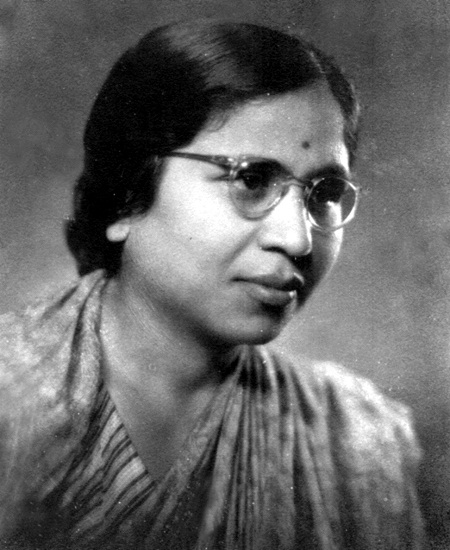
Godavari Parulekar
Krishnaji Gopal Karve (1887-1910) was a member of the Abhinav Bharat Society in Nashik. On 21 December 1909, he along with Anant Laxman Kanhere shotdead Arthur Jackson, the Collector of Nashik. He was sentenced to death in the Bombay high court and hanged in Thane Jail on 19 April 1910.
Lahuji Vastaad or Lahuji Raghoba Salve (1794-1881) was a Dalit activist, preacher and freedom fighter. He learnt wrestling from his father and he became an expert wrestler, which eventually conferred him the title of ‘Vastaad’ (or master). He owned a gymnasium at Ganj peth in Pune where he also taught martial arts to many reknowed people and also acted as a mentor preaching the need for Indian freedom from British Raj and the upliftment of untouchables. Lahuji got acquainted with Jyotirao Phule’s work for the liberation of depressed classes by educating them and joined his Satyashodhak Samaj. (# Why important : Being one of the first Dalit independence activists) Madhavrao Bagal (1895-1986) was among the front runner leaders, who spearheaded the agitation for independence of India and especially merger of Kolhapur State into the Union of India. He was arrested with several of his compatriots like Ratnappa Kumbhar, Dinakar Desai, Nanasaheb Jagadale, R. D. Minche and others. He joined Indian National Congress in mid-1930s, disillusioned by pro-British politics played by older leaders of peasants movement like Bhaskarrao Jadhav, with whom Madhavrao had started agricultural co-operative societies in Kolhapur and adjoining regions.[10] During 1940-47, he was closely working with leaders like Mahatma Gandhi, Vallabhbhai Patel, Jawaharlal Nehru.[
#. Madhav Shrihari Aney (1880 –1968) popularly called Loknayak Bapuji Aney , was an ardent educationist, freedom fighter, statesman, a modern Sanskrit poet and a politician. He was one of the founder of the Congress Nationalist Party along with Madan Mohan Malaviya. He was first among the eminent disciples of Lokmanya Tilak and after Tilak’s death accepted the leadership of Mahatma Gandhi . He disapproved Congress throwing itself in Khilafat Movement and warned against excessive wooing of Muslims at the cost of national interests. Mahatma Gandhi admiring his calm logic, confided in him and often sought his counsel. He was chosen to arbitrate the disputes between Subhash Chandra Bose and Jatindra Mohan Sengupta. (#Why important : For being the confidant of Mahatma Gandhi and a voice of reason)
Nagnath Naikwadi (1922–2012), popularly known as Krantiveer Nagnath anna, was an Indian independence activist, social worker, politician and educationist, known for his revolutionary activism during the Indian independence struggle. During the early 1940s, Naikwadi and his colleagues resorted to armed conflict against the British colonial authorities. In order to raise funds for the movement, his group robbed a government treasury in Dhule and supported the insurgency against the Nizam of Hyderabad.[3] During one of his skirmishes with the British police, he was caught after being injured by a bullet. While in custody at Satara jail, he staged a jailbreak with his fellow activists. The British colonial government announced a reward on his head but Naikwadi managed to stay underground for four years.[2] In 1943, along with Nana Patil, Kisanrao Ahir and a few others, he declared a parallel government, Prati Sarkar, which operated in around 150 villages in the western Maharashtra region which included Satara and Sangli.[3]

Nagnath Naikwadi
# Nana Patil, popularly known as Krantisinh was an Indian independence activist. He was a founder member of the Hindustan Republican Association who went underground between 1929 and 1932. Patil was imprisoned eight or nine times during the struggle with the British Raj from 1932 to 1942. He was the leader of the ‘Satara Parallel Government’ in Maharashtra from August 1943 to May 1946 against British rule. It was an armed offshoot of the 1942 Quit India movement, like the parallel governments in Midnapore in Bengal, Bhagalpur in Bihar, Ballia in Uttar Pradesh and Basudevpur in Odisha. Later on he joined the Communist movement. (#Why important : For leading the Satara Parallel Govt during British rule)
# Pandurang Mahadev Bapat (1880-1967) A maverick freedom fighter who both supported and challenged Mahatma Gandhi, Bapat earned the moniker of ‘Senapati’ when he fought for the rights of farmers during the Mulshi satyagraha in 1921. During his stay in Britain, he was associated with India House, spending a majority of his time learning bomb-making skills instead of pursuing his official studies. He became associated at this time with the Savarkar brothers, Vinayak and Ganesh. While in hiding after the Alipore bombing of 1908, Bapat travelled the country and discovered that the majority of the Indian population did not realize that their country was under foreign rule. At this point, his focus shifted from overthrowing the British government to educating the population. On 15 August 1947 — Indian Independence Day — Bapat was given the honour of raising the Indian national flag over the city of Poona for the first time. (#Why important : For being both a supporter and challenger of Mahatma Gandhi) Pandurang Sadashiv Khankhoje (1884 –1967) was an Indian revolutionary, scholar, agricultural scientist and historian who was among the founding fathers of the Ghadar Party.
Khankhoje's earliest nationalist work abroad dates back to the time around 1908 when he, along with Pandit Kanshi Ram founded the Indian Independence League in Portland, Oregon. His works also brought him close to other Indian nationalists in United States at the time, including Tarak Nath Das. In the years preceding World War I, Khankhoje was one of the founding members of the Pacific coast Hindustan association, and subsequently founded the Ghadar Party. He was at the time one of the most influential members of the party.

Khankhoje
Prabhakar Kunte (1922-2012) joined the Indian National Congress and was active in Quit India movement in 1942, and was imprisoned by British regime. He was a leading trade union leader and was elected to the Bombay Municipal corporation. He actively participated in the Samyukta Maharashtra agitation (1955–1960) and the liberation of Goa (1961). Raghoji Bhangre (1805-1848) was an Indian Revolutionary who challenged and defied the British power in Maharashtra. He was the son of Ramji Rao Bhangre a Koli who also resisted the British rule and was subsequently hanged in Cellular Jail. He had killed a British Officer and 10 constables in an ambush in 1844.
# Rama Khandwala (born 1926) is India's oldest tour guide and the oldest living member of the Rani Jhansi Regiment formed by Subhas Chandra Bose during India's freedom movement. Films Division has made a documentary on Rama Khandwala in 2019. (#Why important : for being the oldest living member of INA founded by Subhash Chandra Bose)
Capt. Rambhhau Lad (1926 - ) ' led the Toofan Sena which was the armed wing of the Prati Sarkar in Satara - an astonishing chapter in India’s struggle for freedom. The prati sarkar, headed by the legendary Krantisinh Nana Patil, functioned as a parallel government in the villages it controlled. It organised the supply and distribution of foodgrain, set up a market structure and ran a judicial system. It also penalised moneylenders, pawnbrokers and landlord collaborators of the Raj, The Toofan Sena conducted daring strikes on imperial armouries, trains, treasuries and post offices.
# Shirishkumar Mehta (1926-1942) was an Indian freedom fighter and the youngest independence activist to be martyred at the age of 15. Mahatma Gandhi started the Quit India movement against the British in 1942. Shirishkumar was leading a procession protesting against the government in Nandurbar. The police had set up barricades at Mangal Bazar area. The police launched a Lathi charge on the protesters as soon as procession reached them. Shirishkumar had the Tiranga, the Indian national flag and the slogan was 'Vande Mataram'. The police opened fire when their lathi charge could not stop the procession. Shirishkumar was killed on the spot. (# Why important : For being the youngest martyr of Quit India Movement at age 15)
Shivram Bhiku Murkar was born in Dabhol village in taluka Dapoli, district Ratnagiri. He actively participated in the freedom struggle, the record of which is lost in time. as he worked in fisheries and had to deal with ports every day, he received secret messages that came via the sea route and passed on to his revolutionary comrades, including the ones underground. He was arrested by the British in Mumbai in 1930. He was arrested because he helped hiding the revolutionaries. He was sentenced to a prison life of around 2 – 3 years. Swami Ramanand Tirtha (1903 –1972) was an Indian freedom fighter, educator and social activist who led the Hyderabad liberation struggle during the reign of Osman Ali Khan, the last Nizam of Hyderabad State. Swami Ramanand Tirtha was the principal leader of the Hyderabad State Congress. Before taking Sanyasa, his family name was Vyenkatesh Bhagvanrao Khedgikar. The state university in Nanded is named after him. (Reasonably well known. Nanded University is named after him)
Umaji Naik (1791-1832) was an Indian revolutionary from Pune was one of the earliest freedom fighter of India who challenged the British rule in India around 1826 to 1832.He fought against East India company and company rule. Soon after the fall of Maratha Empire Umaji raised a tiny army against the British. His anti-British manifesto asked the country-men to fight against the foreign rulers. To capture him, the British Government announced a bounty of 10,000 rupees. Betrayed Nana Raghu Chavan British arrested him, enquired then hold him guilty and hanged till death on 3 Feb 1834.
Vasudev Balwant Phadke (1845 –1883) was an Indian independence activist and revolutionary who sought India's independence from the British Raj. With the help of the Koli, Bhil and Dhangar communities in the region, he formed a revolutionary group of the Ramoshi people. The group started an armed struggle to overthrow the British Raj, launching raids on rich English businessmen to obtain funds for the purpose. Phadke came to prominence when he got control of the city of Pune for a few days after catching British soldiers off-guard during one of a surprise attacks. Phadke was transported to jail at Aden, but escaped from the prison by taking the door off from its hinges on 13 February 1883. He was soon recaptured and then went on a hunger strike, dying on 17 February 1883. (Reasonably well known)

Vishnu Ganesh Pingle (1888 –1915) was an Indian revolutionary and a member of the Ghadar Party . Pingle and a number of other Ghadarites including Kartar Singh Sarabha, Harnam Singh and Bhai Paramanand were tried in the Lahore Conspiracy trial in April 1915 by a special tribunal constituted under the Defence of India Act 1915, for their roles in the February plot.] Pingle was executed by hanging at the Lahore Central Jail on 16 November 1915, along with Kartar Singh.
3 Places associated with freedom struggle
Satara :
The Satara parallel government in Maharashtra from August 1943 to May 1946 against British rule was a legendary chapter in the glorious freedom struggle of India. It was an armed offshoot of the 1942 Quit India movement, like the parallel governments in Midnapore in Bengal, Bhagalpur in Bihar, Ballia in Uttar Pradesh and Basudevpur in Odisha. British rule was effectively overthrown in large parts of Satara district (now bifurcated into Satara and Sangli districts) of western Maharashtra during those three years. The parallel government (prati sarkar) movement was a guerrilla type of struggle, and it operated in over 250 villages with solid peasant support. There were raids on taluka treasuries and armouries. The prati sarkar took over many of the functions of the government. This parallel government established many public utilities like a market system, supply and distribution of food-grains and a judicial system to settle disputes and penalise dacoits and robbers, pawnbrokers and money lenders. Law and order was entirely in its hands. Under this government an army was formed named Toofan Sena
Wardha:
Wardha and its adjacent city Sevagram were major centers for the Indian Independence Movement, especially as the location for an annual meeting of the Indian National Congress in 1934, and Mahatma Gandhi's Ashram. Aronda :

History of Wardha
A village in Sindhudurg District (formerly Ratnagiri district) of Maharashtra on Terkhol river. This village is associated with the Goa Liberation Movement against the Portuguese rule. The Goa Liberation Movement had its first meeting in 1947 in Aronda, held by Dr. Ram Mohan Lohia at Ummal Maidan Palghar Martyrs : Palghar was one of the important sites of 1942 Quit India Movement. On 14 August 1942, there was an uprising against the British in Palghar, in which Kashinath Hari Pagdhare, Govind Ganesh Thakur, Ramprasad Bhimashankar Tiwari, Ramchandra Mahadev Churi, and Govind Sukur More were killed. The main circle of Palghar is known as "Paachbatti" (which means 'five lights' in Marathi) in honour of these martyrs. 14 August has been declared "Martyrs Day" in Palghar, when people gather at Paachbatti Circle to honour the five who sacrificed their lives for Indian independence .