The climate of the Andaman and Nicobar Islands is tropical but is moderated by sea breezes. Temperatures typically rise from the low 70s F (about 23 °C) into the mid-80s F (about 30 °C) daily throughout the year. The territory receives roughly 120 inches (3,000 mm) of rain annually, brought mainly by the southwest monsoon, which blows from May through September, and by the tropical cyclones that follow in October and November. In the Nicobars, Great Nicobar receives considerably more rain than the other islands. The Andamans have long provided meteorological data for shipping in the Bay of Bengal; a reporting station was in operation at Port Blair as early as 1868.
The great majority of the area of the Andaman and Nicobar Islands is covered with dense tropical forest, which
supports a broad spectrum of flora and fauna. The dominant tree species include narra (also called Andaman
redwood, or padauk; Pterocarpus dalbergioides) and various large trees of the family Dipterocarpaceae. The
harbours and tidal creeks often are surrounded by mangrove swamps. Many species of tree ferns of the family
Cyatheaceae are found in the Nicobars but not in the Andamans.
The islands are inhabited by only a few dozen species of terrestrial and marine mammals, a number of which—such
as the Andaman wild pig (Sus scrofa andamanensis)—are endemic to the region. Other common mammals include
macaques, spotted deer, civets, shrews, whales, dolphins, and dugongs (Dugong dugon). The territory is home to
more than 200 species of birds, including many endemic varieties. Numerous types of snakes and lizards inhabit
the forests, and saltwater crocodiles, fish, turtles, and sea snakes are abundant in the coastal waters. Many
species of flora and fauna have yet to be documented systematically.
Although the Andaman and Nicobar Islands territory consists of hundreds of islands, very few of them are
inhabited. Roughly two dozen of the Andaman Islands support human settlements, while only 12 of the Nicobar
Islands are populated.
The vast majority of the population of the Andamans consists of immigrants from South Asia and their
descendants. Most speak Hindi or Bengali, but Tamil, Telugu, and Malayalam also are common. The indigenous
inhabitants of the Andaman Islands, the Andamanese, historically comprised small isolated groups—all speaking
dialects of the Andamanese language. They used the bow and the dog (introduced to the Andamans c. 1857) for
hunting but knew no method of making fire. Turtles, dugongs, and fish were caught with nets or harpooned from
single outrigger canoes. The remoteness of the Andamanese and their general hostility toward foreigners
prevented major cultural change until the mid-20th century. Few indigenous Andamanese survive today, most groups
having been decimated by disease following their encounter with Europeans, Indians, and other outsiders. In the
early 21st century the only Andamanese groups that remained intact and continued to practice the ways of their
ancestors included a small group of Great Andamanese on Strait Island, the Sentinelese of North Sentinel Island,
the Jarawa of the interior areas of Middle and South Andaman, and the Onge of Little Andaman.
The indigenous inhabitants of the Nicobar Islands, the Nicobarese (including the related Shompen), continued to
constitute the majority of the population of the Nicobars in the early 21st century. They probably descend both
from the Malays of insular and peninsular Southeast Asia and from the Mon (also called the Talaing) of Myanmar.
The Nicobarese speak various Nicobarese languages, which belong to the Mon-Khmer language group of the
Austroasiatic language family; some also speak Hindi and English. In addition to the indigenous population,
there are significant numbers of Tamils and other people from the Indian mainland living in the Nicobar Islands.
Many came during the 1960s and ’70s in conjunction with the Indian government’s program to develop the region’s
agriculture.
More than two-thirds of the people of the Andaman Islands are Hindu; Christians make up about one-fifth of the
population and Muslims less than one-tenth. Many Nicobarese are Christian, although some communities practice
local religions or have adopted Hinduism, which is prevalent throughout the region. There is also a notable
Muslim minority in the Nicobars.
The population of the Andaman and Nicobar Islands expanded particularly rapidly in the mid-20th century as
immigrants took advantage of India’s postindependence development initiatives in the territory. Growth began to
slow by the 1980s, and by the early 21st century it had approached a rate roughly comparable to that of the rest
of India. Port Blair is the only major town; it contains more than one-fourth of the territory’s residents. The
remainder of the population is spread across more than 500 small villages, most of which have fewer than 500
inhabitants.
Agriculture is the occupation of most of the residents of the Andaman Islands. Principal crops include rice, coconuts, betel (areca nuts), fruits, and spices (such as turmeric). Rubber, oil palms, and cashews also are important. In addition to farming there is a small forestry sector on the islands, which focuses on production of sawn wood for domestic use; surpluses are exported to the Indian mainland. Similarly, the products of the islands’ fisheries are intended primarily for domestic consumption.
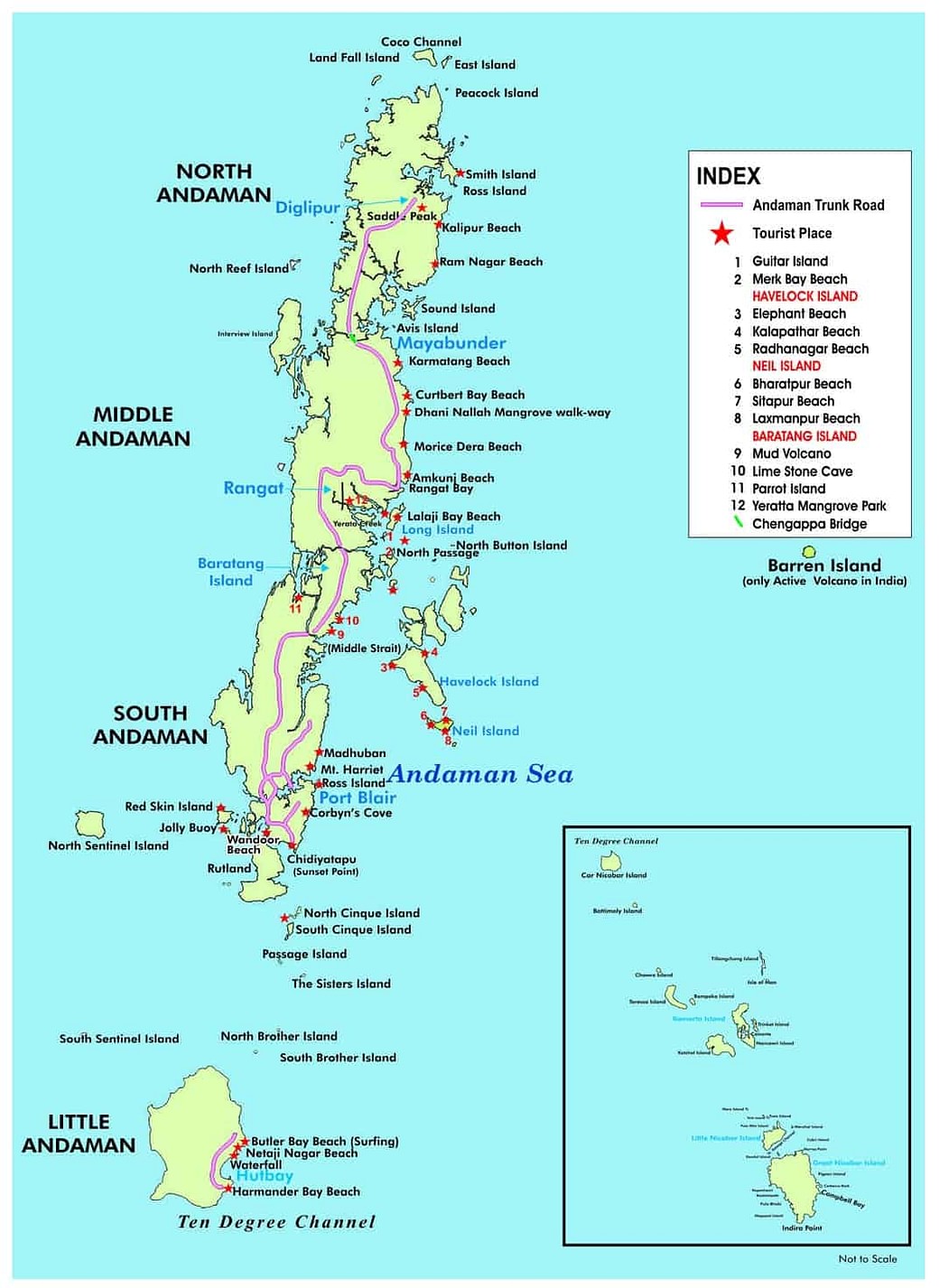
Most of the paved roads are in South Andaman. Port Blair and Diglipur are important harbours of South Andaman and North Andaman, respectively. An interisland boat service connects Port Blair with North, Middle, South, and Little Andaman islands. Air service is available to the northern and southern Indian mainland from Port Blair.
The administrative structure of the Andaman and Nicobar Islands, like most other Indian states and territories,
is defined by the national constitution of 1950. The territory is administered by the central government through
a lieutenant governor, who is appointed by the president of India. The lieutenant governor is assisted by a
Council of Ministers. The territory also has its own legislature with elected members.
The state is divided into nearly three dozen administrative districts. The revenue and general
administration of each district is overseen by the district collector, who also functions as the district
magistrate for the maintenance of law and order. With a view toward involving the people in local
government, elected governing councils (panchayats) were introduced at the village level in 1963.
Basic health care is offered free of charge to residents of the Andaman and Nicobar Islands. Services are
provided by hospitals in the more densely populated areas and by community health-care centres and primary
health-care facilities in the more rural regions. There also is an extensive network of health-care subcentres
spread across the islands. Malaria has been a perennial problem in the territory, and the government has
participated in nationally sponsored mosquito-control and malaria-prevention initiatives to combat the disease.
Similarly, the Andaman and Nicobar Islands territory joined the national government’s leprosy-eradication
program, with the result that the incidence of that illness has dropped dramatically in the territory since the
1990s.
The number of educational institutions is limited, and most schools offer only primary education. Nevertheless, more than four-fifths of the territory’s population is literate, which is well above the Indian national average. There are several postsecondary institutions offering industrial, technical, and teachers’ training. The first nursing school opened in 2001.