Average temperatures in Assam range from highs in the upper 90s F (about 36 °C) in August to lows in the mid-40s F (about 7 °C) in January. The cool season generally lasts from October to February and is marked by fogs and brief showers. The state escapes the normal Indian hot, dry season. Although some rain occurs from March through May, the heaviest precipitation comes with the southwest monsoon, which arrives in June, stays through September, and often causes widespread and destructive flooding. Annual rainfall in Assam is not only the highest in the country but also ranks among the highest in the world; its annual average varies from about 70 inches (1,800 mm) in the west to more than 120 inches (3,000 mm) in the east.
Forests, formerly extending over nearly two-fifths of the state’s area, were reduced by the creation of
Meghalaya and Mizoram in the early 1970s. In the early 21st century about one-third of Assam was covered with
various types of woodlands, including tropical evergreen and deciduous forests, broad-leaved hill forests, pine
forests, and swamp forests, as well as grasslands. Assam is home to some 75 species of trees, many of which have
commercial value. Sal (Shorea robusta) and hollong (Dipterocarpus rhetusus) trees are among the most bountiful
of the hardwoods. Bamboo, orchids, and ferns also are abundant.
Assam has numerous wildlife sanctuaries, the most prominent of which are two UNESCO World Heritage sites—the
Kaziranga National Park (designated in 1985), on the bank of the Brahmaputra River, and the Manas Wildlife
Sanctuary (designated in 1992), near the border with Bhutan. Both are refuges for the fast-disappearing Indian
one-horned rhinoceros, and the sanctuary at Manas is known especially for its tigers and leopards. Among the
other notable inhabitants of Assam’s forests are elephants, gaurs (wild oxen), wild pigs, various species of
deer, and primates, such as langurs and hoolock gibbons. Common birds include cormorants, herons, ducks, and
other water birds, as well as warblers, thrushes, owls, and peacocks. Hornbills are characteristic of Assam,
although they are endangered in some areas. The state also has dozens of species of reptiles, including
poisonous snakes, such as kraits, cobras, and vipers; an array of lizards, skinks, and geckos; and many types of
turtles.
The people of the plains of the Brahmaputra and Barak valleys are mainly of Indo-Iranian ancestry. By the time
of their arrival in the region, however, the local Aryan peoples had become intermixed with Asiatic peoples. The
Ahom people, who arrived in the region from mainland Southeast Asia during the 13th century, ultimately stem
from Yunnan province of southern China. A significant minority of the population consists of rural indigenous
peoples who fall outside the Indian caste system; as such, they are officially designated as Scheduled Tribes.
The Bodo constitute the largest of these groups. Most of the Scheduled Tribes live in the south-central hill
region and are of Asiatic descent.
Assamese, an Indo-Aryan language, is the official and principal language of the state, and an unbroken record of
Assamese literary history is traceable from the 14th century. Tibeto-Burman languages are spoken by most of the
Scheduled Tribes, although the Khasi people speak an Austroasiatic tongue; some groups have adopted Assamese as
their first language. The people in the Barak valley in southern Assam mostly speak Bengali (also called
Bangla), which, like Assamese, is an Indo-Aryan language.
About three-fifths of the Assamese are Hindus, the majority of whom follow Vaishnavism, which venerates the
deity Vishnu. Roughly one-third of the population practices Islam, most Muslims being settlers from Bangladesh
or converts from the lower strata of Hindu society. Although many of the Scheduled Tribes have converted to
Christianity, some continue to practice traditional local religions; the Mikir and Kachari peoples are mostly
Hindus.
The great majority of Assam’s people live in rural areas. The distribution of population is uneven, however,
reflecting the hilly terrain, the number of rivers, the forests, the small amount of cultivable land, and the
lack of industrialization. The agricultural zone of the Barak River valley supports relatively dense settlement.
Since the late 20th century, population growth has been unusually rapid, mostly due to immigration into Assam of
tea garden labourers, herders from Nepal, Muslims from West Bengal, and refugees from Bangladesh. Increasing
population in the state’s urban areas reflects not only the growth of industries and the expansion of commercial
activity but also the tendency of many of the immigrants—particularly those from Bangladesh—to live near towns.
In the early 21st century Guwahati had the most significant urban population.
Agriculture is of basic importance to Assam, engaging about half of the total working population and generating
roughly one-third of the state’s gross product. Rice accounts for more than two-thirds of the sown area. Tea and
jute, widely cultivated in the Brahmaputra valley, are important foreign-exchange earners. Assam grows a large
portion of the country’s tea. Other crops include oilseeds, pulses (legumes, such as peas, beans, or lentils),
corn (maize), sugarcane, rape (an oil-yielding plant, the leaves of which are used for fodder), mustard,
potatoes, and fruits. Through improved cultivation methods, some farms yield more than one crop per year.
Livestock and dairy farming have shown moderate growth since the late 20th century, largely promoted by the
government. Nevertheless, those activities remain but small contributors to the state’s economy. Sericulture
(raising of silk worms), on the other hand, is well established, and Assam is a major producer of silk.
In the forestry sector, sal and other tropical hardwoods are highly valued. Depletion of forest resources and
increased erosion, however, have led the government to impose logging bans and enact other legislation to
reestablish the country’s woodlands. Aside from timber, important forest products include bamboo, firewood, and
lac (the source of shellac).
Aquaculture has been a major focus of agricultural development since the mid-1990s, and yields have increased.
Overall yield, however, has continued to fall short of domestic demand.
Minerals exploited commercially in the state include petroleum, coal, natural gas, and limestone. Since the late
19th century, extensive oil reserves have been discovered in northeastern Assam. A refinery, built in the region
in 1901 at Digboi, was the first in South Asia. Later, another refinery was established in Guwahati in the
west-central part of the state. Coal—used locally by the railways, tea estates, and steamships—also is found in
northeastern and south-central Assam. Liquefied natural gas is produced in the northeast, and limestone is
quarried in the Mikir Hills.
Assam’s energy is provided by thermal and hydroelectric plants. Less than half of the state’s energy is
generated locally, however. A significant portion of Assam’s power is purchased from the national government,
private sources, and, to a much lesser extent, other state governments.
Historically, geography has inhibited the growth of efficient transport systems, and underdeveloped transport
and communication systems have in turn hindered economic development in Assam. The Brahmaputra, for example,
long has been a major barrier to integrating the transportation networks lying north and south of the river. The
situation improved, however, with the opening of several rail and road bridges since the late 20th century.
With Assam’s abundance of waterways, inland water transport is important. The Brahmaputra and Barak (Surma)
rivers are the state’s primary water channels. Numerous passenger ferries operate between various points on the
Brahmaputra, and freight service is offered between Guwahati and Kolkata, West Bengal.
There is considerable air traffic between Assam and Kolkata. Among the towns with air service are Guwahati,
Dibrugarh, Jorhat, Tezpur, and Silchar. The Guwahati airport offers international service.
Like most other Indian states, Assam has a governmental structure that is defined by the national constitution
of 1950. The governor, who is the head of state, is appointed by the president of India and is assisted by a
popularly elected unicameral legislature and a Council of Ministers led by a chief minister, who is head of
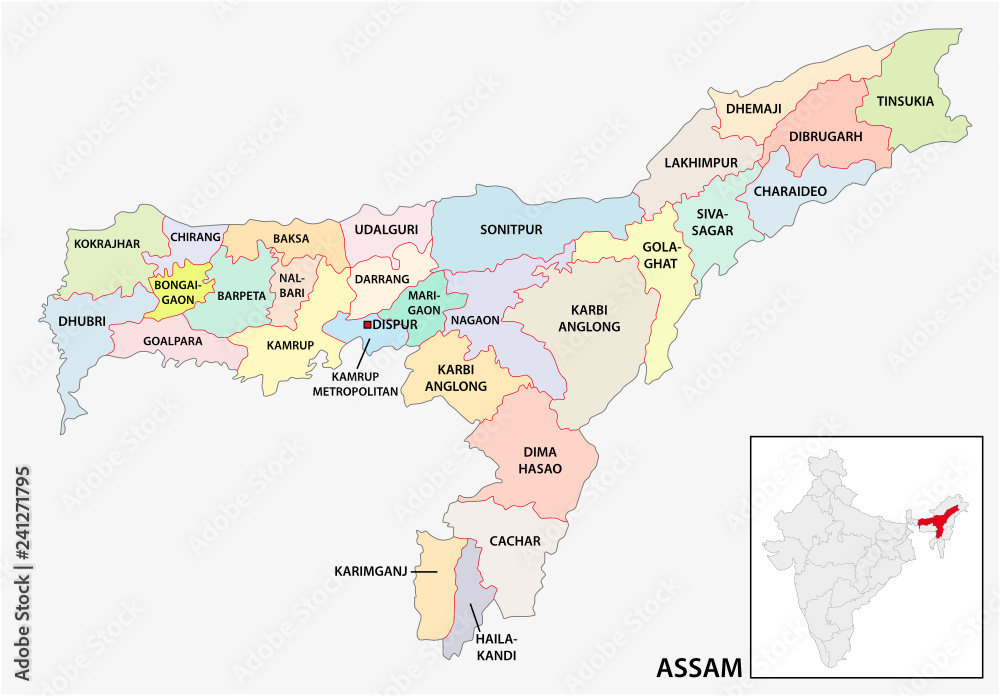
government. The state of Assam comprises nearly three dozen districts, each of which is administered by a deputy
commissioner. Districts are subdivided at several levels, with the village as the smallest administrative unit.
The high court at Guwahati has jurisdiction not only over the state of Assam but also over the states of
Nagaland, Mizoram, and Arunachal Pradesh through outlying benches. The chief justice and all other high court
justices are appointed by India’s president. Permanent judges serve until they are a maximum of 62 years old.
Short-term judges are appointed to help with periodic backlogs. Lower courts include district courts, sessions
courts, and magistrate’s courts.
Education, which is free up to the secondary level, is compulsory for children between the ages of 6 and 14.
Government universities and colleges are located in the state’s larger cities, including Guwahati, Jorhat,
Dibrugarh, Tezpur, and Silchar. Assam also has specialized colleges in the arts, sciences, commerce, law, and
medicine. Welfare-extension projects, operating through dozens of centres, provide recreational and cultural
facilities for women and children.
The cultural life of Assam is interwoven with the activities of a number of cultural institutions and religious
centres, such as the satra (seat of a religious head known as the satradhikar) and namghar (prayer hall). Satras
in Assam have been looking after the religious and social well-being of the Hindu population since the 15th
century.
The Assamese people observe all the pan-Indian religious festivals, but their most important celebrations are
the three Bihu festivals. Originally agricultural festivals, they are observed with great enthusiasm
irrespective of caste, creed, and religious affinity. The Bohag Bihu, celebrated in the spring (usually
mid-April), marks the commencement of the new year (first day of the Bohag or Baishakh month). Also known as
Rangoli Bihu (from rang, meaning merrymaking and fun), it is accompanied by much dancing and singing. The Magh
Bihu, celebrated in mid-January (in the month of Magh), is a harvest festival. Known also as Bhogali Bihu (from
bhog, meaning enjoyment and feasting), it is a time of community feasts and bonfires. The third Bihu festival,
the Kati Bihu (in mid-October or November), is also called the Kangali Bihu (from kangali, meaning poor),
because by this time of year the house of an ordinary family is without food grains, as the stock is usually
consumed before the next harvest.
Weaving is another important aspect of the cultural life of the people of Assam, particularly the women. Nearly
every Assamese household, irrespective of caste, creed, and social status, has at least one loom, and most women
are expected to be skilled in producing fine silk and cotton cloths.
Assamese cuisine is based on rice, a variety of vegetables and fruits, and fish. Distinctive are its bitter
(khar) and sour (tenga) dishes, which are often served at the beginning and end of meals, respectively. A
popular tenga dish is a stew made with pieces of fried fish that are then simmered with fenugreek seeds,
vegetables, and lemon or lime juice. Khar recipes often achieve their slightly astringent taste by using a
sodalike substance made from the ashes of the banana plant.