The climate in Chhattisgarh is governed by a monsoon weather pattern. The distinct seasons are summer (March to May), winter (November to February), and the intervening rainy months of the southwest monsoon (June to September). The summer is hot, dry, and windy, with high temperatures typically reaching at least 85 °F (about 30 °C) in all parts of the state; in some areas temperatures regularly rise above 100 °F (upper 30s C). Winters are usually pleasant and dry, with high temperatures in the upper 70s F (mid-20s C). In December and January there is considerable rainfall over the northern part of the state, although the state as a whole receives most of its precipitation during the southwest monsoon. Rainfall usually ranges from 47 to 60 inches (1,200 to 1,500 mm) annually.
The eastern and southeastern borderlands of Chhattisgarh are characterized by moist deciduous plantlife, but
toward the interior of the state this flora is replaced by dry deciduous vegetation, often degenerating locally
into scrub. The most valuable hardwoods are teak and sal (Shorea robusta). A type of tree called salai yields a
resin used for incense and medicine, while leaves from tendu trees are used for rolling bidi (Indian
cigarettes). Bamboo is abundant and is harvested for many purposes.
The forests are home to a broad array of animals, including tigers, striped hyenas, and blackbucks. Other
species include the chital (spotted deer), gaur (a type of wild buffalo), sambar deer, sloth bear, wild boar,
and four-horned antelope, among others. The woodlands are also inhabited by many species of birds. Chhattisgarh
has a number of national parks and many wildlife sanctuaries. The Indravati National Park contains a wildlife
sanctuary for tigers.
Chhattisgarh supports a population of diverse ethnic, social, religious, and linguistic backgrounds. More than
one-third of the state’s residents officially belong to the Scheduled Castes (groups formerly called
“untouchables” within the Indian caste system) or to the Scheduled Tribes (indigenous minority peoples who are
not embraced by the caste hierarchy). Of the Scheduled Tribes, the Gond peoples are most prominent.
The vast majority of Chhattisgarh’s people practice Hinduism, but there are sizable minorities of Muslims,
Jains, Christians, and Buddhists. There also is a small community of Sikhs. Chhattisgarhi is the most widely
spoken language, followed by Hindi; both are official languages of the state. Many of the Gond speak Gondi.
Marathi, Urdu, Oriya, Gujarati, and Punjabi are spoken by significant numbers.
Some three-fourths of Chhattisgarh’s population is rural. The distribution of this population is uneven,
however, with the far southern portion of the state having significantly fewer residents than its northern
counterpart. The urban population of Chhattisgarh is concentrated mainly in the vicinity of Raipur and Bilaspur
in the state’s midsection and near Raigarh in the east. However, massive public-sector investment in mining has
helped to spur growth around Durg and Bhilai Nagar to the west of Raipur, Korba in the north-central region, and
Ambikapur in the northern part of the state. Raipur, Durg–Bhilai Nagar, and Bilaspur have become major urban
agglomerations, each with a relatively well-developed industrial base.
In the late 20th century the rate of population increase in Chhattisgarh was somewhat below the national
average, but in the early 21st century the rate of increase had risen above the national average. Men have
continued to outnumber women but only slightly. Because Chhattisgarh is predominantly agricultural, the state
experiences seasonal fluctuations in population. When farming activities come to a virtual halt between January
and June, there is mass migration of agricultural workers to Haryana, Punjab, Rajasthan, Delhi, Himachal
Pradesh, and anywhere else where there are opportunities for daily wage labour.
The economy of Chhattisgarh is founded primarily on mining, agriculture, energy production, and manufacturing. The state has major deposits of coal, iron ore, dolomite, and other minerals. The central lowland is known especially for its abundant rice production, and the state as a whole provides the bulk of the country’s tendu leaves for bidis. Chhattisgarh also is a significant regional supplier of electricity, from both thermal and hydroelectric generators. The state’s manufacturing activities focus largely on metals production.
About half of Chhattisgarh’s land is farmland, while most of the remainder is either under forest cover or is
otherwise unsuitable for cultivation. Roughly three-fourths of the farmland is under cultivation. Often called
the country’s rice bowl, the central lowland plain supplies grain to hundreds of rice mills. Maize and millet
dominate the highlands. Cotton and oilseeds are the important commercial crops of the region. Agriculture
continues to be characterized in many areas by the use of manual methods of cultivation; farmers in the basin
have been particularly slow to adopt mechanized agricultural techniques.
Livestock and poultry farming also are prominent. The state’s livestock includes cows, buffalo, goats, sheep,
and pigs. There are several centres for improving the quality of these animals, such as those for the artificial
insemination and crossbreeding of goats in Bilaspur and Dhar.
Chhattisgarh is mineral-rich. Although many of the state’s resources remain to be exploited fully, its major
reserves of coal, iron ore, limestone, bauxite, and dolomite, as well as its significant deposits of tin,
manganese ore, gold, and copper, make the mining industry a major source of income. In fact, Chhattisgarh is one
of the country’s largest suppliers of dolomite. Its iron ore, which is of top quality, is found primarily in the
south-central and southern parts of the state. Deposits of diamonds have been discovered near Raipur.
Chhattisgarh produces more power than it consumes. The bulk of the state’s power comes from thermal power
plants, several of which are near Korba. However, the state also is well endowed with potential sources of
hydroelectric energy. Main hydroelectric projects (jointly developed with other states) are the Ban Sagar dam,
with Bihar and Uttar Pradesh, and the Harked dam over the Mahanadi River. The Hasdeo Bango hydroelectric power
project is near Korba.
Chhattisgarh is well connected to the rest of the country by road, rail, and air. The state is traversed by several national and state highways, as well as by some of the major rail routes. Most of Chhattisgarh’s larger cities are the sites of important railway junctions. Airports at Raipur and Bilaspur serve commercial flights, and the development of airports at Raigarh, Jagdalpur, and Ambikapur began in the 2010s.
The structure of Chhattisgarh’s government, like that of most other Indian states, is defined by the national
constitution of 1950. The head of state—the governor—is appointed by the president of India. The governor is
aided and advised by a chief minister, who heads the Council of Ministers, which is responsible to the elected
Legislative Assembly (Vidhan Sabha). Although the political capital of Chhattisgarh is Raipur, the High Court is
located in Bilaspur. A chief justice presides over the High Court.
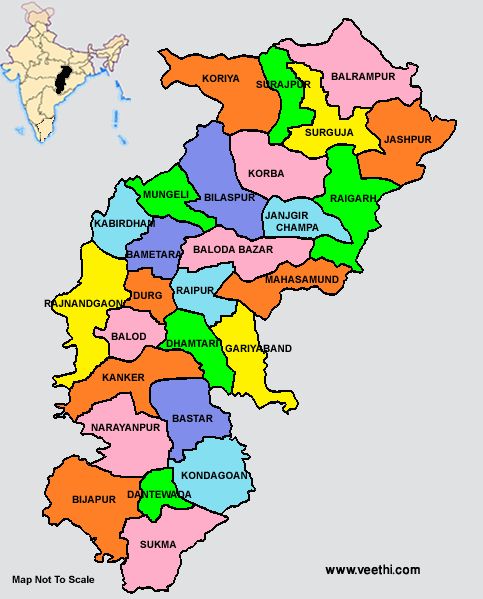
Local government includes several divisions, which are subdivided further into districts. Each division is
administered by a commissioner, while each is headed by a collector. Collectors exercise both executive and
magisterial power
A large area of Chhattisgarh is under the control of the Naxalites (Maoist guerrillas). Indeed, in several
pockets of Bastar division in the south, state law has at times failed to function. The conflict ultimately has
hampered the development of this fertile area.