Winter (November through February) temperatures in Gujarat usually reach a high in the mid-80s F (about 28
°C), while lows drop into the mid-50s F (about 12 °C). Summers (March through May) are quite hot, however,
with temperatures typically rising well above 100 °F (38 °C) during the day and dropping only into the 90s F
(low 30s C) at night.
Gujarat is drier in the north than in the south. Rainfall is lowest in the northwestern part of the state—in
the Rann of Kachchh—where it may amount to less than 15 inches (380 mm) annually. In the central portion of
the Kathiawar Peninsula as well as in the northeastern region, annual rainfall typically amounts to about 40
inches (1,000 mm). Southeastern Gujarat, where the southwest monsoon brings heavy rains between June and
September, is the wettest area; annual rainfall usually approaches 80 inches (2,000 mm) along the coastal
plain.
Forests cover only a small portion of Gujarat, reflecting human activity as well as meagre rainfall. Scrub
forest occurs in the northwestern region and across the Kathiawar Peninsula, the main species being babul
acacias, capers, Indian jujubes, and toothbrush bushes (Salvadora persica). In some parts of the peninsula
and northeastern Gujarat, deciduous species such as teak, catechu (cutch), axlewood, and Bengal kino (butea
gum) are found. Deciduous forests are concentrated in the wetter southern and eastern hills. They produce
valuable timbers, such as Vengai padauk (genus Pterocarpus; resembling mahogany), Malabar simal, and haldu
(Adina cordifolia). The west coast of the peninsula is known for its algae, and the east coast produces
papyrus, or paper plant (Cyperus papyrus).
Gir National Park, in the southwestern region of the Kathiawar Peninsula, contains rare Asiatic lions
(Panthera leo persica), and endangered Indian wild asses (Equus hemionus khur) are protected in a sanctuary
near the Little Rann of Kachchh. The Nal Sarovar Bird Sanctuary, near Ahmadabad, attracts many species of
birds migrating from the Siberian plains and elsewhere in winter. Saras cranes, Brahmini ducks, bustards,
pelicans, cormorants, ibises, storks, herons, and egrets are among the most-notable species. The Rann of
Kachchh is India’s only nesting ground of the greater flamingo. There is excellent offshore and inland
fishing in Gujarat. Catches include pomfret, salmon, hilsa (a type of shad), jewfish (scianid fish), prawn,
Bombay duck (a food fish), and tuna.
The diverse peoples constituting the Gujarati population may be categorized broadly as either Indic
(northern-derived) or Dravidian (southern-derived). The former include the Nagar Brahman, Bhatia, Bhadela,
Rabari, and Mina castes. The Parsis, originally from Persia (Iran), represent a much later northern influx.
Among the peoples of southern origin are the Bhangi, Koli, Dubla, Naikda, and Macchi-Kharwa. The rest of the
population, including the aboriginal Bhil community, is of mixed heritage. Members of the Scheduled Castes
(formerly “untouchables”) and Scheduled Tribes (indigenous minority peoples)—both official designations for
those who are outside of India’s caste hierarchy—together form roughly one-fifth of the state’s population.
Portions of the mountainous region of southeastern Gujarat are populated almost entirely by tribal peoples.
Nearly three-fifths of the residents of Gujarat are rural, although the rural proportion of the population
has declined as urban areas have grown. The main concentration of population is in the eastern part of the
state, in the plains surrounding the cities of Ahmadabad, Kheda, Vadodara, Surat, and Valsad; the region is
both agriculturally productive and highly industrialized. Other concentrations of population occur on the
Kathiawar Peninsula, particularly on the southern coast between the cities of Mangrol and Mahuva, in the
interior around Rajkot, and on the Gulf of Kachchh around Jamnagar. The distribution of population gradually
decreases toward the Kachchh district in the northwest and toward the hilly regions of eastern Gujarat.
Most of the major cities are found in the more fertile regions, and many of them—such as Rajkot, Junagadh,
Porbandar, Bhavnagar (Bhaunagar), and Jamnagar, all on the peninsula—were once the capitals of small states.
The most-urbanized area of Gujarat is the Ahmadabad-Vadodara (Baroda) industrial belt in the east-central
region. Since the late 20th century that area has become just one segment of an ever-expanding urban
agglomeration along the highway that links the northern and southern parts of the state.
Unfavourable climatic conditions, salinity of soil and water, and rocky terrain have hampered Gujarat’s agricultural activities, but the sector has remained a major component of the state’s economy, employing about half the workforce. Wheat, millet, rice, and sorghum are the primary food crops, with rice production being concentrated in the wetter areas. Principal cash crops include cotton, oilseeds (especially peanuts [groundnuts]), tobacco, and sugarcane. Commercial dairying is also important.
Gujarat is rich in minerals, including limestone, manganese, gypsum, calcite, and bauxite. The state also
has deposits of lignite, quartz sand, agate, and feldspar. The fine building stones of Porbandar, on the
Kathiawar Peninsula, are among Gujarat’s most valuable products, and the state’s output of soda ash and salt
amounts to a significant portion of the national yield. In addition, Gujarat produces petroleum and natural
gas.
The state draws its electricity from a variety of sources. The bulk of Gujarat’s power is supplied by coal-
and gas-fueled thermal plants, followed by hydroelectric generators. There also are a number of wind farms
scattered across the state.
Gujarat’s towns and cities are well connected—to each other and to the rest of India—by road and rail. Coastal shipping routes link the state’s many ports. Kandla is a major international shipping terminal. There is air service both within the state and to major Indian cities outside Gujarat.
The governmental structure of Gujarat, like that of most Indian states, is defined by the national
constitution of 1950. The governor is the chief executive and is appointed by the president of India. The
Council of Ministers, led by the chief minister (head of government), aids and advises the governor.
Gujarat’s Legislative Assembly (Vidhan Sabha) is an elected unicameral body. The High Court is the highest
judicial authority in the state. Various lower courts—including the city courts, the courts of district and
sessions judges, and the courts of civil judges—operate within each administrative district.
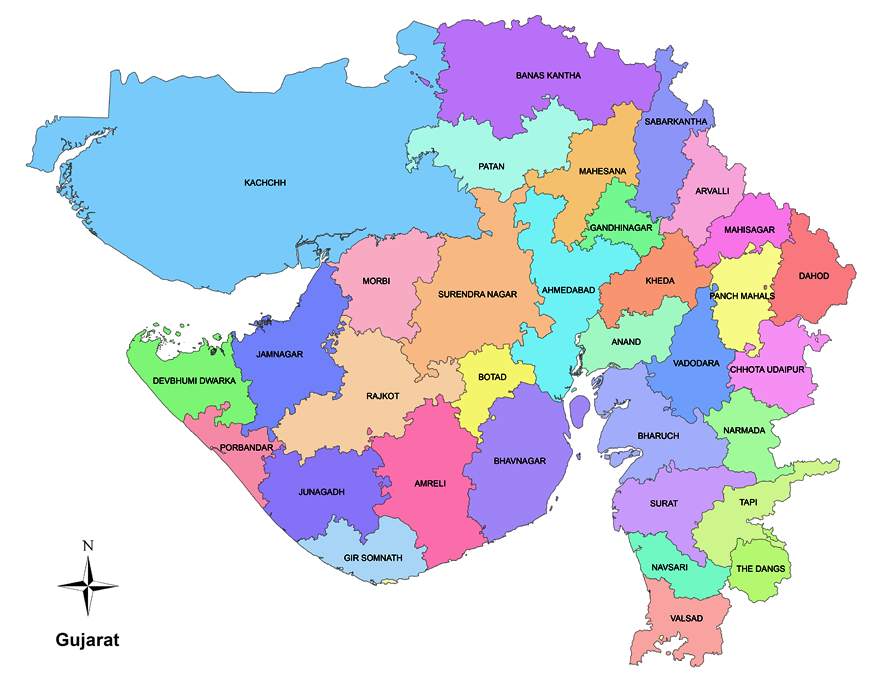
The state is divided into nearly three dozen administrative districts. The revenue and general
administration of each district is overseen by the district collector, who also functions as the district
magistrate for the maintenance of law and order. With a view toward involving the people in local
government, elected governing councils (panchayats) were introduced at the village level in 1963.
Health and medical services in Gujarat include programs to control malaria, tuberculosis, HIV/AIDS, and
other communicable diseases; to prevent blindness; and to eradicate leprosy and polio. Other services focus
on reproductive and family health and on health education. Primary health centres offer medical services
throughout the state. Public and private hospitals as well as medical colleges offer more-specialized
services, primarily in the larger urban areas. Various state institutions address the welfare needs of
children, women, people with disabilities, and senior citizens. Special programs also are available to
assist those who belong to communities that, by tradition, have been socially, economically, and
educationally disadvantaged.
Primary schooling for all children between the ages of 7 and 11 is available in most villages with 500 or more inhabitants. Special schools serve children in the rural tribal regions. Secondary schools are spread throughout the state in larger villages, towns, and urban areas.Gujarat has a number of important institutions of higher education. Among the state’s most-notable universities are Maharaja Sayajirao University of Baroda (founded 1949) in Vadodara and Gujarat University (1949) in Ahmadabad. Major research institutions include the Physical Research Laboratory (1947; a unit of the national Department of Space) in Ahmadabad, the Ahmadabad Textile Industry’s Research Association (1949), the Central Salt and Marine Chemicals Research Institute (1959) at Bhavnagar, and the National Institute of Design (1961) and the Sardar Patel Institute of Economic and Social Research (1965), both in Ahmadabad. In addition to its universities and research centres, Gujarat has numerous smaller tertiary institutions (e.g., engineering colleges and technical schools) with specialized curriculum.
Much of the culture of Gujarat reflects the mythology surrounding the Hindu deity Krishna (an incarnation of
the god Vishnu), as transmitted in the Puranas, a class of Hindu sacred literature. The older rasnritya and
raslila dance traditions honouring Krishna find their contemporary manifestation in the popular dance called
garba. The dance is performed primarily at the Navratri festival (September–October), which honours the
divine feminine; dancers move in a circle, singing and keeping time by clapping their hands. Also commonly
performed at Navratri is bhavai, a type of popular, rural, comic drama that depicts various aspects of rural
life. All of the roles in bhavai—both male and female—are played by men.
Shaivism (Shivaism), the cult of the Hindu god Shiva, has long flourished in Gujarat; so too has Vaishnavism
(the worship of Vishnu), from which have emerged not only the cult of bhakti (devotion) but also a rich
repertoire of verse and song. Notable Vaishnava saints, poets, and musicians include Narsinh (or Narasimha)
Mehta, who composed padas (verses) in the 15th century; Mira Bai, a 16th-century Rajput princess who
renounced her royal home and composed bhajans (devotional songs); Premanand, an 18th-century poet and
writer; and Dayaram, an 18th-century composer of songs who popularized the bhakti cult.
In the Jain tradition, writings of the prolific 12th-century author Hemacandra continue to be held in high
regard. Hemacandra produced numerous textbooks on various aspects of Indian philosophy, as well as
grammatical analyses of Sanskrit and Prakrit. He also wrote an epic history of the world from a Jain
perspective as well as a number of poems.
Mahatma Gandhi is also recognized as one of the state’s most prodigious authors. Noted for their vigour and
simplicity, Ghandi’s writings in Gujarati have exerted a strong influence on modern Gujarati prose.
The ancient architectural style of Gujarat, known for its luxuriousness and intricacy, is preserved in
monuments and temples such as those in Somnath and Dwarka in the southwestern part of the state; Modhera in
the north; and Than, Ghumli (near Porbandar), the Girnar Hills, and Palitana in the Kathiawar Peninsula.
Under Muslim rule, a distinctive architectural style that blended Muslim and Hindu elements developed. That
style is exemplified by the 15th- and 16th-century mosques and tombs of Ahmadabad.
Also distinctive are the region’s many stepwells—ancient subterranean edifices and water sources. Gujarat
has an especially large number of the stepwells that have survived. Included among them is the
well-preserved Rani ki Vav (“Queen’s Stepwell”) in Patan, which was designated a UNESCO World Heritage site
in 2014.
In addition to its architecture, Gujarat is widely recognized for its highly skilled craftwork. Notable
products include the jari (gold and silver embroidery) of Surat, the bandhani-work (using a tie-dyeing
technique) fabrics of Jamnagar, and the patola silk saris (garments worn by Indian women) of Patan, in
northern Gujarat. Also from the northern region, the toys of Idar, the perfumes of Palanpur, and the
hand-loomed products of Kanodar are well known. Ahmadabad and Surat are renowned for their decorative
woodwork depicting miniature temples and mythological figures.
Among the most durable and effective of the state’s cultural institutions are the trade and craft guilds
known as the mahajans. Often coterminous with castes—and largely autonomous—the guilds have in the past
solved disputes, acted as channels of philanthropy, and encouraged arts and other cultural activities.