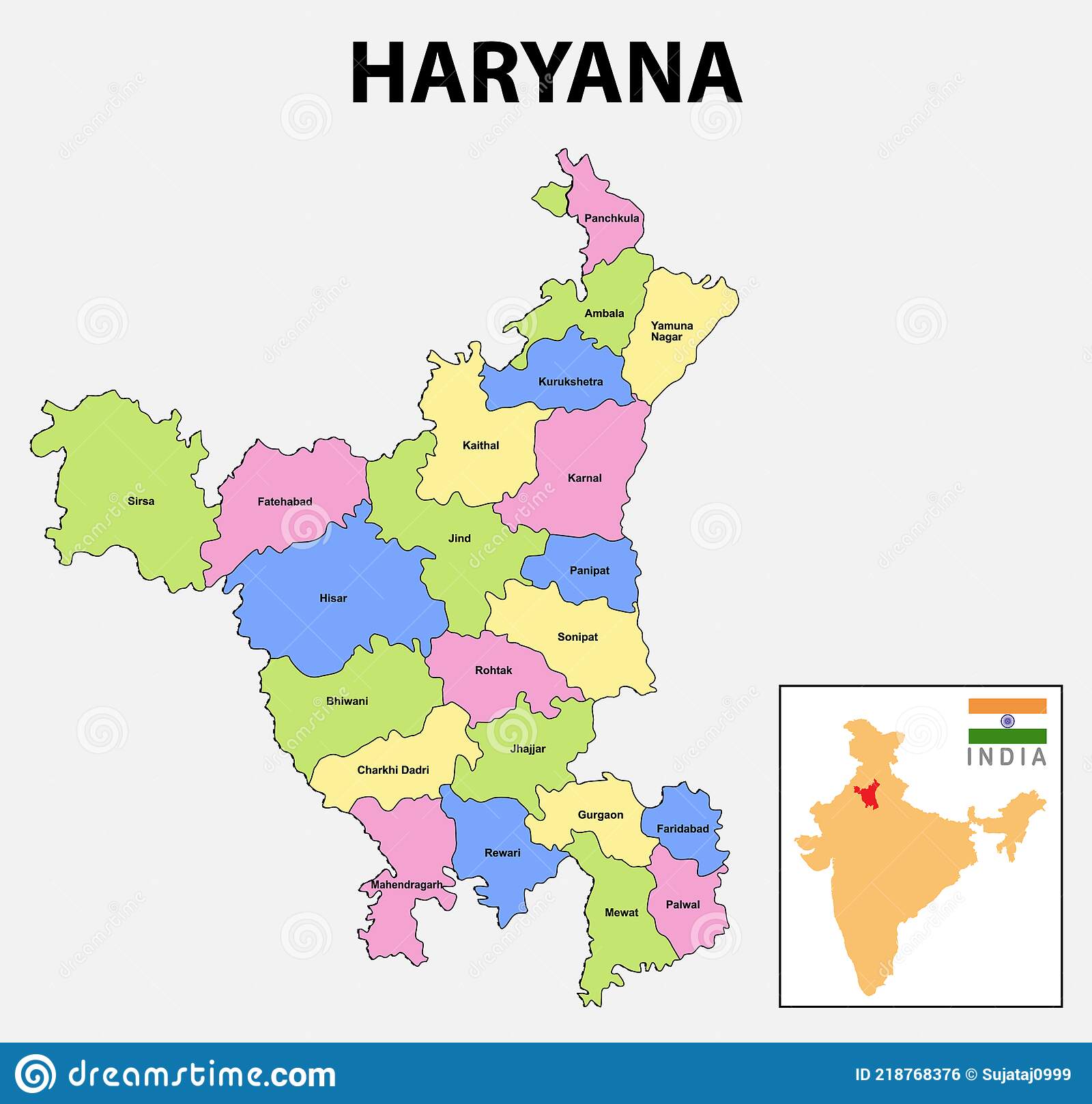
The climate of Haryana is hot in the summer and markedly cold in winter; maximum temperatures in May and June
may exceed 110 °F (43 °C), and in January, the coldest month, low temperatures may drop below the freezing
point.
Most of the state experiences arid to semiarid conditions; only in the northeast are conditions relatively
humid. Precipitation averages about 18 inches (450 mm) annually, most falling between July and September.
Although the state has a system of canal irrigation and tube wells, there are chronic drought-prone areas,
particularly in the southern and southwestern regions. By contrast, the areas surrounding tributaries of the
Yamuna and the Ghaggar are subject to occasional floods.
Little natural vegetation remains in Haryana. Eucalyptus trees are planted along the highways and in wastelands.
Shisham (Dalbergia sissoo) trees grow along the roads and canals in the northern half of the state, while small,
spiny kikar (Acacia arabica) trees and scrub are found in southern and southwestern Haryana.
Haryana is home to a variety of mammals. Larger species, including leopards, jackals, wild boars, and several
types of deer, among others, are generally limited to the hilly regions of the northeast and the far south.
Small mammals, such as bats, squirrels, mice, rats, and gerbils, are common in the plains. Ducks and teals of
various sorts are found near the rivers. Pigeons and doves are common in the agricultural areas, as are small,
colourful birds such as parakeets, buntings, sunbirds, bulbuls, and kingfishers. Several species of snakes are
found in the state; among these are pythons, boas, and rat snakes, as well as poisonous kraits and vipers. Other
reptiles, including various lizards, frogs, and tortoises, also inhabit Haryana.
Hindus constitute the great majority of Haryana’s population. Sikhs and Muslims each form a small but
significant minority; there is also a tiny community of Christians. Most of the state’s Sikh population is
located in the northeast and northwest, while Muslims are concentrated in the southeastern districts adjoining
Delhi. Jats (members of the peasant caste) form the backbone of Haryana’s agricultural economy. They also are
prominent in India’s armed forces.
Roughly three-fourths of Haryana’s population remained rural in the early 21st century; however, cities have
continued to grow rapidly as commercial, industrial, and agricultural marketing centres. The state’s largest
cities include Faridabad, Rohtak, Panipat, Hisar, Sonipat, and Karnal. With the exceptions of Rohtak, which is
in central Haryana, and Hisar, which is in the northwest, most of the major urban centres lie in the eastern
part of the state.
An agriculturally prosperous state, Haryana contributes a large amount of wheat and rice to the Central Pool (a
national repository system of surplus food grain). In addition, the state produces significant quantities of
cotton, rape and mustard seed, pearl millet, chickpeas, sugarcane, sorghum, corn (maize), and potatoes. Dairy
cattle, buffaloes, and bullocks, which are used for plowing the land and as draft animals, are prominent in the
northeastern region.
Haryana’s agricultural productivity is largely attributable to the so-called Green Revolution, an international
movement launched in the 1960s to diminish world hunger. As a result of this movement, large-scale investments
have been made in irrigation, fertilizers, and high-quality seeds. In the early 21st century, nearly two-fifths
of the state’s workforce was employed in agriculture.
Haryana has long been well connected to surrounding states and to the rest of India. A number of major highways and railway lines—including the historic Grand Trunk Road and the main line of the Northern Railway—pass through the state to converge on Delhi. State-owned bus service operates between most of Haryana’s larger towns and cities. The state is served by a domestic airport in Chandigarh.
The governmental structure of Haryana, like that of most Indian states, is defined by the national constitution
of 1950. The governor, appointed by the president of India, is the head of the state. The Council of Ministers,
which is led by a chief minister and is accountable to the state’s Legislative Assembly (Vidhan Sabha), assists
and advises the governor. Haryana’s legislature is a unicameral body; members are normally elected to a
five-year term. The state has a common High Court with Punjab.
Haryana comprises six divisions, each of which consists of a number of districts. Divisional commissioners
oversee the divisions, while each district is headed by a deputy commissioner. The council (panchayat) system of
self-government operates at the village level.
A network of district and subdivisional hospitals and primary health centres provides health and medical
services throughout Haryana. Since the early 1990s all villages in the state have had access to safe drinking
water. The state government provides loans and grants to members of traditionally disadvantaged communities for
agricultural, industrial, and business activities.
Education has been given a high priority in the state’s development program, and both the government and private
organizations have made a significant contribution to the promotion of education at all levels. However, while
thousands of primary and secondary schools have ensured that basic education is available throughout the state,
much of the population—especially rural women—remained unable to read in the early 21st century. In an effort to
reverse this tendency, the state has continued to provide assistance to students from socially and economically
disadvantaged backgrounds to pursue education of all sorts.
Several universities and hundreds of smaller colleges offer postsecondary education in or near Haryana’s larger
towns and cities. Among the state’s most prominent tertiary institutions are the National Dairy Research
Institute (1923) at Karnal and Kurukshetra University (1956) and the National Institute of Technology (1963),
both at Kurukshetra, in the northeastern region; Maharshi Dayanand University (1976) at Rohtak, in central
Haryana; and Chaudhary Charan Singh Haryana Agricultural University (1970; including a renowned college of
veterinary sciences) and Guru Jambheshwar University of Science and Technology (1995), both at Hisar, in the
northwest. Of the smaller colleges, most provide general education, and many are exclusively for women.
Haryana’s cultural life reflects both the seasonal rhythm of its agricultural economy and a treasure of
traditions and legends with roots in ancient India. The boisterous spring festival of Holi is celebrated by
people showering coloured powder (or coloured powder mixed with water) on each other, irrespective of age or
social status. Janmasthami, the birthday of Krishna (an incarnation of the god Vishnu), is of special religious
importance in Haryana because it was on a battlefield at Kurukshetra that Krishna is said to have delivered to
the warrior Arjuna the teachings contained in the Bhagavadgita (a part of the epic known as the Mahabharata).
Festivals in honour of other deities and saints are also an important element of the state’s cultural life, as
are cattle fairs, which are held at a number of locations.
Many prominent pilgrimage sites are located in Haryana. The solar eclipse bathing festival at Kurukshetra
invariably attracts hundreds of thousands of pilgrims from various parts of India. Pehowa, in north-central
Haryana, is an important pilgrimage centre as well. Situated on the bank of the sacred Sarasvati River
(identified with Sarasvati, a Hindu goddess of learning and the arts), it is considered a premier place for
performing propitiatory rites for ancestors (shraddha). Rites to ensure the salvation of the souls of those who
died unnatural deaths or who died in bed are also performed at Pehowa
Haryana’s traditional family homes, called haveli, are known for their unique architectural features, especially
their gates and podiums. The elaborate gates of these homes ultimately impart a medieval—and aesthetically
pleasing—character to Haryana’s alleys, while the buildings themselves have richly decorated podiums that are
used for various social and religious functions. These podiums indicate the social status of the owner of the
haveli.