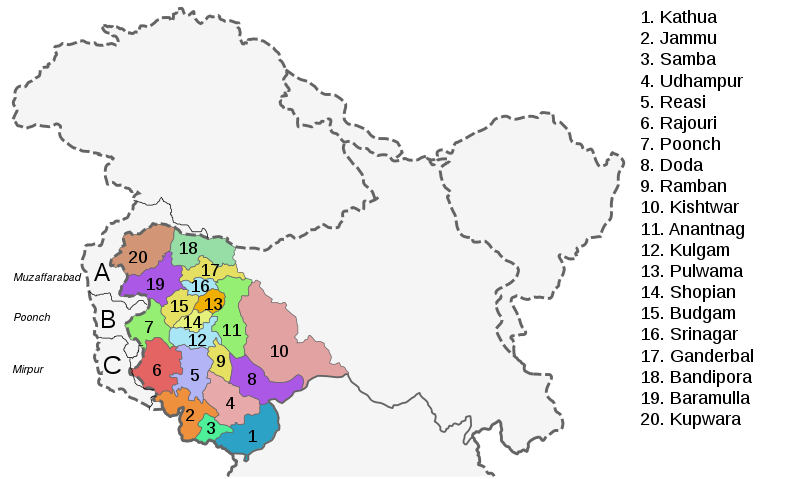
The Great Himalayas lie along the eastern border with Ladakh. Geologically complex and topographically immense, the Great Himalayas contain ranges with numerous peaks reaching elevations of 20,000 feet (6,100 metres) or higher, between which lie deeply entrenched remote valleys. The region was heavily glaciated during the Pleistocene Epoch, and remnant glaciers and snowfields are still present. The zone receives some rain from the southwest monsoon in the summer months—and the lower slopes are forested—but the mountains constitute a climatic divide, representing a transition from the monsoon climate of the Indian subcontinent to the dry continental climate of Central Asia. Jammu and Kashmir contains only a small section of the Great Himalayas, but the highest summit in the union territory, at Bharanzar in the Kishtwar district, still manages an impressive elevation of 21,500 feet (6,550 metres).
Winter (November through February) temperatures in Gujarat usually reach a high in the mid-80s F (about 28
°C), while lows drop into the mid-50s F (about 12 °C). Summers (March through May) are quite hot, however,
with temperatures typically rising well above 100 °F (38 °C) during the day and dropping only into the 90s F
(low 30s C) at night.
Gujarat is drier in the north than in the south. Rainfall is lowest in the northwestern part of the state—in
the Rann of Kachchh—where it may amount to less than 15 inches (380 mm) annually. In the central portion of
the Kathiawar Peninsula as well as in the northeastern region, annual rainfall typically amounts to about 40
inches (1,000 mm). Southeastern Gujarat, where the southwest monsoon brings heavy rains between June and
September, is the wettest area; annual rainfall usually approaches 80 inches (2,000 mm) along the coastal
plain.
Among the wild mammals found in the union territory are the rare hangul (or Kashmir stag) found in Dachigam National Park, the endangered markhor (a large goat) inhabiting mainly protected areas of the Pir Panjal Range, and black and brown bears. There are many species of game birds, including vast numbers of migratory ducks.
Jammu, winter capital of the maharajas (the former Hindu rulers of the region) and second largest city in the
union territory, was historically the seat of the Dogra dynasty. More than two-thirds of the region’s residents
are classified as Hindu. Most of Jammu’s Hindus live in the southeastern portion of the region and are closely
related to the Punjabi-speaking peoples in Punjab state; many speak the Dogri language. The majority of Sikhs in
the union territory also live in the Jammu region. To the northwest, however, the proportion of Muslims
increases, with Muslims making up a dominant majority in the area around the western town of Punch.
The Vale of Kashmir, surrounded by the highlands of the broader Kashmir region, always has had something of a unique character. The vast majority of the people are Muslims who speak Kashmiri or Urdu. Culturally and ethnically, their closest links are with peoples in the northwestern highlands of the Gilgit area (in the Gilgit-Baltistan district) of the Pakistani-administered sector of Kashmir. The Kashmiri language is influenced by Sanskrit and belongs to the Dardic branch of Indo-Aryan languages, which also are spoken by the various hill peoples of Gilgit. Kashmiri has rich folklore and literary traditions. The great majority of the population resides in the lower reaches of the vale. Srinagar, Jammu and Kashmir’s largest city, is located on the Jhelum River.
Jammu and Kashmir’s physiographic diversity is matched by a considerable variety of human occupation. In the
plains and foothills of the southwestern region, colonization movements from the Punjab areas over a long period
of time have produced numerous agricultural settlements. In the dun regions and lower valleys of the foothills,
where alluvial soils and the availability of water for irrigation make agriculture possible, the population is
sustained by crops of wheat and barley, which are gathered in the spring (rabi) harvest, and of rice and corn
(maize), gathered in the late summer (kharif) harvest; livestock also are raised. The upper sections of the
valleys support a sparser population that depends on a mixed economy of corn, cattle, and forestry. Herders
migrate to higher pastures each spring to give their flocks the necessary forage to produce milk and clarified
butter, or ghee, for southern lowland markets. In winter the hill dwellers return to lower areas to work in
government-owned forests and timber mills. Agricultural hamlets and nucleated villages predominate throughout
union territory; cities and towns such as Jammu and Udhampur function essentially as market centres and
administrative headquarters for the rural populations and estates in the vicinity.
The majority of the people of Jammu and Kashmir are engaged in subsistence agriculture of diverse kinds on terraced slopes, each crop adapted to local conditions. Rice, the staple crop, is planted in May and harvested in late September. Corn, millet, pulses (legumes such as peas, beans, and lentils), cotton, and tobacco are—with rice—the main summer crops, while wheat and barley are the chief spring crops. Many temperate fruits and vegetables are grown in areas adjacent to urban markets or in well-watered areas with rich organic soils. Sericulture (silk cultivation) is also widespread. Large orchards in the Vale of Kashmir produce apples, pears, peaches, walnuts, almonds, and cherries, which are among the union territory’s major exports. In addition, the vale is the sole producer of saffron in the Indian subcontinent. Lake margins are particularly favourable for cultivation, and vegetables and flowers are grown intensively in reclaimed marshland or on artificial floating gardens. The lakes and rivers also provide fish and water chestnuts.
The union territory has limited mineral and fossil fuel resources, much of which are concentrated in the Jammu
region. Small reserves of natural gas are found near the city of Jammu, and bauxite and gypsum deposits occur in
the vicinity of Udhampur. Other minerals include limestone, coal, zinc, and copper. The pressure of population
on land is apparent everywhere, and all available resources are utilized.
All the principal cities and towns and a majority of the villages are electrified, and hydroelectric and thermal
generating plants have been constructed to provide power for industrial development based on local raw
materials. Major power stations are located at Chineni and Salal and on the upper Sind and lower Jhelum rivers.
Jammu and Kashmir has vast hydroelectric generating potential, principally along the Chenab River in the
southwestern part of the union territory but also including the basins of the Indus, Jhelum, and Ravi rivers.
Although by the early 21st century only a relatively small fraction of that potential was being exploited, a
large number of projects were in various stages of planning or completion at the end of the 2010s that were
intended to considerably boost the union territory’s generating capacity.
Transport within Jammu and Kashmir remains a problem, although the Indian central government has made a
substantial investment in developing the infrastructure of the union territory. As a result of the
India-Pakistan dispute over the Kashmir region, the route through the Jhelum valley from Srinagar to Rawalpindi,
Pakistan, was closed in the late 1940s. The route was reopened in 2005, but in the intervening years its closure
had made it necessary to transform a longer and more-difficult cart road through Banihal Pass into an
all-weather highway in order to link Jammu with the Vale of Kashmir; included was construction of the Jawahar
Tunnel, which at the time of its completion in 1959 was one of the longest in Asia. That road, however, is often
made impassable by severe weather, which causes shortages of essential commodities in the vale. A road also
connects Srinagar with Kargil and Leh in Ladakh. In addition, a route through the Pir Panjal Range that followed
the ancient Mughal Road opened in 2010, significantly reducing the travel distance between Punch and the
vale.
Jammu is the terminus of the Northern Railway of India. In the 1990s construction got underway on a rail link
between Jammu and Baramula (via Srinagar) near the northern end of the vale. Work proceeded slowly, but by the
early 21st century the segments had been completed between Jammu and Udhampur and from Baramula to just south of
Anantnag (the southern limit of the vale), southeast of Srinagar. Srinagar and Jammu are linked by air to Delhi
and other Indian cities, and there is air service between Srinagar, Leh, and Delhi.
Jammu and Kashmir’s remoteness and inaccessibility were major impediments to developing traditional landline
telephone service. The advent of mobile telephony, however, transformed telecommunications in the region. The
use of landlines there steadily dropped, while usage of mobile devices grew dramatically to completely dwarf the
older technology in numbers of subscribers.
Until 2019, Jammu and Kashmir retained a special status within the union government of India as a semiautonomous
state. Unlike the rest of the states, which are bound by the Indian constitution, Jammu and Kashmir followed a
modified version of that constitution—as delineated in the Constitution (Application to Jammu and Kashmir)
Order, 1954—which affirmed the integrity of the state within the Republic of India. A governor, who was
appointed by the president of India, served as head of state and was aided and advised by an elected chief
minister as head of government and a council of ministers. The legislature consisted of two houses: the
Legislative Assembly (Vidhan Sabha), comprising several dozen members elected from single-member constituencies;
and the smaller Legislative Council (Vidhan Parishad), with most members elected by various groups of
politicians, local administrators, and educators and a few appointed by the governor. The union government had
direct legislative powers in matters of defense, foreign policy, and communications within the state and had
indirect influence in matters of citizenship, Supreme Court jurisdiction, and emergency powers.
In August 2019 the union government effectively suspended the constitution of the state of Jammu and Kashmir and
in October the state was formally bifurcated into the union territory of Jammu and Kashmir and the union
territory of Ladakh. Under this reorganization, the union territory of Jammu and Kashmir came under the
administration of a lieutenant governor appointed by the president of India, aided by a chief minister and a
council of ministers appointed by that lieutenant governor. The reorganization also provided for a Legislative
Assembly, with members elected to five-year terms, though it may be dissolved by the lieutenant governor before
the term expires. Unlike with state legislatures, which have constitutional authority over matters of public
order and policing, those matters fall under the domain of the union government (through the lieutenant governor
as its representative). The territory directly sends five elected representatives to the Lok Sabha (lower
chamber) and four members, elected by the combined Legislative Assembly and Council, to the Rajya Sabha (upper
chamber) of the Indian national parliament. Jammu and Kashmir shares with Ladakh union territory a common High
Court, which consists of a chief justice and 11 other judges, who are appointed by the president of India.
Medical service is provided by hospitals and dispensaries scattered throughout the union territory. Influenza,
respiratory ailments such as asthma, and dysentery remain common health problems. Cardiovascular disease,
cancer, and tuberculosis have increased in the Vale of Kashmir since the late 20th century.
Education is free at all levels. Literacy rates are comparable to the national average, but female literacy is considerably lower than that for males. The two major institutes of higher education are the University of Kashmir at Srinagar and the University of Jammu, both founded in 1969. In addition, agricultural schools have been established in Srinagar (1982) and Jammu (1999). A specialized institute of medical sciences was founded in Srinagar in 1982.