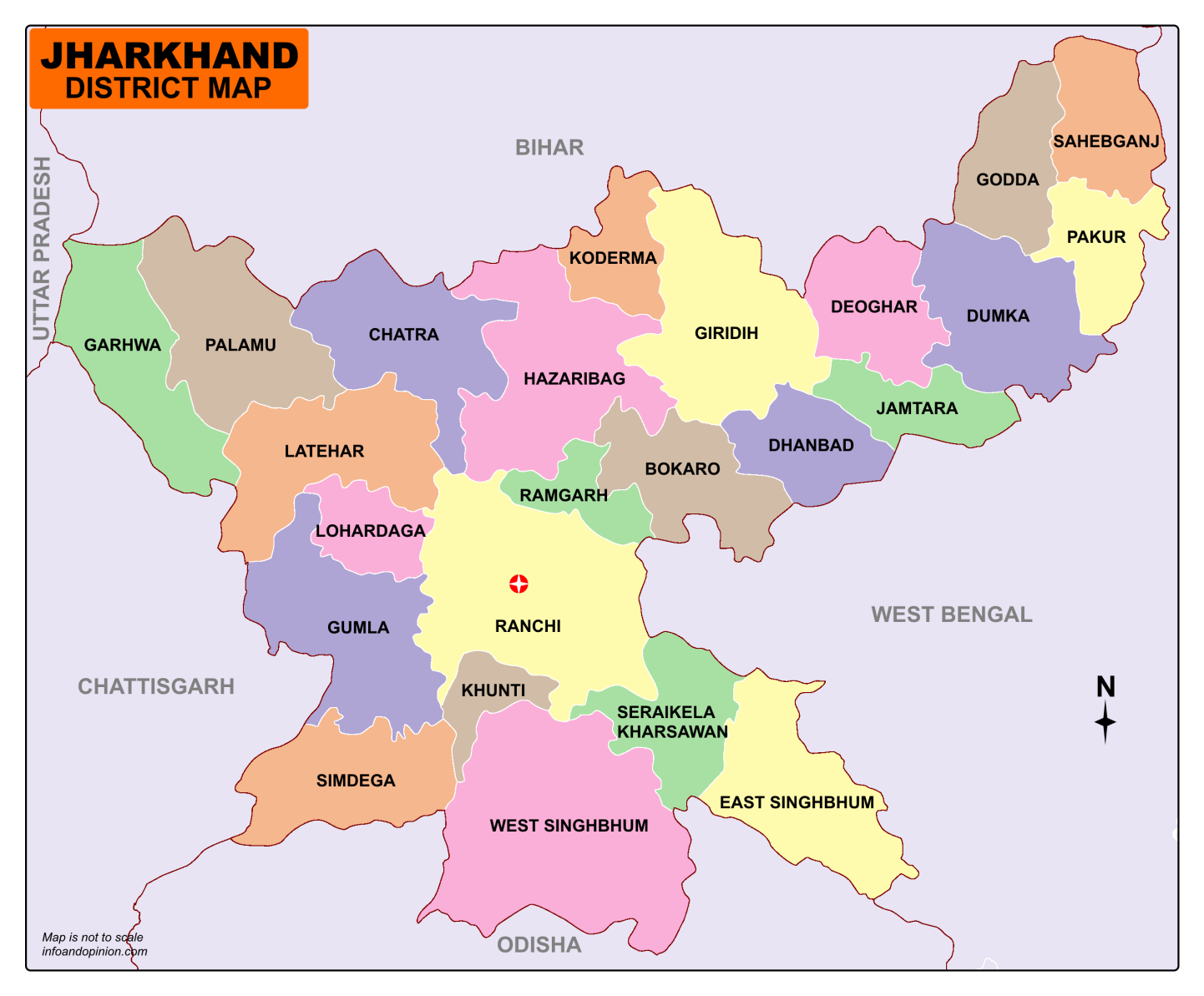
There are three well-defined seasons in Jharkhand. The cold-weather season, from November to February, is the most pleasant part of the year. High temperatures in Ranchi in December usually rise from about 50 °F (10 °C) into the low 70s F (low 20s C) daily. The hot-weather season lasts from March to mid-June. May, the hottest month, is characterized by daily high temperatures in the upper 90s F (about 37 °C) and low temperatures in the mid-70s F (mid-20s C). The season of the southwest monsoon, from mid-June to October, brings nearly all of the state’s annual rainfall, which ranges from about 40 inches (1,000 mm) in the west-central part of the state to more than 60 inches (1,500 mm) in the southwest. Rainfall on the plateau is generally heavier than on the plains. Nearly half of the annual precipitation falls in July and August.
More than one-fourth of Jharkhand’s land area is forested. Most forests occur on the Chota Nagpur plateau; those
on the plain largely have been cleared to allow cultivation of the land. The natural vegetation is deciduous
forest; Chota Nagpur is rich in sal (Shorea robusta), a valuable hardwood. Other trees include the asan
(Terminalia tomentosa), the leaves of which provide food for the silkworms of the sericulture industry, as well
as several trees that are important in the production of lac (a resinous substance used to make varnishes). The
tree locally known as mahua (Madhuca longifolia) yields sweet edible flowers that are used to make liquor.
Bamboo and bhabar (an Indian fibre grass; Ischaemum angustifolium) from Chota Nagpur supply raw materials for
paper manufacture. Among the other common trees, most of which are found in the plain, are the banyan (Ficus
benghalensis), Bo tree (or pipal; Ficus religiosa), and palmyra palm (Borassus flabellifer)
The Hazaribag Wildlife Sanctuary is noted for its Bengal tigers. These endangered animals, along with leopards,
elephants, and bears, inhabit only the more remote forests. Various species of small mammals, birds, reptiles,
and fish are plentiful throughout the state.
Nearly two-fifths of the population of Jharkhand consists of various indigenous peoples classified as Scheduled
Tribes, as well as members of the Scheduled Castes (formerly called “untouchables”; groups that officially
occupy a low position within the Indian caste hierarchy). The Santhal, Oraon (Kurukh), Munda, Kharia, and Ho are
the principal indigenous groups, and together they constitute the great majority of the total tribal population.
Non-Scheduled peoples, who hold a higher status within the traditional Indian social system, constitute most of
the remaining three-fifths of the population.
Hindus constitute the religious majority in Jharkhand. The Hindu population comprises the elite upper castes
(Brahmans, Bhumihars, Rajputs, and Kayasthas), the large and diverse community of less-advantaged castes (such
as the Yadavas, Kurmis, and Banias), and the Scheduled Castes (notably, the Chamars or Mochis, Dusadhs, and
Mushars). Most of the tribal groups also follow Hinduism, although Christianity is significant among the Munda,
Kharia, and Oraon peoples. Some members of the Scheduled Tribes—especially from the Ho community—adhere to local
religions. There also is a notable Muslim minority within the state.
Languages from the Indo-European family are the most widely spoken in Jharkhand. Most prominent of these are
Hindi; the Bihari languages of Bhojpuri, Maithili, and Magadhi; and Urdu, which is used primarily within the
Muslim community. Some of the tribal languages—including Munda, Santhal, and Ho—belong to the Austroasiatic
family, while other indigenous communities, such as the Oraon, speak Dravidian languages.
With just over one-tenth of its population classified as urban, Jharkhand remained one of the most rural states
in India in the early 21st century. Dispersed villages are characteristic of Chota Nagpur, where settlement is
confined largely to river valleys, deforested peneplains (areas reduced almost to plains by erosion), and
mineral and industrial belts. The indigenous groups are concentrated mostly in the districts of Ranchi in
central Jharkhand, Dumka in the northeast, and East and West Singhbhum in the southeast. The major cities and
urban agglomerations are Ranchi, Jamshedpur, Dhanbad-Jharia-Sindri, and Bokaro-Chas.
Since the achievement of statehood at the turn of the 21st century, the government of Jharkhand has pursued an active course of economic planning and development. Information technology, transportation and infrastructure, agriculture, and local craft production have been among the prioritized sectors. Meanwhile, several Industrial Area Development Authorities—centred at Adityapur (near Jamshedpur), Bokaro, and Ranchi—have been charged with land acquisition, improvement of the infrastructure, and development of public utilities, among other functions, within their areas of jurisdiction.
Jharkhand is endowed with surface water and groundwater, fertile land, and a moderate climate, all of which have helped the state build a strong agriculture sector. The state’s agricultural-development programs have especially emphasized the raising of livestock for meat, dairy products, and wool. In an effort to improve quality and to increase the output of mutton and wool, a selective sheep-breeding program was implemented in the town of Chatra, in the northwest, and wool-collection centres were established in the district of East Singhbhum. Most of the state’s goats are raised in the districts of Dumka, Deoghar, and Godda, all in the northeast, although the state also has goat farms in Sahibganj, Chatra, and Ranchi districts. There are pig farms in various towns across the state, notably in Kanke (in Ranchi district), Saraikela (near Dhanbad), and Jamshedpur.
The Chota Nagpur plateau is the richest mineral belt in India, and it is responsible for a significant share (by
value) of the country’s mineral yield. Jharkhand produces almost the entire national output of copper, kyanite
(used in the manufacture of heat-resistant porcelain), pyrite (used to make sulfuric acid), and phosphate, as
well as much of the output of bauxite (a source of aluminium), mica, kaolin and other clays, and iron ore. Most
of these minerals are mined in the districts of East and West Singhbhum. Coal, however, accounts for the bulk of
Jharkhand’s mineral production. The principal coalfields, all in the Damodar River valley in eastern Jharkhand,
supply most of the coking coal of India.
The Damodar Valley Corporation (DVC) is the most prominent multipurpose power project of Jharkhand. The
corporation operates several thermal plants and hydroelectric dams not only in Jharkhand but also in
neighbouring West Bengal; all the stations are networked within the DVC grid, which serves urban and rural areas
in both states.
Although the road network has continued to expand since statehood, all-weather roads still reach fewer than half
of Jharkhand’s villages. However, a number of national highways pass through the state, including the venerable
Grand Trunk Road (one of the oldest roads in India). Road service is best on the Chota Nagpur plateau, where
Allied operations during World War II brought many improvements.
The Kolkata-Delhi rail line, which opened in 1864, crosses Jharkhand. Extensive goods-handling facilities are
located along the rails at Ranchi, Bokaro, Dhanbad, and Jamshedpur. In addition, ore-loading facilities are
available at Lohardaga, in west-central Jharkhand, and at all the coal mines. Scheduled airlines serve Ranchi on
a regular basis. Waterways, once important avenues of transport, are now of little significance in Jharkhand.
Like that of most other Indian states, the structure of Jharkhand’s government is determined by the national
constitution of 1950. Appointed by the president of India, the governor is the head of the state and functions
on the advice of the chief minister, who is the head of the Council of Ministers. Jharkhand is one of the few
Indian states that has a bicameral legislature; the upper house is the Legislative Council (Vidhan Parishad),
and the lower house is the Legislative Assembly (Vidhan Sabha).
The state is divided into a number of districts, each of which is governed by a deputy commissioner who also
functions as the district magistrate and collector. Districts are split further into subdivisions, each
administered by a subdivisional officer. The police administration is headed by an inspector general, assisted
by a superintendent at the district level.
There is a high court in Ranchi, with a chief justice and several other judges. Below the high court are
district courts, subdivisional courts, munsifs’ (subordinate judicial officers’) courts, and village councils.
Although Jharkhand has more than 500 medical centres, medical facilities, though improving, have remained
inadequate outside the towns. Villages are served mainly by allopathic (Western) and Ayurvedic (ancient Indian)
medical dispensaries. Unani (traditional Muslim) and homeopathic systems of medicine also are available. Large
and well-equipped hospitals are located at Jamshedpur, Ranchi, and Dhanbad. Specialized facilities for the
treatment of tuberculosis, mental illness, and leprosy are located near Ranchi; there is a cancer hospital in
Jamshedpur.
Respiratory diseases, dysentery, and diarrhea are among the leading causes of death. Cholera and malaria seldom
occur.
Education has been a primary focus of Jharkhand’s development initiatives. The literacy rate has been rising rapidly, having climbed more than 10 percent in the 1990s to surpass 50 percent by the start of the 21st century. Aside from thousands of primary and secondary schools scattered throughout the state, Jharkhand has several universities, the most notable of which include Ranchi University (1960), Birsa Agriculture University (1981) in Kanke, Sido Kanhu Murmu University (1992) in Dumka, and Vinoba Bhave University (1992) in Hazaribag. There also are a number of colleges and research centres that specialize in engineering, labour relations, law, medicine, and other fields. Among the most prominent of these institutions are the Indian School of Mines (1926), Birsa Institute of Technology (1949), and the Central Institute of Mining and Fuel Research (1950), all in Dhanbad; Xavier Labour Relations Institute (1949) in Jamshedpur; and the Birla Institute of Technology (1955) in Ranchi. The Indo-Danish Tool Room (1991) in Jamshedpur, built with assistance from the government of Denmark, as well as other tool rooms and training centres in Ranchi and Dumka, has played an important role in providing a skilled foundation for Jharkhand’s industrial development.
Many of the villages of the various tribal peoples share some common characteristics. Most settlements have a
community dance floor that springs to life during festive times. Among the most widely recognized of Jharkhand’s
dances is chhau, an elaborate masked dance of the southeastern region, particularly the Saraikela and East
Singhbhum districts. Although once a village tradition associated with Chaitra Parva, a festival held every
April in honour of the god Shiva, chhau eventually received royal patronage and then state sponsorship; it has
since become a virtual emblem of the region. Other tribal celebrations that provide occasions for music and
dancing include the festival of flowers known as Sarhul (or Baha), a cattle festival called Sohrai, and a
postharvest festival called Mage Parab.
In addition to the dance floor, most tribal villages have a sacred grove (sarna), where worship is offered by a
village priest, and a bachelors’ dormitory (dhumkuria). The haat, or weekly market, plays an important role in
the village economy.
There also are numerous annual Hindu celebrations in Jharkhand that span tribal and nontribal areas. Holi is a
colourful fertility festival held in February or March. Chhatt is a tribute to the Sun, usually held in October
or November.
The natural environment contributes to the cultural life of Jharkhand. Many are drawn for outdoor recreation to
Dimna Lake and the Dalma Wildlife Sanctuary in Jamshedpur. Also popular is Jamshedpur’s Jubilee Park, which is a
replica of the famous Vrindavan Gardens of Mysore, in the state of Karnataka. Meanwhile, the cool air and
pristine surroundings of Netarhat, on the Ranchi plateau, make it one of the most attractive tourist resorts in
the state.