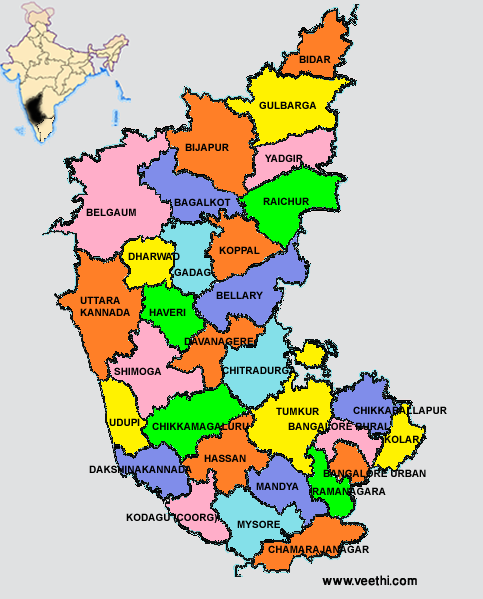
The climate of Karnataka is subtropical, with winter (January and February), summer (March through May), southwest monsoon (June through September), and post-monsoon (October through December) seasons. Maximum daily temperatures in winter reach the upper 80s F (low 30s C), whereas in the summer months temperatures rise into the low 100s F (about 40 °C). Annual precipitation ranges from roughly 20 inches (500 mm) in the drier portions of the Maidan to nearly 160 inches (4,000 mm) in the wettest parts of the coastal plain. Most of the state’s annual precipitation falls between June and September; much of the remainder is brought by a less-significant northeast monsoon that blows during the post-monsoon season. The winter months are particularly dry.
While coconut palms line the lagoons of the coastal plain region of Karnataka, monsoon forests cover the Malnad area of the Western Ghats, and scrub forests and scrublands stretch across the drier plains of the Maidan. The monsoon forests are especially rich in wildlife, which includes tigers, elephants, gaurs (wild cattle), and deer. Wild boars, bears, and leopards inhabit the Maidan. Peacocks are among the state’s common birds. Karnataka has many wildlife sanctuaries, including the large Dandeli Wildlife Sanctuary in the northwest, which abuts the Mahaveer sanctuary in Goa. The state also has several national parks, among the most notable of which are at Bandipur, in the south, near the border with Tamil Nadu, and at Nagarhole, in the southwest, near the border with Kerala.
As speakers of Dravidian languages, most of Karnataka’s people are considered to be the descendants of the
so-called Dravidian population of India that was driven southward between about 2000 and 1500 BCE by the descent
into the Asian subcontinent of speakers of Indo-Aryan languages. Although the Dravidians of South India remain
distinct from the Indo-Aryans of North India, centuries of interaction between the two groups has resulted in
many shared linguistic and cultural characteristics. Today in Karnataka, the northern region exhibits a somewhat
greater degree of such mixture than does its southern counterpart.
Kannada, which is a Dravidian language, is spoken by a large majority of the population and is the official
language of the state. Hindi is sometimes used in trade and business. Toward the borders of the state, other
languages, such as Tamil and Telugu, both Dravidian, and Marathi and Konkani, both Indo-Aryan, are also spoken.
Konkani is associated particularly with the city of Mangaluru (Mangalore), in southwestern Karnataka.
The predominant religion in the state is Hinduism. Jainism and Buddhism—once widespread—still have
practitioners, however. Small portions of the population follow Islam and Christianity.
About two-thirds of the population of Karnataka was rural in the early 21st century, but, with increasing
industrialization, the pace of urbanization continued to accelerate. The principal cities are the capital
Bengaluru and Mysuru (Mysore), both in the southern part of the state. Other major urban centres include
Hubballi-Dharwad, Mangaluru, Belgavi (Belgaum), Kalaburagi (Gulbarga), Davangere, Ballari (Bellary), Shivamogga
(Shimoga), Vijayapura (Bijapur), and Raichur.
Agriculture engages the majority of the population. The coastal plain is intensively cultivated, with rice as
the principal food crop, followed by sorghum (jowar) and millet (ragi). Sugarcane is the main cash crop,
supplemented by cashews, cardamom, betel (areca) nut, and grapes. Coffee and tea plantations are located on the
cool slopes of the Western Ghats; Karnataka is one of the country’s chief sources of coffee. In the eastern
region, irrigation enables the cultivation of sugarcane, some rubber, and such fruits as bananas and oranges.
The black soil of the northwest supports cotton, oilseeds, and peanuts (groundnuts).
The forests of the Malnad area in the west produce a significant portion of the world’s supply of sandalwood.
Oil processed from sandalwood in Mysuru also is a leading state export. Other important forest products include
teak, eucalyptus, rosewood, bamboo, and such substances as tanning dyes, gums, and lac (used in the manufacture
of varnishes).
Karnataka is mineral-rich. The state is a major source of chromite, and it is one of the few states of India
that produces magnesite. High-grade iron ore reserves are tapped most notably in Bellary district, in the
east-central part of the state. Kolar Gold Fields, near Bengaluru, yielded much of the country’s gold in the
20th century; by the early 21st century, however, virtual depletion of the deposits and high operating costs
forced the mines to close. Other minerals that have been extracted in Karnataka, albeit in small quantities,
include mica, copper ore, bauxite, and garnet.
Karnataka’s many hydroelectric plants generate enough power not only to meet local needs but also to distribute
to neighbouring states. The hydroelectric station on the Sharavati River near Jog Falls is an especially large
facility that supplies power to many of Karnataka’s industries. Additional energy is provided by thermal- and
wind-powered plants.
The obstacle formed by the Western Ghats has hindered the building of railroads to link the state’s numerous
minor ports to the plateau in the interior. Bengaluru, in the southeast, is the main focus of rail
transportation. The port of Mangaluru, in the southwest, is connected to Mumbai (Bombay) in Mahrashtra by tracks
running parallel to the coast through the state of Goa.
The import and export trade relies primarily on road transport, but many roads in the western part of the state
become impassable during the rainy season. National highways run from Bengaluru east to Chennai (Madras) in
Tamil Nadu, north to Hyderabad in Telangana, northwest to Mumbai, and west through Hassan to the coast of
Mangalore. Airports are located at Bengaluru, Belgavi, and Mangaluru.
The government of Karnataka, like that of most other states and territories in India, is determined by the
national constitution of 1950. The head of state is the governor, who is appointed by the president of India.
The governor is aided and advised by a chief minister, who, in turn, is assisted by a Council of Ministers.
Karnataka is one of the few Indian states with a bicameral legislature, consisting of a Legislative Assembly
(Vidhan Sabha) of directly elected members and a Legislative Council (Vidhan Parishad), members of which are
elected variously by the Legislative Assembly, by local leaders, and by teachers and graduates.
The state High Court is subordinate to the Supreme Court in New Delhi; it consists of a chief justice and
several additional judges, who are appointed by the president of India in consultation with the chief justice of
India and the governor of the state. There are also district and subordinate courts. A public service
commission, whose members are appointed by the governor, functions in an advisory capacity.
The state is divided into more than two dozen districts, which are grouped into four divisions. Each district is
headed by a deputy commissioner, who also serves as the district magistrate and collector. There are several
levels of administrative units below the district level.
A state insurance scheme covers sickness, maternity, and employment injuries and provides medical treatment to
workers (and their families) in various professions. Welfare schemes are run by the government for socially and
economically disadvantaged groups. State agencies also provide welfare services specifically for women and
children.
With a literacy rate that had reached about two-thirds by the early 21st century (a rate higher than the national average), Karnataka has one of the most highly educated populations in India. The state has a large number of schools and educational institutions, nearly half of which are managed by the government; the remainder are operated by local boards and private bodies. Compulsory free primary education is provided in most towns and villages. Among Karnataka’s oldest and most-prominent institutions of higher learning are the Indian Institute of Science (1909), Bangalore University (1964), and the University of Agricultural Sciences (1964)—all in Bengaluru—as well as the University of Mysore (1916) in Mysuru, Karnatak University (1949) in Dharwad, Gulbarga University (1980) in Kalaburagi, and Mangalore University (1980) in Mangaluru.
Karnataka possesses a rich cultural heritage, compounded by the contributions of successive dynasties, which have fostered various religions and philosophies that, in turn, have influenced literature, architecture, folklore, music, painting, and other arts. The town of Shravanabelagola, 56 miles (90 km) from Mysuru, is especially significant for its ancient buildings and monuments. It contains notable examples of architecture from the Mauryan empire (c. 321–185 BCE), as well as a colossal 10th-century stone figure of Bahubali (Gommateshvara), the Jain saint. Indeed, such enormous monolithic Jain statues are peculiar to the Kannada-speaking region of India. The influence of the Chalukya (543–757 CE) and Pallava (4th to 9th century) dynasties is still apparent in temple architecture stemming from the 7th century CE.