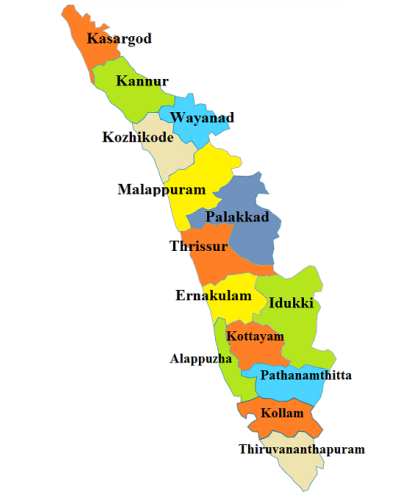
The climate of Kerala is equable and varies little from season to season. Throughout the year, daily temperatures usually rise from the low 70s F (low 20s C) into the 80s F (27 to 32 °C). The state is directly exposed to the southwest monsoon, which prevails from July through September, but it also receives rain from the reverse (northeast) monsoon, which blows in October and November. Precipitation averages about 115 inches (3,000 mm) annually statewide, with some slopes receiving more than 200 inches (5,000 mm).
The watery coastal zones of Kerala are interspersed with coconut palm groves, while much of the Western Ghats and riverine areas are covered with rainforests and monsoon forests (tropical deciduous forests). Rolling grasslands are typical of the upland region. This diverse natural environment is home to an extraordinary array of wildlife. Mammals include sambar deer, gaurs (wild cattle), Nilgiri tahrs (wild goatlike animals; Hemitragus hylocrius, or, by some classifications, Nilgiritragus hylocrius), elephants, leopards, tigers, bonnet monkeys, rare lion-tailed macaques (Macaca silenus), and Hanuman and Nilgiri langurs (Semnopithecus entellus and Trachypithecus johnii, respectively). King cobras (Ophiophagus hannah) are among the notable reptiles, while peacocks and hornbills are common birds. The state has several national parks and wildlife sanctuaries, among which the Periyar National Park and Tiger Reserve is the largest.
The Malayalis are a group of people of mixed ethnic heritage who speak Malayalam, a Dravidian language; they
constitute the majority of the population of Kerala. Most Malayalis are descendants of the early inhabitants of
India, the so-called Dravidians (speakers of Dravidian languages), who were driven southward between about 2000
and 1500 BCE when the Aryans (speakers of Indo-Aryan languages) descended into the Indian subcontinent. Over the
millennia, there has been much exchange between the two groups. Elements of Indo-Aryan ancestry remain strongest
among the Nambudiri, a prominent caste of orthodox Hindus. Also living in Kerala is a significant minority of
Tamils, a neighbouring people of Dravidian ancestry.
More than half of Kerala’s residents, including most of the Malayalis, follow Hinduism. About one-fourth of the
population practices Islam, with the Moplah (Mapilla) people of the Malabar Coast constituting the state’s
largest Muslim community. Christians, who account for nearly one-fifth of the population, belong broadly to the
Syrian Orthodox and Roman Catholic churches as well as to various Protestant denominations. Regardless of their
sect, these indigenous Christians share a common set of early Christian traditions unique to the Malabar Coast.
They are referred to collectively as St. Thomas (Mar Thoma) Christians in allusion to the tradition that St.
Thomas the Apostle first evangelized the region. Kerala also has tiny Jain, Sikh, Buddhist, and Jewish
communities; there is an ancient synagogue in Kochi.
Kerala is one of the most densely populated states in India. While only about one-fourth of the population was
reported as urban in the early 21st century, such statistics are deceptive because of the close proximity of
rural houses, especially in the coastal plain. Indeed, in parts of the state there are densely populated rural
equivalents of urban megalopolises. The major urban centres and industrial complexes include Kochi,
Thiruvananthapuram, Kozhikode, Kollam (Quilon), Alappuzha (Alleppey), Thrissur (Trichur), and Thalassery
(Tellicherry).
Agriculture is the state’s main economic activity. Commercial plantings on less than half of the total land
under cultivation earn a sizable amount of foreign exchange but have necessitated the importation of food for
local consumption. Kerala’s principal cash crops are rubber, coffee, and tea, which are cultivated in
plantations on the slopes of the foothills, as well as areca nut, cardamom, cashew nut, coconut, ginger, and
pepper. The major food crops are rice, pulses (e.g., peas and beans), sorghum, and tapioca. Commercial poultry
farming is well developed.
The forests yield valuable timbers such as ebony, rosewood, and teak. In addition, Kerala’s woodlands supply
industrial raw materials such as bamboo (used in the paper and rayon industries), wood pulp, charcoal, gums, and
resins. The state is also a national leader in fish production. Sardines, tunas, mackerels, and prawns are among
the principal products of the industry.
Kerala lacks major reserves of fossil fuels. However, there are moderate deposits of ilmenite (the principal ore
of titanium), rutile (titanium dioxide), and monazite (a mineral consisting of cerium and thorium phosphates),
all of which are found in beach sands. Other minerals include limestone, iron ores, and bauxite (the principal
ore of aluminum). The state is especially known for its high-quality kaolin (china clay), which is used to make
porcelain.
Kerala has great hydroelectric potential, with some two dozen hydroelectric stations operating within the state.
Several thermal plants supply additional energy, and in the late 20th century the state began to establish wind
farms. Despite its wealth of renewable resources for power generation, Kerala has continued to import some of
its electricity from elsewhere in India.
Kerala has well-developed road and railway systems. It is connected with the states of Tamil Nadu and Karnataka by national highways. A railway coming from the east through the Palghat Gap in the Western Ghats meets with a railway running from north to south through the state and on to Kanniyakumari, the southernmost town of India. There is a major port at Kochi and intermediate ports at Kozhikode, Alappuzha, and Neendakara (near Thiruvananthapuram); all handle coastal and foreign traffic. Kochi also has major shipyard and oil refining facilities and serves as a district headquarters for the Indian coast guard and as a regional headquarters for the navy. More than 1,000 miles (1,600 km) of inland waterways form the main arteries for carrying bulk freight to and from the ports. Thiruvananthapuram, Kozhikode, and Kochi have international airports.
The structure of the government of Kerala, like that of most other states of India, is determined by the
national constitution of 1950. Appointed by the president of India, the governor is the head of the state and
functions on the advice of the chief minister, who is the head of the Council of Ministers. The state has an
elected unicameral Legislative Assembly (Vidhan Sabha). The High Court in Ernakulam (near Kochi) is headed by a
chief justice; appeals from the High Court may go to the Supreme Court of India. Below the High Court are
district courts, subdivisional courts, munsifs’ (subordinate judicial officers’) courts, and munsif-magistrate
courts. In addition, there are family courts and other courts that handle particular types of cases.
At the local level, the state is divided into districts, which in turn are subdivided for revenue purposes into
talukas (subdivisions) and villages. Since the mid-20th century, Kerala’s political experience has largely been
one of instability, with a proliferation of political parties and coalition governments.
The state maintains a relatively high standard of health service. A comprehensive health insurance plan is
available for workers in a number of professions, and free medical treatment is offered in many hospitals,
health centres, and dispensaries. Among the top priorities of government health schemes have been the
establishment of health care facilities in rural areas, the promotion of family planning, prevention of
blindness, and control of communicable diseases such as leprosy, tuberculosis, and malaria.
Kerala has one of the most advanced educational systems and highest levels of literacy in India. Elementary education is compulsory between the ages of 6 and 14. There are primary, middle, and secondary schools, as well as polytechnical and industrial training institutes, arts and science colleges, and professional colleges. Kerala also has several universities, including the University of Kerala (1937) in Thiruvananthapuram, the University of Calicut (1968) in Kozhikode, Cochin University of Science and Technology (1971) in Kochi, and Kerala Agricultural University (1971) in Thrissur.
The cultural heritage of Kerala reflects extensive interaction with diverse communities from antiquity to the
present. With an array of ancient Hindu temples with copper-clad roofs, later mosques with “Malabar gables”
(triangular projections at the rooftops), and Baroque churches from the Portuguese colonial era, the state’s
architecture offers a chronicle of the social, spiritual, and political history of the area. Other
characteristically Keralan art forms include intricate paintings on wood, thematic murals, and a remarkable
variety of indoor and outdoor lamps (from which the state has earned the sobriquet “Land of Lamps”).
Literature and learning, in both Tamil and Sanskrit, have flourished since the 2nd century CE; meanwhile, the
Malayalam language, though an offshoot of Tamil, has absorbed much from Sanskrit and also has a prolific
literature. Notable names in Malayalam poetry are Tunchattu Eluttaccan and Kuncan Nampiyar among classical poets
and Kumaran Asan and Vallathol in the 20th century. In 1889 Chandu Menon wrote Indulekha, the first outstanding
novel in Malayalam, for which he received a certificate from Queen Victoria. Thakazhi Sivasankara Pillai, who
produced hundreds of works before his death in 1999, has remained among the most widely read Malayali novelists.
Most traditional dances of Kerala pertain to the great Indian epics—the Mahabharata and the Ramayana—or to the
honouring of specific Hindu deities. In kathakali, the classical martial dance-drama of Kerala, male performers
portray both male and female characters. By contrast, the bharata natyam dancing, dating to early Tamil times,
is practiced exclusively by females.