The climate in Madhya Pradesh is governed by a monsoon weather pattern. The distinct seasons are summer
(March through May), winter (November through February), and the intervening rainy months of the southwest
monsoon (June through September). The summer is hot, dry, and windy; in Bhopal, low temperatures average in
the upper 70s F (about 25 °C), while high temperatures typically reach the low 100s F (about 40 °C). Winters
are usually pleasant and dry, with daily temperatures normally rising from about 50° (about 10 °C) into the
upper 70s F (about 25 °C). Temperatures during the monsoon season usually range from the low 70s F (low 20s
C) to the upper 80s F (low 30s C).
The average annual rainfall is about 44 inches (1,100 mm). In general, precipitation decreases westward and
northward, from 60 inches (1,500 mm) or more in the east to about 32 inches (800 mm) in the west. The
Chambal valley in the north averages less than 30 inches (750 mm) of rainfall per year. Most parts of Madhya
Pradesh receive almost all of their precipitation in the monsoon months; however, there is considerable
rainfall over the northern part of the state in December and January.
In the early 21st century, official statistics indicated that nearly one-third of the state’s total area was
forested, but satellite imagery revealed the proportion to be closer to one-fifth. An even smaller
percentage of Madhya Pradesh consists of permanent pasture or other grazing land. The main forested areas
include the Vindhya Range, the Kaimur Hills, the Satpura and Maikala ranges, and the Baghelkhand Plateau.
Among the state’s most notable trees are teak and sal (Shorea robusta), both of which are valuable
hardwoods; bamboo; salai (Boswellia serrata), which yields a resin used for incense and medicine; and tendu,
the leaves of which are used for rolling bidis (Indian cigarettes).
The forests abound in large mammals, such as tigers, panthers, bears, gaurs (wild cattle), and many types of
deer, including chital (spotted deer), sambar, blackbucks, and the rare barasingha (swamp deer). The
woodlands also are home to many species of birds. Madhya Pradesh has a number of national parks and many
wildlife sanctuaries, of which the best known are Kanha National Park, in the southeastern part of the
state, for the barasingha; Bandhavgarh National Park, in the east, for the endangered white tiger; and
Shivpuri (Madhav) National Park, in the north, where there is a bird sanctuary. The Kanha National Park has
a sanctuary for tigers, and the National Chambal Sanctuary (administered jointly with Rajasthan and Uttar
Pradesh), in the northwest, has been established for the conservation of (freshwater) Ganges river dolphins
(Platanista gangetica), as well as crocodiles, gavials (crocodile-like reptiles), and various large
terrestrial animals.5.
About one-fifth of the people in Madhya Pradesh are officially classified as members of Scheduled Tribes (a
category embracing indigenous peoples who fall outside the predominant Indian social hierarchy). Among the
most prominent of these tribes are the Bhil, Baiga, Gond, Korku, Kol, Kamar, and Maria. Non-Scheduled
peoples, who hold a higher status within the Indian social system, make up most of the remaining four-fifths
of the state’s population.
Hindi, the official state language, is also the language most widely spoken in Madhya Pradesh. Eastern Hindi
dialects, represented by Bagheli and Awadhi, are spoken in the southern and eastern parts of the state and
in the upper Narmada River valley. Bundeli, a Western Hindi dialect, is spoken in the central and
northwestern districts of Madhya Pradesh; Malvi, recognized by some as a Western Hindi dialect as well, is
the speech of western Madhya Pradesh.
The second most important language in terms of the number of speakers is Marathi. Urdu, Oriya, Gujarati, and
Punjabi are each spoken by sizable numbers. Also spoken are Telugu, Bengali, Tamil, and Malayalam. The Bhil
speak Bhili, and the Gond speak Gondi.
Most of the people are Hindus. There are, however, significant minorities of Muslims, Jains, Christians, and
Buddhists. There is also a small Sikh population.
Roughly three-fourths of the population of Madhya Pradesh is rural, but the distribution of this population
is very uneven. Densely populated rural regions are confined largely to the river valleys—the upper
Wainganga, the lower Chambal, and the Narmada—and to scattered patches on the Malwa Plateau in western
Madhya Pradesh. The largest urban areas are Bhopal, in west-central Madhya Pradesh; Indore, in the west; and
Jabalpur (Jubbulpore), in the east-central region. Other major cities include Gwalior, in the north, Ujjain,
in the west, and Sagar (Saugor), in the central part of the state.
Agriculture is the basis of Madhya Pradesh’s economy. Less than half of the land area is cultivable,
however, and its distribution is quite uneven because of variations in topography, rainfall, and soils. The
main cultivated areas are found in the Chambal River valley and on the Malwa and Rewa plateaus. The Narmada
valley, covered with river-borne alluvium, is another fertile region.
Agriculture in Madhya Pradesh is characterized by low productivity and the use of nonmechanized methods of
cultivation. Because only a portion of the sown area is irrigated, the state’s agriculture has remained
heavily dependent on rainfall; some regions often suffer from drought. Irrigation in Madhya Pradesh is
carried out primarily by means of canals, wells, and tanks (village lakes or ponds).
The most important crops are wheat, sorghum (jowar), corn (maize), rice, and pulses (legumes such as peas,
beans, or lentils). Rice is grown principally in the east, where there is more rainfall, while in central
and western Madhya Pradesh wheat and sorghum are more important. The state is one of the largest producers
of soybeans in India. Other crops include linseed, sesame, sugarcane, and cotton, as well as various
millets, which are grown in hilly areas.
Livestock and poultry farming also are prominent in Madhya Pradesh. The state contains a significant portion
of the country’s livestock—cows, buffaloes, goats, sheep, and pigs. In addition, the state’s many rivers,
canals, ponds, and reservoirs support a fisheries industry.
Madhya Pradesh is rich in minerals, though these resources have yet to be fully exploited. There are large
reserves of coal and important deposits of iron ore, manganese ore, bauxite, limestone, dolomite, copper,
fireclay, and kaolin (china clay). At Panna, in the northeast, there are diamond reserves.
The state is well endowed with hydroelectric power potential, and a number of hydroelectric projects have
been developed jointly with neighbouring states. Madhya Pradesh also draws a portion of its power from
several thermal stations located within the state. Most of these thermal plants are coal-fired.
In comparison with most other Indian states, Madhya Pradesh has a somewhat less developed infrastructure and communication network. Although served by several national highways, the state has a low density of roads, especially in remote rural areas. However, the construction of bridges across the Narmada and other rivers has greatly helped the development of all-weather traffic routes. The main railroads that pass through the state were originally laid down to connect the ports of Chennai (Madras), Mumbai (Bombay), and Kolkata (Calcutta) with their hinterlands. Important railway junctions include Bhopal, Ratlam, Khandwa, and Katni. Airports at Bhopal, Gwalior, Indore, Jabalpur, and Khajuraho offer domestic service.
The structure of the government of Madhya Pradesh, like that of most other states of India, is determined by
the national constitution of 1950. The head of state is the governor, who is appointed by the president of
India. The governor is aided and advised by the Council of Ministers, which is headed by a chief minister
and is responsible to the elected, unicameral Legislative Assembly (Vidhan Sabha). Madhya Pradesh has High
Court benches at Indore, Gwalior, and Jabalpur, from which appeals can be made to the Supreme Court of
India. Lower courts include district courts and family courts.
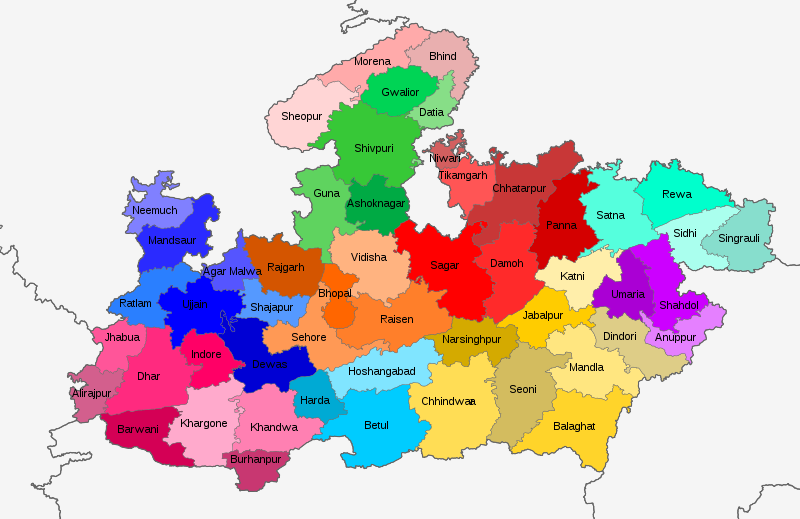
At the local level, the state is divided administratively into a number of divisions, which in turn are
subdivided into numerous districts. Each division is headed by a commissioner and each district by a
collector. The collector exercises both executive and magisterial power. Since 1962 the lowest level of
local administration has been entrusted to village panchayats (village councils). In addition, official
grievance-redressal committees help to solve local problems.em and conflicting interests with state-level
development agencies, the system became less
effective.
Every district in Madhya Pradesh has at least one hospital, typically in an urban centre, and hundreds of
community and primary health centres and subcentres spread across the rural areas. The state also has
several eye hospitals, mental hospitals, and other specialized facilities for the prevention and treatment
of tuberculosis, venereal disease, and rabies, which, along with filariasis and leprosy, have remained major
health concerns. Gwalior has a cancer research centre. Malaria, which was formerly endemic throughout Madhya
Pradesh, has been virtually eradicated.
The government has implemented several social welfare programs, including adult literacy classes and various
schemes directed toward the special problems of rural youths, the Scheduled Tribes, and members of other
traditionally marginalized communities. There are also a number of programs for women and girls, which
include informal social service clubs called mahila mandals, schemes for helping rural women with problems
of motherhood, and programs that make education available to girls from economically disadvantaged families.
Grants-in-aid are given to social welfare and physical welfare institutions, while the government operates
leprosy clinics, as well as homes for the impoverished or otherwise needy citizens.
Roughly two-thirds of the state’s population is literate. There are schools for primary, middle, and high school education, as well as specialized schools for polytechnics, industrial arts, and crafts. Madhya Pradesh has a number of state universities; among these, the Dr. Harisingh Gour University (1946; formerly University of Saugar), located at Sagar, and Vikram University (1957), in Ujjain, are the oldest and best-known, while the music school at Khairagarh is one of the finest in India. Jabalpur has an agricultural university, and there is an institute of journalism and public relations in Bhopal
The state has several well-known annual cultural events, such as Kalidas Samaroh (for the visual and performing arts) in Ujjain, Tansen Samaroh (classical music) in Gwalior, and a dance festival in Khajuraho, where artists from all over India participate. In Bhopal there is a unique multifaceted cultural complex, the Bharat Bhavan, which functions as a meeting ground for artists from various fields; the sprawling complex houses a museum, a library, an open-air theatre, and a number of conference halls. The state has important yearly religious melas (gatherings) in Mandsaur (Mandasor) and Ujjain, both in the Malwa region of western Madhya Pradesh.