The climate is temperate in the valley and cold in the hills. In summer the average high temperature is in the low 90s F (about 32–34 °C), while in the winter temperatures can drop into the mid-30s F (about 1–2 °C). Rainfall is abundant, with about 65 inches (1,650 mm) of precipitation occurring annually. November through February are the state’s driest months.
The hills are densely covered with mixed forests containing stands of bamboo and teak. Other trees include oak, magnolia, and chinquapin. The Luzon pine grows in the Naga Hills. Among the state’s notable plants are rhododendrons, primroses, and blue poppies. Animal life includes the Asiatic elephants, tigers, leopards, and wild buffalo. The Indian one-horned rhinoceros, once found occasionally in Manipur, has largely disappeared from the state because of illegal poaching. The brow-antlered deer is in danger of extinction. Gaurs are the largest wild bison in the world; the mithan (gayal), the domesticated form, is widely distributed in the state.
About two-thirds of the people are Meitei (Meetei), who occupy the Manipur valley and are largely Hindus. Meitei
women conduct most of the trade in the valley and enjoy high social status. Indigenous hill tribes, such as the
Nagas in the north and the Kukis in the south, make up the rest of the population. Divided into numerous clans
and sections, the people of these tribes speak languages of the Tibeto-Burman family and practice traditional
animist religions. Some of the Nagas have been converted to Christianity. More than three-fifths of the people
speak Manipuri, which, along with English, is the official language of the state. Manipur’s population is
largely rural, Imphal being the only city of any size.
Agriculture and forestry are the main sources of income. Rice is the major crop, and the rich soil also supports corn (maize), sugarcane, mustard, tobacco, orchard fruits, and pulses (legumes). Terracing is common in the hills, where the farmers plow the ground with hand hoes. Among some of the hill tribes, domestic animals are kept only for meat and are not milked or used for hauling. Teak and bamboo are major forestry products. The Nagas are known to use intoxicants to catch fish.
Manipur remains somewhat isolated from the rest of India, and communications within the state are poor. A national highway passes through the state from Tamu on the Myanmar border in the south via Imphal to Dimapur (in Nagaland) in the north; this highway also connects Imphal with the Northeast Frontier Railway near Dimapur. There are air links from Imphal to Guwahati and Silchar in Assam and to Kolkata (Calcutta) in West Bengal state.
The governor, appointed by the president of India, is the constitutional head of the state. The governor
functions on the advice of the elected chief minister and the Council of Ministers. Manipur has a unicameral
legislature consisting of a Vidhan Sabha (Legislative Assembly) of 60 members. The state’s High Court, which is
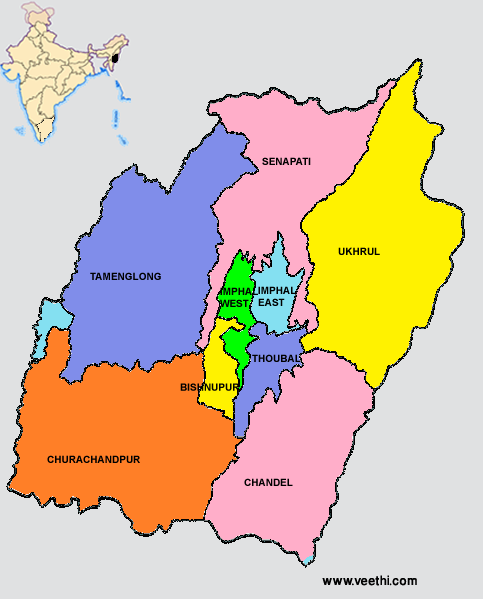
located in Imphal, heads the state judiciary. Manipur is divided into 16 administrative districts.
The state is divided into nearly three dozen administrative districts. The revenue and general
administration of each district is overseen by the district collector, who also functions as the district
magistrate for the maintenance of law and order. With a view toward involving the people in local
government, elected governing councils (panchayats) were introduced at the village level in 1963.
About three-fifths of the population is literate; the state has a university at Imphal and more than 30
colleges. Major health problems include tuberculosis, leprosy, venereal disease, and filariasis. The state
continues to have an inadequate number of health facilities.
Polo and field hockey are popular sports. Manipur has given birth to an indigenous form of classical dance known as manipuri. Unlike other Indian dance forms, hand movements are used decoratively rather than as pantomime, bells are not accentuated, and both men and women perform communally. The dance dramas, interpreted by a narrator, are a part of religious life. Themes are generally taken from the life of Krishna, the pastoral god of Hinduism. Long an isolated art form, manipuri was introduced to the rest of India by the poet Rabindranath Tagore in 1917.