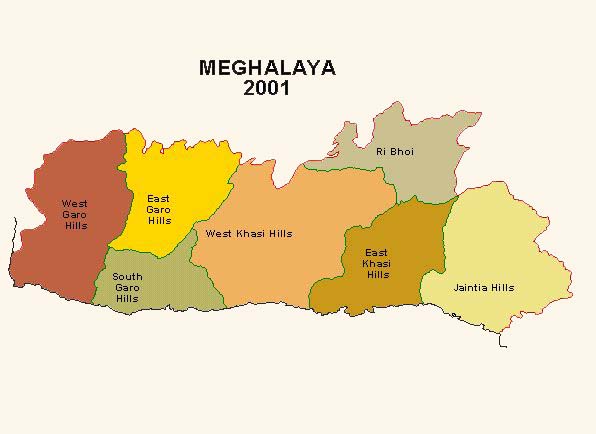
The climate of Meghalaya is generally mild. In August the mean temperature at Shillong (in the Khasi Hills) is
in the low 70s F (about 21–23 °C); it falls to the upper 40s F (about 8–10 °C) in January.
One of the world’s wettest regions is found in Meghalaya—Cherrapunji, which has an average annual precipitation
of about 450 inches (11,430 mm) during monsoon season (from May to September). (Rainfall at Cherrapunji may be
exceeded, however, by that at Mawsynram, a village directly west of Cherrapunji, where rainfall totals of some
700 inches [17,800 mm] per year have been recorded.) Annual rainfall in Shillong, only about 50 miles (80 km)
from Cherrapunji, is about 90 inches (2,290 mm). During the winter months (December to February), the climate is
relatively dry.
Meghalaya is blanketed in lush forests, and pines, sals, and bamboo are plentiful. Other species include oak, birch, beech, and magnolia. Elephants, tigers, leopards, deer, wild pigs, gaurs (wild bison), mithan (or gayals, the domesticated form of the gaur), wolves, anteaters, monkeys, apes, squirrels, snakes, hares, and sambar deer are all found in the state. Birds in Meghalaya include peacocks, partridges, pigeons, hornbills, jungle fowls, mynas, and parrots.
TMost of the inhabitants of Meghalaya are Tibeto-Burman (Garos) or Mon-Khmer (Khasis) in origin, and their
languages and dialects belong to these groups. The Khasis are the only people in India who speak a Mon-Khmer
language. Khasi and Garo along with Jaintia and English are the state’s official languages; other languages
spoken in the state include Pnar-Synteng, Nepali, and Haijong, as well as the plains languages of Bengali,
Assamese, and Hindi.
Christianity, Hinduism, and animistic forms of Hinduism are the major religions in the area. There are also a
small minority of Muslims and even smaller groups of Buddhists and Sikhs.
The population is predominantly rural, and few towns exist in the state. Shillong is the largest town; other
urban centres, listed in descending order of population, include Tura, Mawlai, Nongthymmai, and Jowai.
Agriculture is the dominant economic activity of the state. The main crops grown in Meghalaya are rice, millet, corn (maize), potatoes, pepper, chilies, cotton, ginger, jute, betel nuts, fruits (including oranges and mangoes), and vegetables. Communal land ownership is common, but jhum (shifting cultivation) has eroded the soil.
GMeghalaya has abundant but untapped natural resources, including coal, limestone, kaolin, feldspar, quartz,
mica, gypsum, bauxite, and other minerals. Its sillimanite deposits (a source of high-grade ceramic clay) are
reputedly the best in the world and account for almost all of India’s sillimanite output. Electricity is
produced through several hydroelectric power plants in the state; however, during times when rainfall is scarce,
power must be imported.
Internal communications are poor, and many areas remain isolated. There are no railways in Meghalaya. A national highway runs through the state from Guwahati (Assam) in the north to Karimganj (Assam) in the south. Shillong is served by a domestic airline handling short-haul, low-capacity routes at Umroi, about 18 miles (30 km) from Shillong; and in 2008 an airport opened at Tura, in the western part of the state.
Like other states of the Indian union, Meghalaya has a governor, appointed by the president of India. A Council
of Ministers, headed by a chief minister, is appointed from an elected Legislative Assembly (Vidhan Sabha). The
state’s judiciary is headed by the High Court in Shillong. The state has 11 administrative districts.
The state is one of the least developed in India. About three-fifths of the people are literate. However, the
state does have a number of colleges and institutes of higher education, including North-Eastern Hill University
at Shillong. The 1947 partition of the subcontinent disrupted the tribal populations; some tribes found
themselves divided by the new international frontier, and this resulted in tribal migrations from East Pakistan
(now Bangladesh) to India.
Meghalaya is rich in tribal culture and folklore. Drinking and dancing to the accompaniment of music from singas
(buffalo horns), bamboo flutes, and drums are integral parts of religious ceremonies and social functions.
Marriages are exogamous. However, the advent of Christianity in the mid-19th century, along with its strict
morality, disrupted many of the tribal and communal institutions.
A curious custom among the Garos is that after marriage the youngest son-in-law goes to live in his wife’s
parents’ house and becomes his father-in-law’s nokrom, or clan representative in the mother-in-law’s family. If
the father-in-law dies, the nokrom marries (and the marriage has to be consummated) the widowed mother-in-law,
thus becoming the husband of both mother and daughter. The custom has been falling into disuse. The Khasis
formerly practiced human sacrifice.