The climate in Mizoram is moderate. During the coolest months (November through February), temperatures in Aizawl typically rise from the low 50s (low 10s C) into the high 60s F (about 20 °C) daily. In the warmest months (June through August), minimum temperatures are in the high 60s F, while maximum temperatures usually peak in the mid-80s F (about 30 °C). Rainfall averages about 100 inches (2,500 mm) annually, with most brought by the southwest monsoon (which blows from May to September).
More than three-fourths of the land area of Mizoram is forested. Thick evergreen forests contain valuable timber trees, such as champak (Michelia champaca), ironwood, and gurjun (genus Dipterocarpus). The woodlands also provide habitat for many animals, including elephants, tigers, bears, deer, monkeys, gibbons, and serows (wild goatlike mammals). Such animals are protected in a number of national parks and wildlife sanctuaries.
The residents of Mizoram consist almost entirely of Scheduled Tribes (an official category embracing indigenous
groups that fall outside the predominant Indian social hierarchy). These groups are loosely called Mizo, a local
term meaning “highlanders.” Among the most prominent of the Mizo peoples are the Kuki, Pawi, and Lakher. Most of
the Mizo are Tibeto-Burman peoples, speaking Mizo or a closely related Tibeto-Burman language or dialect. One
group in the state, however, the Chakma, speaks an Indo-Aryan language. Mizo and English are the principal and
official languages. Having no script of its own, Mizo uses the Roman alphabet.
Christian missionaries began to work in the Mizo Hills area in the late 19th century. Consequently, the great
majority of the population is Christian—predominantly Protestant—with most conversions having occurred in the
1920s and ’30s. Buddhists form the largest religious minority in Mizoram, followed by Hindus and Muslims; there
also are tiny groups of Sikhs and Jains.
Mizoram is one of the most sparsely populated states of India. The population density decreases from north to
south, owing primarily to a southward increase in humidity and temperature that renders the area less desirable
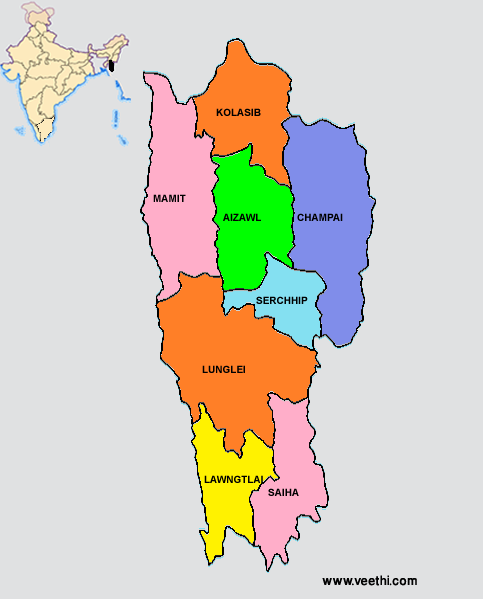
for habitation. Aizawl is the state’s only major city; large towns include Lunglei, in the eastern part of the
state, and Champhai, in the south-central region.
Agriculture is the dominant economic activity of Mizoram, engaging more than two-thirds of the workforce in the early 21st century. Two types of agriculture are practiced: terrace cultivation, in which crops are planted on relatively permanent, graduated terraces on the sides of hills and mountains to conserve water and reduce soil loss; and shifting agriculture, in which tracts—called jhum—are cleared by burning, cultivated for a limited period of time, and then abandoned for a number of years to allow regeneration of the natural vegetation and nutrients in the soil. An increase in the number of people farming in the 20th century forced a reduction in the traditional eight-year cycle of jhum regeneration, which in turn resulted in a decrease in farm productivity. Rice, corn (maize), cotton, and vegetables are the main crops.
The infrastructure of Mizoram remains limited. However, the state is traversed by two national highways, and major roads serve most of the larger towns. Regular bus routes operate across the state, and some also provide interstate service. A small airport offers flights from Aizawl to neighbouring states. There are no railways in Mizoram.
The basic governmental structure of Mizoram, like that of most other Indian states, is determined by the national constitution of 1950. The governor, appointed by the president of India, is the head of state and is assisted by the chief minister, the Council of Ministers, and the unicameral Legislative Assembly (Vidhan Sabha). The state is divided into several administrative districts, each headed by a deputy commissioner. The state is served by the High Court of Guwahati (Assam), and there is a permanent bench in Aizawl. Lower courts include district council and village courts. In Mizoram, the judiciary is not separate from the executive branch of government.
Early development and promotion of institutionalized education in Mizoram is attributable largely to Christian
missionaries, who established the first schools in the area around the turn of the 20th century. By the early
21st century, Mizoram had some 2,000 primary, middle, and secondary schools, and its rate of literacy was among
the highest of all Indian states.
In 2001 Mizoram University was established in Tahnril, near Aizawl. It replaced a branch of North Eastern Hill
University (based in the state of Meghalaya), which until that time had been the principal university in the
state. Other institutions of higher learning include the Aizawl Theological College (1907) and Hrangbana College
(1980), both in Aizawl, as well as various technical colleges and teachers’ training institutes.
Music and dance are important elements in Mizo cultural life, with many festivities associated with the Christian holidays. Other celebrations, however, are centred on significant phases of the agricultural cycle. The mim kut, for instance, is held in August or September, after the first harvest of the year; it is intended both to give thanks and to honour deceased relatives. The pawl kut is also a harvest festival, which takes place in December or January. Among shifting agriculturalists, the chapchar kut is held at the start of the agricultural year, after the forest has been felled and before the burning of the new fields begins—usually sometime in March.