Nagaland has a monsoonal (wet-dry) climate. Annual rainfall averages between 70 and 100 inches (1,800 and 2,500 mm) and is concentrated in the months of the southwest monsoon (May to September). Average temperatures decrease with greater elevation; in the summer temperatures range from the low 70s F (about 21–23 °C) to the low 100s F (about 38–40 °C), while in the winter they rarely drop below 40 °F (4 °C), though frost is common at higher elevations. Humidity levels are generally high throughout the state.
Forests cover about one-sixth of Nagaland. Below 4,000 feet (1,220 metres) are tropical and subtropical
evergreen forests, containing palms, rattan, and bamboo, as well as valuable timber species (notably mahogany).
Coniferous forests are found at higher elevations. Areas cleared for jhum (shifting cultivation) have a
secondary growth of high grass, reeds, and scrub jungle.
Elephants, tigers, leopards, bears, several kinds of monkeys, sambar deer, buffalo, wild oxen, and the
occasional rhinoceros live in the lower hills. Porcupines, pangolins (scaly anteaters), wild dogs, foxes, civet
cats, and mongooses also are found in the state. The longtail feathers of the great Indian hornbill are
treasured for use in traditional ceremonial dress.
The Nagas, an Indo-Asiatic people, form more than 20 tribes, as well as numerous subtribes, and each one has a
specific geographic distribution. Though they share many cultural traits, the tribes have maintained a high
degree of isolation and lack cohesion as a single people. The Konyaks are the largest tribe, followed by the
Aos, Tangkhuls, Semas, and Angamis. Other tribes include the Lothas, Sangtams, Phoms, Changs, Khiemnungams,
Yimchungres, Zeliangs, Chakhesangs (Chokri), and Rengmas.
The Naga tribes lack a common language; there are about 60 spoken dialects, all belonging to the Sino-Tibetan
language family. In some areas dialects vary even from village to village. Intertribal conversation generally is
carried on through broken Assamese, and many Nagas speak Hindi and English. English is the official language of
the state
The traditional Naga religion is animistic, though conceptions of a supreme creator and an afterlife exist.
Nature is believed to be alive with invisible forces, minor deities, and spirits with which priests and medicine
men mediate. In the 19th century, with the advent of British rule, Christianity was introduced, and Baptist
missionaries became especially active in the region. As a result, the population is about two-thirds Christian,
with Hindus and Muslims following in numbers of adherents. (Remains of the Hindu kingdom that was destroyed by
the Ahom in the 16th century are at Dimapur [the ancient Kachari capital], on the eastern border of Nagaland
facing Assam.)
Nagaland is a rural state. More than four-fifths of the population lives in small isolated villages. Built on
the most prominent points along the ridges of the hills, these villages were once stockaded, with massive wooden
gates approached by narrow sunken paths. The villages are usually divided into khels, or quarters, each with its
own headmen and administration. Dimapur and Kohima are the only urban centres with more than 50,000 people.
Agriculture employs about nine-tenths of the population. Rice, corn (maize), small millets, pulses (legumes), oilseeds, fibres, sugarcane, potato, and tobacco are the principal crops. Nagaland, however, still has to depend on imports of food from neighbouring states. The widespread practice of jhum has led to soil erosion and loss of soil fertility. Only the Angamis and Chakhesangs of the southern regions of Kohima use terracing and irrigation techniques. Traditional implements include the light hoe, the dao (a multipurpose heavy knife), and the sickle; except in the plains, the plow is not used. Forestry is also a primary source of income and employment.
Chromium, nickel, cobalt, iron ore, and limestone are found in Nagaland, but only low-grade coal deposits are
mined at present. Boreholes drilled in the western district of Wokha have yielded oil, and seepages in the Dikhu
valley, near Assam, suggest the presence of exploitable oil reserves.
Power generation depends mainly on diesel plants, though hydroelectric output has increased. More than half of
Nagaland’s power is generated in Assam state.
Nagaland depends mostly on roads for transportation. A national highway runs from Dimapur to Kohima and then on to Imphal in Manipur. Another main road links Mokokchung with Amguri in Assam state. A short stretch of the Northeast Frontier Railway passing through Dimapur from Assam is the only rail link with the rest of India. Air service is available from Dimapur to Guwahati in Assam and to Kolkata (Calcutta) in West Bengal state.
Nagaland is governed by a Council of Ministers, headed by a chief minister, which is responsible to the
60-member Legislative Assembly (Vidhan Sabha). The constitutional head of state is the governor, appointed by
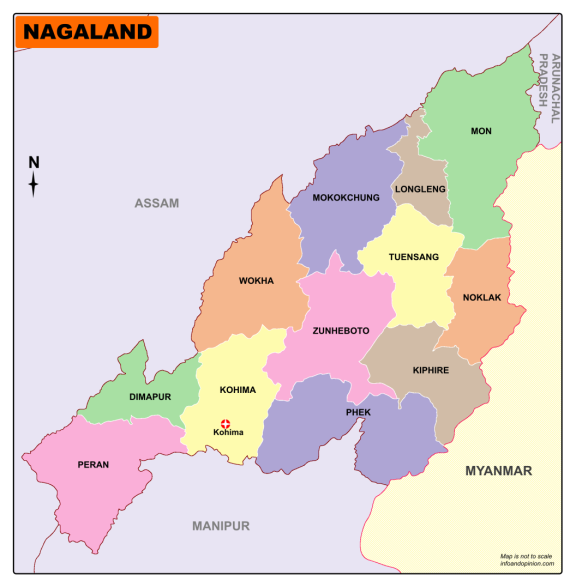
the president of India. The state is divided into seven administrative districts.
Unlike other Indian states, Nagaland has granted a large degree of autonomy to its various tribal communities.
Each tribe has a hierarchy of councils (at the village, range, and tribal levels) to deal with disputes
involving breaches of customary laws and usages. Appeals of such cases are made to the Naga Tribunal. Special
administrative provisions were made for the Tuensang district, which was put under a regional council elected by
all the tribes within the district’s boundaries.
The state has placed considerable emphasis on public health. It has programs for treating tuberculosis and
malaria and for improving drinking water supplies
More than four-fifths of Nagaland’s population is literate, which is higher than the national average. In
addition to its numerous primary and secondary schools, the state has a number of colleges for higher education,
including Nagaland University, which is administered by the union government.
Tribal organization varies from the autocratic angs (chiefs) of the Konyaks and hereditary chieftainships of the Semas and Changs to the democratic structures of the Angamis, Aos, Lothas, and Rengmas. A prominent village institution is the morung (a communal house or dormitory for young unmarried men), where skulls and other trophies of war formerly were hung. The pillars are still carved with striking representations of tigers, hornbills, and human and other figures. Women hold a relatively high and honourable position in Naga society. They work in the fields on equal terms with men and have considerable influence in the tribal councils. A central feature of Naga life is the Feast of Merit, a series of ceremonies culminating with the sacrifice of a mithan (a domesticated guar). Each tribe has its gennas, or festivals, and Naga dance, music, song, and folklore all express an exuberant concern for life.