Odisha is located in a climatic region known as tropical wet-dry (or tropical savanna). In January, the coolest month, high temperatures in Cuttack typically rise into the mid-80s F (about 30 °C) from a low in the mid-50s F (low 10s C). In May, the warmest month, temperatures usually reach the mid-90s F (mid-30s C) from a low in the low 70s F (low 20s C). The higher elevations of the hills provide some relief from the summer heat, which becomes particularly oppressive in the basins of the central tract. Average annual rainfall in the state is about 60 inches (1,500 mm), mostly occurring during the months of the southwest monsoon (June through September). The Eastern Ghats receive heavier precipitation, while the coastal area south of Chilka Lake, which is the driest region in the state, may receive less than 50 inches (1,300 mm) annually.
Odisha’s forests cover nearly one-third of the state. They are commonly classified into two categories: tropical
moist deciduous and tropical dry deciduous. The first type occupies the hills, plateaus, and more-isolated areas
within the northeastern part of the state, while the second is found in the southwest. From northeast to
southwest, the density of forest cover generally decreases. Bamboo grows in both forest types, as do tropical
hardwoods, such as teak, rosewood, and padauk.
Odisha’s woodlands are inhabited by an array of wildlife, much of which is protected in parks and sanctuaries
established by the state and national governments. Notable mammals include elephants, gaurs (wild cattle),
blackbucks, four-horned antelope, several types of tigers, and various species of monkeys. Peacocks are among
the characteristic birds of Odisha’s forests. In the east-central coastal region, Chilka Lake is a breeding
ground for many fish and waterfowl.
Scheduled Tribes (the official government designation applied to indigenous peoples who fall outside the
predominant Indian social hierarchy) and Scheduled Castes (formerly called “untouchables”; the official name for
groups that occupy a low position within the caste system) together constitute some two-fifths of the population
of Odisha. The tribal peoples are divided into three linguistic groups: the speakers of Munda languages of the
Austroasiatic language family, the speakers of various languages of the Dravidian family, and the speakers of
Odia (or Oriya), which is an Indo-Aryan language. Historically, the Santhal, Savara, and Juang peoples have been
among the most prominent of the Munda speakers, while the Khond, Gond, and Oraon (Kurukh) have been the
principal speakers of Dravidian languages. The Bhuiyan speak Odia. By the early 21st century, many of the tribal
peoples had adopted Odia as their primary language. Odia is the official language of Odisha and is spoken by
most of Odisha’s nontribal population, except in some parts of the northeast, where Bengali is widely spoken.
Hindus make up the overwhelming majority of the population of Odisha. Muslims are the largest religious minority
in all areas of the state except in certain administrative localities, including Sundargarh, Ganjam, Koraput,
and Phulabani, where there are greater numbers of Christians. In none of the state’s districts, however, does a
single minority religion claim more than a tiny fraction of the population.
The caste structure in Odisha is similar to that in other states of eastern India. Just below the highest-level
Brahmans are the Karanas (the writer class), who claim Kshatriya (military) status, with the pen as their weapon
rather than the sword. The Khandayats (literally, “Swordsmen”) are mostly cultivators but call themselves
“Khandayat-Kshatriyas.” The tribal peoples for a long time have been undergoing the process of Hinduization, and
many tribal chieftains also have claimed Kshatriya status. All castes look to Jagannatha, one of the
incarnations of the Hindu god Vishnu, as the centre of their religious faith. For centuries the city of Puri,
known as the abode of Jagannatha, has been the only place in India where all castes eat together.
Odisha has a predominantly rural population. The irrigated rice-farming region of the coastal plains is heavily
populated. Although some tribal peoples have settled in the plains, most live in the hill areas. The major
cities are Bhubaneshwar, Cuttack, Brahmapur, Raurkela, Sambalpur, and Puri. All are in the coastal region except
Raurkela and Sambalpur, which are in the northwestern part of the state.
Although much of the land is either unproductive or unsuitable for more than a single annual crop, about three-fifths of the working population is engaged in agriculture, and the sector accounts for roughly one-sixth of the state’s gross product. Cultivated lands occupy about one-third of the total area of the state; about three-fourths of those lands are sown with rice. Other important crops include pulses (legumes), oilseeds, vegetables, cereals (such as wheat, corn [maize], sorghum, and pearl millet), jute, sugarcane, coconuts, and spices. Low sunlight availability, modest soil quality, limited use of fertilizer, and variable volume and timing of the monsoon rains combine to give the state’s farmers generally low yields. Agricultural families sometimes supplement their income through nonagricultural pursuits, as farming does not typically provide year-round employment.
The mineral resources of Odisha are considerable. The state is a national leader in the production of chromite,
bauxite (aluminum ore), manganese ore, graphite, and nickel ore. It is also one of the top producers of
high-quality iron ore. Coal from the Talcher field near the east-central city of Dhenkanal provides the energy
base for a number of the state’s large-scale industries.
Aside from its “captive power plants” (power plants that are dedicated to specific industries), the bulk of
Odisha’s energy comes from hydroelectric stations. Indeed, the great Mahanadi River system has been harnessed by
one of the most ambitious multiple-purpose projects on the subcontinent; the Hirakud Dam and the Machkund
hydroelectric project, together with several smaller units, provide flood control, irrigation, and power to the
entire lower basin. Thermal plants are a significant secondary source of power.
Communication facilities were undeveloped before 1947, but the merger of a number of feudatory states with what
was then Orissa and the discovery of mineral resources required the construction of a network of good roads.
Beginning in the mid-20th century, bold construction programs—such as the building of bridges over most of the
principal rivers—were undertaken by the state government, and by the early 21st century national highways and
major roads covered most regions of the state.
Odisha also is served by a number of railways. Major train stations are located in Bhubaneshwar, Puri,
Baleshwar, Cuttack, Khurda Road (just southwest of Bhubaneshwar), and Brahmapur—all in the coastal plains. There
is an all-weather, sheltered, deep-draft port at Paradip, at the mouth of Mahanadi River. That port has become
an important departure point for the state’s exports, especially coal. An airport in Bhubaneshwar offers
domestic service.
The government of Odisha, like that of most other states and territories in India, is determined by the national
constitution of 1950. The head of state is the governor, appointed by the president of India. The actual
administration, however, is conducted by the Council of Ministers, which is headed by a chief minister and
responsible to the unicameral Legislative Assembly (Vidhan Sabha), whose members are elected at intervals of not
more than five years through universal adult suffrage. There is a high court in Cuttack; its chief justice is
appointed by the president of India. Below the high court are district and sessions courts, magistrates’ courts,
and various courts that handle particular types of cases.
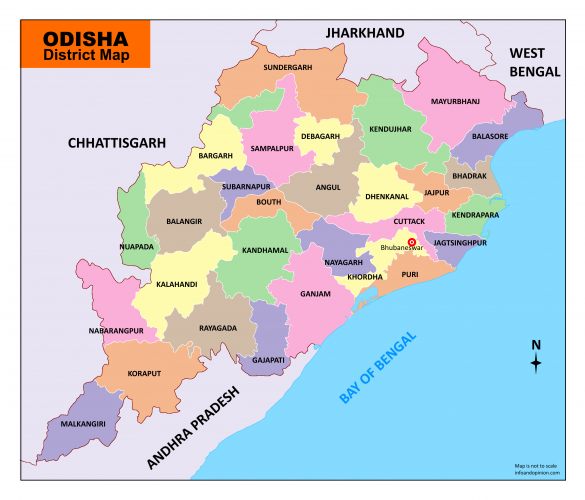
Odisha is divided into about 30 districts, grouped into several revenue divisions, each under a divisional
commissioner. A board of revenue is in charge of revenue administration. The district administration is
conducted by a deputy commissioner, who is also the district magistrate. The districts are divided into tahsils,
each having a tahsildar as its revenue officer. Tahsils comprise groups of villages, administered by panchayats
(village councils), to which villagers elect their representatives. A sarpanc (elected president) heads each
panchayat. The towns are administered by municipalities.
At one time there was a high rate of malaria along the coastal belt, and the whole state was subject to
epidemics of cholera and smallpox. The incidence of filariasis (a disease caused by the presence of filarial
worms in the blood and glands), leprosy, and tuberculosis was also high. Since the mid-20th century much
attention has been paid to health services, and great progress in reducing the incidence of those diseases has
been achieved through various programs. Nevertheless, with the exception of cholera and smallpox, which have
been brought under control, those diseases as well as sexually transmitted diseases (including HIV/AIDS) and
measles have remained a concern and a focus of state health initiatives. Allopathic (Western), Ayurvedic
(ancient Indian), and homeopathic medical treatment is available throughout the state.
The state conducts various programs to improve and broaden educational, cultural, economic, and social
opportunities for tribal peoples and other disadvantaged groups. A research and training institute in
Bhubaneshwar is charged with collecting information to assist the state government in formulating plans and
policies regarding tribal welfare. Other schemes, such as public education initiatives and the expansion of
urban immunization and health services, aim to better the welfare of women and children.
Although the number of educational institutions in Odisha has increased considerably since the mid-20th century, the state’s literacy rate has remained below the national average, and only a small fraction of Odisha’s population is university-educated. Higher education is available, however, at several local universities (and numerous associated colleges). Of the universities, Utkal University (founded 1943) and Orissa University of Agriculture & Technology (1962), both in Bhubaneshwar, are the largest and best known. Training in allopathic, Ayurvedic, and homeopathic medicine is offered at more than a dozen government and private colleges. Odisha also has numerous pharmacy colleges and nursing schools.
Odisha has a rich artistic heritage and has produced some of the finest examples of Indian art and architecture.
Among the most-notable traditions in the visual arts are mural painting, stone carving, wood carving, icon
painting (known as patta), and painting on palm leaves. The state also is widely recognized for its exquisite
silver filigree ornamentation, pottery, and decorative work.
In tribal areas Odisha has a wide variety of dances. Music of the madal (a type of local drum) and flute is
characteristic of the countryside. The classical dance of Odisha, known as odissi, has survived for more than
700 years. Originally it was a temple dance performed for the gods. The movements, gestures, and poses of the
dance are depicted in relief on the walls of the great temples. Chhau, a type of masked dance associated with
the Mayurbhanj district and adjacent areas in the north, is emblematic of Odia culture. For the promotion of
dancing and music, the Kala Vikash Kendra centre was founded at Cuttack in 1952, and it has continued to be a
prominent arts performance and training venue in Odisha.
Odisha is the site of many traditional festivals. One that is unique to the state is the ceremony of
Boita-Bandana (worshipping of boats) in October or November (the date is set to the Hindu calendar). For five
consecutive days before the full moon, people gather near riverbanks or the seashore and float miniature boats
in remembrance of their ancestors who once sailed to faraway lands (such as Malaysia and Indonesia).
The town of Puri is the site of the Jagannatha temple, perhaps the most famous Hindu shrine in India, and of the
temple’s annual Chariot Festival, which attracts hundreds of thousands of people; the English word juggernaut,
derived from the temple’s name, was inspired by the massive, nearly unstoppable wagons used in the festival. A
short distance away, in Konark (Konarak), is a 13th-century temple that reinforces the significance of the
chariot in the region; it is constructed in the form of the chariot of the Hindu sun god, Surya.