Punjab has an inland subtropical location, and its climate is continental, being semiarid to subhumid. Summers are very hot. In June, the warmest month, daily temperatures in Ludhiana usually reach about 100 °F (upper 30s C) from a low in the upper 70s F (mid-20s C). In January, the coolest month, daily temperatures normally rise from the mid-40s (about 7 °C) into the mid-60s F (upper 10s C). Annual rainfall is highest in the Siwalik Range, which may receive more than 45 inches (1,150 mm), and lowest in the southwest, which may receive less than 12 inches (300 mm); statewide average annual precipitation is roughly 16 inches (400 mm). Most of the annual rainfall occurs from July to September, the months of the southwest monsoon. Winter rains from the western cyclones, occurring from December to March, account for less than one-fourth of the total rainfall.
With the growth of human settlement over the centuries, Punjab has been cleared of most of its forest cover.
Over large parts of the Siwalik Range, bush vegetation has succeeded trees as a result of extensive
deforestation. There have been attempts at reforestation on the hillsides, and eucalyptus trees have been
planted along major roads.
Natural habitats for wildlife are severely limited because of intense competition from agriculture. Even so,
many types of rodents (such as mice, rats, squirrels, and gerbils), bats, birds, and snakes, as well as some
species of monkeys, have adapted to the farming environment. Larger mammals, including jackals, leopards, wild
boar, various types of deer, civets, and pangolins (scaly anteaters), among others, are found in the Siwaliks.
The people of Punjab are mainly descendants of the so-called Aryan tribes that entered India from the northwest
during the 2nd millennium BCE, as well as the pre-Aryan population, probably Dravidians (speakers of Dravidian
languages), who had a highly developed civilization. Relics of this civilization have been unearthed at Rupnagar
(Ropar). Successive waves of invaders—Greeks, Parthians, Kushans, and Hephthalites (Hunas)—added to the
diversity of earlier social, or caste, groups (jatis). Later, invaders under the banner of Islam forced several
vanquished groups (such as the Jat peasant caste and the Rajput class of landowners) to convert to the Muslim
faith, although many conversions were voluntary under the influence of Sufi saints.
Today, however, the majority religion of Punjab is Sikhism, which originated from the teachings of Nanak, the
first Sikh Guru. Hindus make up the largest minority, but there also is a significant population of Muslims.
There are small communities of Christians and Jains in some areas. Some two-fifths of Punjab’s population
consists of Hindus and Sikhs who officially belong to the Scheduled Castes (formerly called “untouchables”),
which occupy a relatively low position within the traditional Indian caste system.
Punjabi is the official state language. Along with Hindi, it is the most widely spoken. However, many people
also speak English and Urdu.
About one-third of Punjab’s population lives in cities and towns. Its major cities are Ludhiana in the central
region, Amritsar in the northwest, Jalandhar in north-central Punjab, Patiala in the southeast, and Bathinda in
the south-central part of the state. Muslims reside mostly in and around the southwest-central city of Maler
Kotla, which was once the centre of a princely state ruled by a Muslim nawab (provincial governor).
Some two-fifths of Punjab’s population is engaged in the agricultural sector, which accounts for a significant
segment of the state’s gross product. Punjab produces an important portion of India’s food grain and contributes
a major share of the wheat and rice stock held by the Central Pool (a national repository system of surplus food
grain). Much of the state’s agricultural progress and productivity is attributable to the so-called Green
Revolution, an international movement launched in the 1960s that introduced not only new agricultural
technologies but also high-yielding varieties of wheat and rice.
Aside from wheat and rice, corn (maize), barley, and pearl millet are important cereal products of Punjab.
Although the yield of pulses (legumes) has declined since the late 20th century, there has been a rapid increase
in the commercial production of fruit, especially citrus, mangoes, and guavas. Other major crops include cotton,
sugarcane, oilseeds, chickpeas, peanuts (groundnuts), and vegetables
With almost the entire cultivated area receiving irrigation, Punjab is among India’s most widely irrigated
states. Government-owned canals and wells are the main sources of irrigation; canals are most common in southern
and southwestern Punjab, while wells are more typical of the north and the northeast. The Bhakra Dam project in
neighbouring Himachal Pradesh provides much of Punjab’s supply of irrigation water.
Lacking fossil fuels, Punjab draws its energy primarily from thermal plants fired with imported coal. However, a
significant amount of power is provided by hydroelectric plants and, to a lesser extent, by solar power
stations. In the early 21st century the demand for electricity in Punjab continued to exceed the supply.
Punjab has one of the best-developed road networks in the country. All-weather paved roads extend to most villages, and the state is crossed by a number of national highways. Punjab also is well served by the Northern Railway—part of the national railway system. There is an international airport in Amritsar, and regular domestic service is available in Chandigarh and Ludhiana. Several other airports offer cargo service.
Punjab’s services sector includes trade, transportation and storage, financial services, real estate, public administration, and other services. The sector has grown rapidly since the late 20th century. By the early 21st century it had become the largest component of Punjab’s economy.
The structure of Punjab’s government, like that of most other states of India, is determined by the national
constitution of 1950. The state is led by a governor, who is appointed by the president of India. The governor
is aided and advised by a Council of Ministers, which is led by a chief minister and responsible to the
unicameral Legislative Assembly (Vidhan Sabha).
At the head of the judiciary is the High Court, which is located in Chandigarh and is shared with the state of
Haryana. Appeals from the High Court are directed to the Supreme Court of India. Below the High Court are
district-level courts.
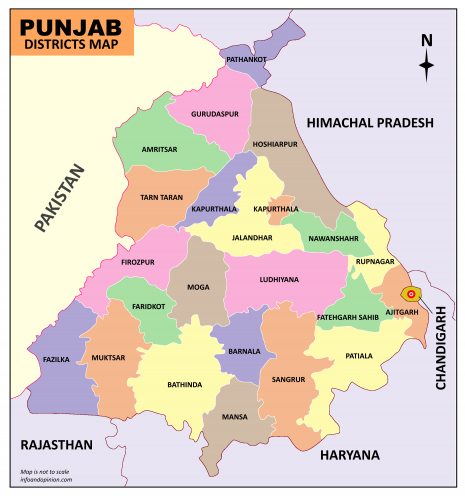
The state is divided into about two dozen districts, which are grouped into several revenue divisions. Each
district is headed by a deputy commissioner. The districts are parceled further into a number of tehsils, or
subdivisions. Lower administrative and revenue units include circles, blocks, and villages, as well as police
districts and police stations.
Punjab enjoys better health conditions than most states in India. Hospitals attached to medical colleges,
district- and tehsil-level medical facilities, health care centres in rural areas, and numerous dispensaries
constitute a widespread health care network.
Numerous social services are provided by government and voluntary organizations. The government provides
pensions for the elderly and operates a network of employment exchanges to assist the unemployed. The state also
has schemes to aid those from traditionally disadvantaged social groups through scholarships, employment
services, and assorted loans and grants for business activities.
In addition to the government, private organizations have played a significant role in the extension of
education at the primary, secondary, and tertiary levels throughout the state. Education is compulsory and free
for pupils aged 6 to 14. Secondary education is also free in state schools. Broadcasting has been especially
important in the dissemination of vocational and cultural education throughout the state.
Punjab has several state universities, including Punjabi University (1962) in Patiala, Guru Nanak Dev University
(1969) in Amritsar, Panjab University (1956) in Chandigarh, Punjab Agricultural University (1962) in Ludhiana,
Punjab Technical University (1997) in Jalandhar, and Baba Farid University of Health Sciences (1998) in
Faridkot. In addition, there are more than 200 specialized colleges and technical institutions.
Ballads of love and war, fairs and festivals, dancing, music, and Punjabi literature are among the
characteristic expressions of the state’s cultural life. The origins of Punjabi literature trace to the mystical
and religious verse of the 13th-century Sufi (mystic) Shaikh Farīd and to the 15th–16th-century founder of the
Sikh faith, Guru Nanak; those figures were the first to use Punjabi extensively as a medium of poetic
expression. The works of Sufi poet Waris Shah greatly enriched Punjabi literature in the second half of the 18th
century. Contemporary in the 20th and early 21st centuries Punjabi literature found some of its greatest
exponents in poet and author Bhai Vir Singh and the poets Puran Singh, Dhani Ram Chatrik, Mohan Singh “Mahir,”
and Shiv Kumar Batalvi; renowned novelists included Jaswant Singh Kanwal, Gurdial Singh, Giani Gurdit Singh, and
Sohan Singh Shital, among others. Kulwant Singh Virk is one of the best-known writers of short stories in
Punjabi
Punjab holds numerous religious and seasonal festivals, such as Dussehra, a Hindu festival celebrating the
victory of Prince Rama over the demon king Ravana, as recounted in the epic Ramayana; Diwali, a festival of
lights celebrated by both Hindus and Sikhs; and Baisakhi, which for Hindus is a new year’s festival and for
Sikhs is both an agricultural festival and a celebration of the birth of the community’s Khalsa order. There
also are numerous anniversary celebrations in honour of the Gurus (the 10 historical leaders of Sikhism) and
various saints. Dancing is a typical feature of such festivities, with bhangra, jhumar, and sammi among the most
popular genres. Giddha, a native Punjabi tradition, is a humorous song-and-dance genre performed by women. In
addition to Sikh religious music, semiclassical Mughal forms, such as the khyal dance and the ṭhumrī, ghazal,
and qawwālī vocal performance genres, continue to be popular.
The state’s outstanding architectural monument is the Harmandir Sahib (Golden Temple) at Amritsar, which blends
Indian and Muslim styles. Its chief motifs, such as the dome and the geometric design, are repeated in most of
the Sikh places of worship. The Harmandir Sahib is rich in gold filigree work, panels with floral designs, and
marble facings inlaid with coloured stones. Other important buildings include the Martyr’s Memorial at
Jallianwalla Bagh (a park in Amritsar), the Hindu Temple of Durgiana (also in Amritsar), the so-called Moorish
Mosque in Kapurthala (patterned after a Moroccan model), and the old forts of Bathinda and Bahadurgarh.