Sikkim exhibits a variety of climatic types, from almost tropical conditions in the south to severe mountain climates in the north. In Gangtok, temperatures in January (the coldest month) drop into the low 30s F (about 0 °C); in August (the warmest month), temperatures may reach the low 80s F (about 28 °C). Depending on elevation and exposure, annual precipitation varies from 50 to 200 inches (1,270 to 5,080 mm), most occurring during the months of the southwest monsoon (May through October). The heavy rains and snows often trigger destructive landslides and avalanches.
More than two-fifths of Sikkim is forested. Sal (a type of hardwood), pandanus, palms, bamboos, ferns, and
orchids are common in the subtropical forests found below about 5,000 feet (1,500 metres). In the temperate
forests (5,000 to 13,000 feet [1,500 to 4,000 metres]), oak, laurel, maple, chestnut, magnolia, alder, birch,
rhododendron, fir, hemlock, and spruce predominate. Alpine tundra replaces forest at the higher elevations.
Sikkim has a rich and varied animal life, including black bears, brown bears, red pandas, numerous species of
deer, blue sheep, gorals (small goatlike mammals), and Tibetan antelope. Tigers, leopards, and lesser cats are
also found. Birdlife includes pheasants, partridges, quail, eagles, barbets, Himalayan cuckoos, Tibetan black
crows, and minivets. Sikkim has several national parks and a number of wildlife sanctuaries, which provide a
protected environment for the state’s diverse flora and fauna. The Kanchenjunga National Park (established in
1977), near the peak from which it draws its name, is among the largest of India’s high-elevation conservation
areas.
Roughly three-fourths of Sikkim’s residents are Nepalese in origin; most speak a Nepali (Gorkhali) dialect and
are Hindu in religion and culture. About one-fifth of the population consists of Scheduled Tribes (an official
category embracing indigenous peoples who fall outside the predominant Indian social hierarchy). The most
prominent of these tribal groups are the Bhutia, the Lepcha, and the Limbu; they all speak Tibeto-Burman
languages and practice Mahayana Buddhism as well as the indigenous Bon religion. There is a notable Christian
minority in Sikkim, as well as a tiny community of Muslims. A small fraction of Sikkim’s people belong to the
Scheduled Castes (an official term designating those peoples who traditionally have occupied a low position
within the Indian caste system).
The great majority of Sikkim’s population is rural, living in scattered hamlets and villages. Gangtok is
Sikkim’s largest settlement. Other notable towns include Singtam, Rangpo, Jorethang, Naya Bazar, Mangan,
Gyalshing, and Namchi.
Sikkim’s economy is based predominantly on agriculture, with the sector engaging more than half of the working population. Corn (maize), rice, buckwheat, wheat, and barley are produced in terraced fields along the valley flanks. Beans, ginger, potatoes, vegetables, fruits, and tea also are grown. Sikkim is one of the world’s principal producers of cardamom. Many of Sikkim’s farmers also raise livestock, including cattle, pigs, sheep, goats, and poultry. Cattle and buffalo are limited mainly to the subtropical humid belt, while yaks and sheep are herded in the higher elevations in the north.
Copper, lead, and zinc are mined in Sikkim. The state also has deposits of other minerals, including coal,
graphite, and limestone. Only a fraction of Sikkim’s mineral resources are commercially exploited.
The hydroelectric potential of Sikkim’s Tista River system is considerable. There are a few large hydroelectric
stations and many smaller plants that provide energy to Gangtok, Rangpo, Singtam, and Mangan. Rural
electrification has remained a government priority.
Roads, though not extensive, are the primary mode of travel. Ropeways, which are similar to ski lifts, also have been provided at many points. The capital of Gangtok is nearly 75 miles (120 km) from the nearest airport, at Baghdogra, and 70 miles (110 km) from the railhead at Shiliguri, both in West Bengal.
The constitution of Sikkim provides for a governor—appointed by the president of India—as the head of state. The
governor is aided by the state Council of Ministers, which is led by a chief minister. The Legislative Assembly
(Vidhan Sabha) is a unicameral elected body, with a portion of the seats allocated to the combined Lepcha and
Bhutia populations. One Lepcha-Bhutia seat is reserved for the nominee of the lamas (Tibetan Buddhist religious
leaders); some seats also are reserved for representatives of the Scheduled Castes. The final court in the
judiciary system is the High Court at Gangtok, from which appeals may be made to the Supreme Court of India.
Lower courts include district courts, which handle both criminal and civil cases, and sessions courts, which
generally handle civil cases; judicial magistrates rule on criminal offenses.
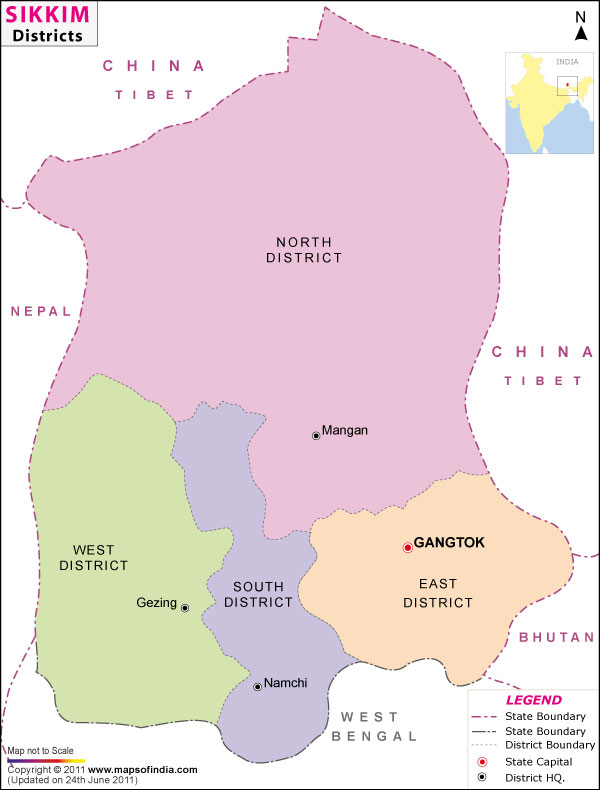
The state is divided into a handful of districts. Within each district, local headmen serve as liaisons between
the people and the district administration. Panchayats (village councils) administer the villages and implement
welfare programs.
Sikkim has several hospitals and, in each district, at least one community health centre. Rural regions are
served by primary health centres and subcentres. The state participates in national programs to control
tuberculosis, blindness, and other diseases. Diarrheal diseases (including cholera), respiratory infections of
various sorts, hepatitis, and family-planning issues remain among Sikkim’s principal health concerns.
Primary and secondary education in Sikkim is offered free of charge through hundreds of government schools. However, there also are many private schools operating within the state. Higher education is available at a number of institutions, including the Sikkim Manipal University of Health, Medical and Technological Sciences (1995) in Gangtok, as well as smaller colleges offering degrees in law, engineering, teaching, religious studies, and other fields.
Sikkim’s cultural life, though showing strong Tibetan influences, retains a character derived from the various tribes of Sikkim and their pre-Buddhist customs. The most important festival of the year is the two-day Phanglhapsol festival in August or September, in which masked dancers perform in honour of Kanchenjunga, the presiding deity. The Namgyal Institute of Tibetology (1958), in Gangtok, has one of the largest collections of Tibetan books in the world. Many monasteries are repositories of wall paintings, thang-kas (religious paintings mounted on brocade), bronze images, and other artworks.