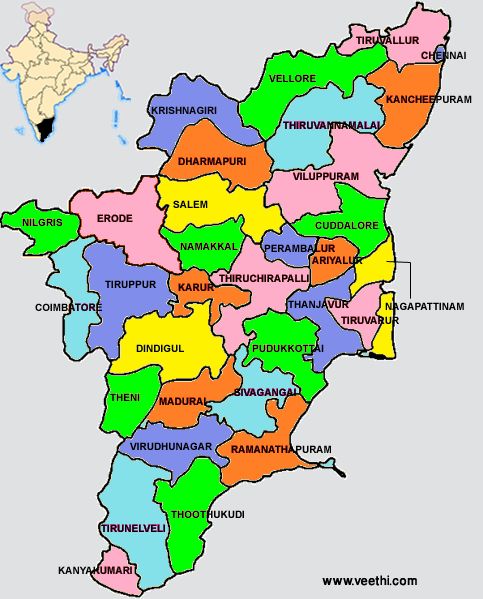
The climate of Tamil Nadu is essentially tropical. In May and June, the hottest months, maximum daily temperatures in Chennai average about 100 °F (38 °C), while minimum temperatures average in the low 80s F (upper 20s C). In December and January, the coolest months, temperatures usually rise from about 70 °F (21 °C) into the mid-80s F (about 30 °C) daily. The average annual precipitation, falling mainly between October and December, depends on the southwest and northeast monsoons and ranges between 25 and 75 inches (630 and 1,900 mm) a year. The mountainous and hilly areas, especially in the extreme western part of the state, receive the most precipitation, while the lower-lying southern and southeastern regions receive the least rainfall.
Forests cover roughly 15 percent of the state. At the highest elevations in the Western Ghats, the mountains
support subalpine vegetation. Along the eastern side of the Western Ghats and in the hills of the northern and
central districts, the plant life is a mixture of evergreen and deciduous species, some of which are markedly
adapted to arid conditions.
Tamil Nadu has several national parks and more than a dozen wildlife and bird sanctuaries. Among the most
notable of these protected areas are the Mudlumbai Wildlife Sanctuary and National Park in the Nilgiri Hills and
the large Indira Gandhi Wildlife Sanctuary and National Park at the southern tip of the Western Ghats. These
sanctuaries provide a safe habitat for a broad spectrum of fauna, including elephants, gaurs (wild cattle),
Nilgiri tahrs (goatlike mammals), wild boars, sloth bears, and various species of deer. Tigers, leopards, and an
assortment of primates, including macaques, langurs, and lorises, also inhabit these areas. Venomous king cobras
are among the many species of reptiles that make their home in Tamil Nadu. Woodpeckers and flycatchers are
common woodland birds; aquatic birds find a haven at the Vedantangal sanctuary in the south-central part of the
state.
The area’s population evidently has changed little over the centuries. As speakers of a Dravidian language, the
Tamils, who constitute the majority of the population, are understood to be descendants of the early inhabitants
of India (the so-called Dravidians), who were driven southward between about 2000 and 1500 BCE when the Aryans
(speakers of Indo-Aryan languages) descended into the Indian subcontinent. In addition to the Tamils, the
population includes various indigenous communities, who live primarily in the hill regions; these people also
speak Dravidian languages. In Tamil Nadu, as in the rest of the country, the caste system is strong, even though
discrimination has been banned by the constitution of India. Members of Scheduled Castes (an official category
embracing those groups that traditionally occupy low positions within the caste system) account for about
one-fifth of the population. Scheduled Tribes (those indigenous peoples who fall outside the caste hierarchy)
account for just a small fraction of Tamil Nadu’s residents.
Tamil, the official state language, is spoken by most of the people. Other Dravidian languages used within the
state include Telugu, which is spoken by roughly one-tenth of the population, as well as Kannada and Malayalam,
which are spoken by much smaller numbers. In the western region—near the convergence of the borders of Tamil
Nadu, Karnataka, and Kerala—Kannada (and its dialect Badaga) and Malayalam are stronger. There also is a
community of Urdu (an Indo-Aryan language) speakers. English is used as a subsidiary language.
The overwhelming majority of Tamil Nadu’s residents practice Hinduism. There are, however, notable minorities of
Christians and Muslims, with a large concentration of Christians in the far southern segment of the state. A
small community of Jains is found in northern Tamil Nadu, in and around the cities of Arcot and Chennai.
Although Tamil Nadu is one of the most urbanized states of India, more than half the population in the early
21st century continued to live in rural areas. The Chennai metropolitan region, covering the industrial areas,
townships, and villages surrounding Chennai city, has the largest population. Other important urban
agglomerations include Coimbatore in western Tamil Nadu, Madurai in the south-central region, and
Tiruchchirappalli in the central part of the state.
Agriculture is the mainstay of life for about half the working population of Tamil Nadu. Since very early times,
Tamil farmers have skillfully conserved scarce rainwater in small and large irrigation reservoirs, or “tanks.”
Government canals, tube wells, and ordinary wells also form part of the irrigation system. Because several of
the river valley projects depend for water on rain brought by the erratic northeast monsoon, the government also
taps subsoil water sources.
Agricultural practices have shown radical improvement since the mid-20th century through multiple cropping, the
use of stronger and more productive strains of staple crops, and the application of chemical fertilizers; since
the late 1960s the state has been self-sufficient in the production of food grains. The principal crops for
domestic consumption are rice, millet, and other cereals, as well as peanuts (groundnuts) and pulses (such as
chickpeas); sugarcane, cotton, cashews, and chilies are important cash crops. Many farmers in Tamil Nadu also
raise livestock, primarily cows (especially for the dairy industry), poultry, goats, and sheep.
Tamil Nadu is one of India’s top fish producers, with most of the yield coming from marine operations, although
there also are many inland fisheries. In addition, the state has an active forestry sector, with pulpwood, babul
(a type of acacia that yields valuable tannin), firewood, bamboo, and teak among the primary products. Rubber,
grown largely in plantations, is important as well.
The major minerals mined in Tamil Nadu are limestone, bauxite, gypsum, lignite (brown coal), magnesite, and iron
ore. The opencast lignite mine at Neyveli, in the north-central part of the state, is among the largest in
India, and its products are used to fuel a thermal-power plant that provides much of the state’s electricity.
The bulk of Tamil Nadu’s energy comes from thermal stations, but hydroelectric plants—especially along the
Kaveri River and its tributaries—provide an important secondary source of energy. The state also is a leader in
wind-power generation.
The transport system of the southern Indian states converges on Chennai. A well-developed road network makes
express bus service available to all major towns and places of interest. Many railways also run through the
state.
Two of India’s major seaports are located in Tamil Nadu—in the north at Chennai and in the south at Tuticorin.
The international airport at Meenambakkam, near Chennai, is one of the largest airports in India. Domestic
flights are available from a number of other cities, including Madurai, Coimbatore, and Tuticorin; the airport
at Tiruchchirappalli offers domestic and limited international service.
The structure of the government of Tamil Nadu, like that of most other states of India, is determined by the
national constitution of 1950. The head of state is the governor, who is appointed by the president of India.
The governor is aided and advised by the Council of Ministers, which is led by a chief minister and is
responsible to the elected unicameral Legislative Assembly (Vidhan Sabha). Most of the ministries are housed in
the 17th-century Fort St. George in Chennai. The state’s judiciary is headed by the High Court in Chennai
(Madras High Court), which has original jurisdiction for the city and appellate jurisdiction for the state; the
High Court also may hear original cases of an extraordinary nature from other parts of Tamil Nadu. A bench of
the High Court is located in Madurai. Lower courts include district and sessions courts, magistrates’ courts,
and munsifs’ (subordinate judicial officers’) courts.
The state is divided into more than two dozen administrative districts, each administered by a district
collector. Lower administrative and revenue units are called talukas, firkas, and villages. Panchayats (village
councils) are responsible for local self-government and rural development.
The medical needs of Tamil Nadu’s population are served by a large number of public and private hospitals,
dispensaries, and primary health centres. Allopathic (Western), Ayurvedic and Siddha (traditional Indian), Unanī
(a Muslim system using prescribed herbs and shrubs), and homeopathic medical treatments are all recognized and
supported by the government and are available throughout the state. Among Tamil Nadu’s primary health concerns
are cholera, malaria, filariasis (disease caused by infestation of the blood and tissues by parasitic worms),
and HIV/AIDS infection. The state has largely brought leprosy under control, although thousands of cases are
still treated annually.
Various government agencies sponsor programs to improve the housing, education, and economic status of the
Scheduled Castes and other traditionally disadvantaged groups. The state also provides assistance to women,
children, and people with disabilities. A special insurance program is available for those with autism, cerebral
palsy, and other developmental disabilities.
Tens of thousands of public and private primary, middle, and high schools are scattered across the state of Tamil Nadu. In addition, there are numerous arts and science colleges, medical colleges, engineering colleges, polytechnic institutes, and industrial training institutes. Among the most prominent of Tamil Nadu’s universities are the University of Madras (1857) and Tamil Nadu Veterinary and Animal Sciences University (1989), both in Chennai, Annamalai University (1929) in Chidambaram; Tamil Nadu Agricultural University (1971) in Coimbatore; and Madurai Kamaraj University (1966) in Madurai. The Dakshina Bharat Hindi Prachar Sabha (1918) in Chennai and the Gandhigram Rural University (1956) in Gandhigram, in southwest-central Tamil Nadu, are the two institutes of national importance that are engaged in popularizing the Hindi language and Mahatma Gandhi’s concept of rural higher education, respectively. Tamil University (1981) near Thanjavur (Tanjore), in the eastern part of the state, focuses on the study of Tamil language, literature, and culture.
Hinduism lies at the core of the culture of Tamil Nadu. Among the most famous of the state’s temples, which
number in the tens of thousands, are the 7th- and 8th-century structures at Mamallapura, which were designated a
UNESCO World Heritage Site in 1984. The gopurams, or gateway towers, of such temples are dominant in most towns,
particularly Chidambaram, Kanchipuram, Thanjavur, Madurai, and the Srirangam pilgrimage centre in
Tiruchchirappalli. The Hindu Religious and Charitable Endowments Administration Department is responsible for
the administration of the state’s temples and sanctuaries.
The cycle of temple festivals attracts large congregations of devotees. Noteworthy also are the car festivals,
during which large chariots decorated with religious icons are taken in procession around the temple. In
addition, Tamil Nadu is scattered with sectarian monastic institutions, or mathas—of which the most important
are the Shankara Matha at Kumbakonam and the Vaishnava compound at Srirangam—which hold various activities;
Hindu families typically owe allegiance to a number of such institutions.
Bharata natyam, one of India’s major classical dance forms, and Karnatak music (South Indian classical music)
are both widely practiced. Painting and sculpture are less prominent, although there are schools that teach the
art of sculpture in stone and bronze. Tamil literature rapidly adopted the Western literary forms of the novel
and the short story. The poet Subrahmanya Bharati (1882–1921) was one of the first to modify traditional Tamil
poetry by blending popular and scholastic literary styles. Motion pictures are the most prevalent form of mass
entertainment. There are both touring and permanent movie theatres, and sentimental and spectacular films, often
featuring music and dancing, are produced by the film studios situated largely around Chennai.