Telangana lies at a crossroads between northern and southern India, and it has a diverse population. In general,
the state’s various communities are identified more readily by a combination of language, religion, and social
class or caste than they are by specific ethnic affiliation. The Dravidian language Telugu is the official and
most widely spoken language in the state. A small minority speaks Urdu, a language primarily of northern India
and Pakistan. Most of the remaining groups speak border-area languages, including Hindi, Kannada, and Marathi.
Lambadi (Banjari) and other languages are spoken by the state’s Scheduled Tribes (the official designation for
indigenous minority peoples). The great majority of Telangana’s residents practice Hinduism, while smaller
numbers of the population follow Islam. Some one-fourth of the state’s people are members of Scheduled Castes
(the official designation for those formerly called “untouchables”) and Scheduled Tribes.
Telangana is largely rural, with roughly two-fifths of the state’s population classified as urban. Hyderabad
accounts for more than half of those in urban areas. The state’s other main cities include Warangal, Nizamabad,
Mahbubnagar, and Adilabad.
Telangana’s economy was long dominated by agriculture, notably the production of rice. The state’s rivers,
particularly the Godavari and the Krishna, have been tapped to provide irrigation for the dry interior, although
many areas still depend on the somewhat unpredictable monsoon rainfall. In addition to rice, other important
crops are corn (maize) and cotton. The Nagarjuna Sagar multipurpose dam project on the border with Andhra
Pradesh, which diverts the waters of the Krishna for irrigation, has substantially increased the production of
rice and sugarcane. Rice flour, rice-bran oil, paints and varnishes, soaps and detergents, cardboard and other
packaging materials, and cattle feed are all produced from local paddy rice. Other agricultural commodities
include chili peppers, sorghum, pulses (peas, beans, and lentils), castor beans, and peanuts (groundnuts), as
well as a variety of tropical fruits. Livestock raising and aquaculture are also important, each accounting for
a small but still significant component of annual economic output.
The state’s woodlands annually yield high-quality timber, such as teak and eucalyptus. Non-timber forest
products—including sal seeds (from which an edible oil is extracted), tendu leaves (for rolling cigarettes), gum
karaya (a type of emulsifier), and bamboo—are also important. The state government initiated a major
reforestation program.
Among Telangana’s principal mineral resources are coal, limestone, quartz, granite, feldspar, dolomite, and
barite. The diamond mines of the Golconda Plateau were once renowned worldwide for producing the Koh-i-noor
diamond and other famous stones; efforts have been made to revive production in the area. Most of Telangana’s
energy is produced by thermal generators in the public sector, with hydroelectric power stations providing an
important secondary source of energy. In addition, the government has taken steps to develop wind and solar
energy production.
The industrial sector—including manufacturing, utilities, and construction—has become a major factor in
Telangana’s economy. The Hyderabad area has become known for aeronautics and other high-technology
manufacturing, as well as for plants producing electrical equipment, machine tools, and pharmaceuticals. A
number of important enterprises of moderate size, such as sugar factories, are scattered across the medium-size
and smaller urban areas. The increase in power generated by hydroelectric and thermoelectric projects since the
late 20th century has benefited industrialization and irrigation.
Services have become the largest contributor to Telangana’s economy, constituting some three-fifths of its
annual value. In addition to such components as banking and insurance, communications, and trade, activities
associated with information technology have become important, especially in the Hyderabad metropolitan area.
Tourism has been of small but growing significance.
There is an international airport at Hyderabad. An extensive road and rail system connects Telangana with most
other parts of India. Bus transportation, a large share of which is privately operated, offers facilities for
express travel between various cities.
Telangana is a constituent unit of the Republic of India, and, as such, its government structure, like that of
most Indian states, is defined by the national constitution of 1950. A governor appointed by the president of
India is the executive head of the state administration, but the real power is in the hands of a chief minister
and a Council of Ministers responsible to the state legislature. The state has a unicameral legislature, the
Legislative Assembly (Vidhan Sabha), which is elected by adult suffrage from territorial constituencies. Members
of the assembly serve for five-year terms, unless the assembly is dissolved prior to the next elections.
The administration is conducted by various ministries and departments, each under the direction of a minister
who is assisted by a staff of permanent civil servants. The State Secretariat at Hyderabad supervises the
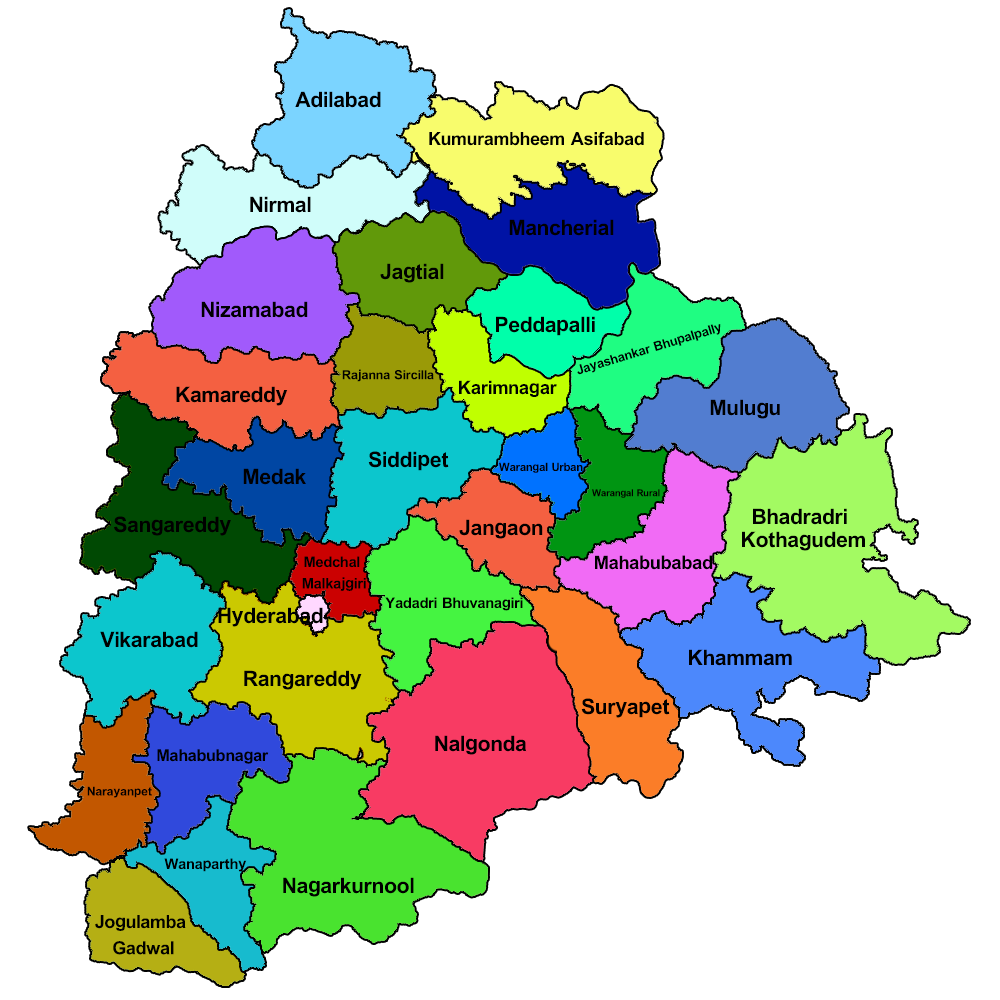
administration of the state’s 10 districts. Local administration in each district is the responsibility of a
district collector. Rural local government has been democratically decentralized by the introduction of a system
in which local authorities operate at the village, block (a unit consisting of a group of villages), and
district levels. Municipal bodies govern the urban areas.
The state judiciary is headed by a High Court, located in Hyderabad, which has jurisdiction for both Telangana
and Andhra Pradesh; the High Court has original jurisdiction in some cases and exercises appellate and
administrative control over the district and lower-level courts. The High Court is itself subject to the
appellate authority of the Supreme Court of India in certain matters. Secunderabad, north of and adjacent to
Hyderabad, is home to a number of defense establishments.
Government-supported health facilities expanded rapidly beginning in the late 20th century. Under the Primary
Health Centres program, medical help, both curative and preventive, was brought to many rural areas. Urban
public medical centres, such as the large Osmania Hospital at Hyderabad, have been expanded and upgraded; and
specialized institutes, including those for treating specific diseases, have been opened. There is also a
family-planning program. Medical aid is free to low-income groups, and several medical insurance programs cover
various categories of employees.
Before India’s independence, social welfare work was mainly undertaken by private agencies. Since the mid-20th
century, however, the magnitude of need and the scarcity of resources, both organizational and financial, led
the state government to accept primary responsibility in that field. Public investment in social welfare
accounts for a large proportion of the total amount spent on planning. There are social welfare programs for
people with disabilities, for Scheduled Castes and Scheduled Tribes, and for other groups that are not fully
integrated into the social structure. Such programs include, among others, those that reserve places in
educational institutions, those that provide employment, and housing and land-distribution schemes.
The state’s educational system provides for 10 years of schooling, followed by a two-year junior college course
leading to undergraduate and postgraduate education. Primary school is compulsory, and both primary and
secondary school are provided free of charge. About two-thirds of the state’s population is literate, although
the proportion for males is considerably higher than that for females. The English and Foreign Languages
University (founded 1958), a nationally prominent institution of higher education, is located at Hyderabad, as
is the University of Hyderabad (1974).
Since the late 20th century, technical education has received special attention in order to meet the demands of
industrialization. Various institutes offer vocational training, while the engineering colleges of the
universities train advanced technical personnel. Scholarship programs are available for Scheduled Castes,
Scheduled Tribes, and other disadvantaged groups in all educational institutions that receive substantial
financial assistance from state and federal agencies. Privately run facilities also operate at all levels.
Many of southern India’s major composers of Indian classical music have been from the region, and Telugu has
been the language of most of the compositions. Telugu, one of the four literary languages of the Dravidian
family, occupies a prestigious place among Indian languages, being renowned for its antiquity and admired by
many for its mellifluous quality. Telugu literature was prominent in the Indian literary renaissance of the 19th
and 20th centuries, as the writing resonated with a revolution in literary forms and expression, stimulated to a
large degree by Western genres. Telangana has many periodicals in English, Telugu, and Urdu. Muslim culture in
the state further enriches its cultural diversity.
Hyderabad is at the cultural heart of Telangana and is home to numerous museums, religious edifices, and
cultural venues. The city is also renowned for its many parks and green spaces, which include one of India’s
best-known zoos. In addition, Hyderabad and Warangal are noted for a wealth of historic sites in and around them
that chronicle the centuries of Muslim rule in the region. Hyderabad, dubbed Tollywood, is also the centre of a
thriving Telugu-language film industry.