The warmest months in Tripura are April and May, when maximum daily temperatures in the lowlands average in the
low 90s F (about 33 °C), and minimum temperatures average in the mid-70s F (about 23 °C). The coolest month is
January, with temperatures typically rising from the low 50s F (about 10 °C) into the upper 70s F (about 25 °C)
daily. Throughout the year, it is cooler in the hill regions.
Annually, the state registers about 80 inches (2,000 mm) of rainfall, most of which is brought by the monsoon,
which generally blows from June to September. North-central Tripura usually receives the most rainfall; the
southwestern region typically receives the least.
About half of Tripura’s land area is under forest cover. One of the most notable types of trees of the state’s
forests is sal, a valuable tropical hardwood. There also are large tracts of bamboo, some species of which are
believed to be endemic to the state.
Animal life includes tigers, leopards, elephants, jackals, wild dogs, wild boars, serows (goatlike mammals), and
various species of wild cattle, including gayals and other types of gaurs. Several species of primates,
including langurs and gibbons, also inhabit Tripura’s woodlands. The state’s lowlands are visited by many types
of migratory birds, such as teals, ibises, and storks. Tripura’s flora and fauna are protected in a number of
wildlife sanctuaries.
Roughly half of the state’s population belongs officially to Scheduled Castes (a term designating those classes
that have traditionally occupied a low position in the Indian caste system) and Scheduled Tribes (a term
generally applied to indigenous peoples who fall outside the traditional Indian social hierarchy). The Tripuri
constitute more than half the tribal community. Other prominent tribal groups include the Reang, the Chakma, the
Halam (a subgroup of the Kuki), the Garo, the Lusai (Mizo), and the Marma (Mogh); most originally moved to
Tripura from various hill regions in neighbouring states.
Bengali (Bangla), an Indo-Aryan language, is spoken by more than half the population; it and Kokborok (Tripuri),
a Tibeto-Burman language, are the state’s official languages. Manipuri, another Tibeto-Burman language, also is
widely spoken.
Hinduism is the religion of the great majority of Tripura’s people. Muslims constitute the largest minority but
account for less than one-tenth of the population. There also are small minorities of Christians, particularly
among the tribal peoples. Most of the Chakma and Mogh are Buddhist.
Tripura is predominantly rural. The highest densities of rural population are found in the state’s most fertile
agricultural lands, located in the western plain and the Gumti, Dharmanagar, and Khowai valleys. Towns are
concentrated on the western plain. The state capital of Agartala is the largest city; major towns include
Badharghat, Jogendranagar, and Dharmanagar.
The agriculture sector engages roughly two-thirds of Tripura’s workforce and accounts for nearly half the state’s gross product. The major crop is rice, which is grown throughout the state. Cash crops include jute (used in the manufacture of sacking, burlap, and twine), cotton, tea, sugarcane, and various fruits, such as jackfruit, pineapples, oranges, and mangoes. Coconuts and potatoes are also important. Livestock plays only a subsidiary role in the state’s agriculture. Forestry-based industries produce timber, firewood, rubber, and charcoal.
Tripura has extensive resources of natural gas that in the early 21st century remained largely untapped. The
bulk of the state’s energy is provided by several gas- and diesel-powered thermal plants. There is also a small
hydroelectric station on the Gumti River.
Tripura’s hilly topography has continued to impair transportation and communication within the state. Moreover, with Bangladesh bordering the state on three sides, Tripura is virtually isolated from India. There is, however, a national highway that passes through the state, linking the capital city of Agartala in the west with the state of Mizoram in the northeast and Bangladesh in the southeast. Larger towns of Tripura are connected through a network of major roads. The North-East Frontier Railway of India’s national rail network serves several cities in Tripura. Most rivers carry boat traffic, but this is generally for local transport. Agartala is linked by air to several cities in India, including Kolkata (Calcutta) in West Bengal, Guwahati in Assam, and the national capital of New Delhi.
The structure of the government of Tripura, like that of most other states of India, is determined by the
national constitution of 1950. The governor is the constitutional head of state and is appointed by the
president of India. The actual administration, however, is conducted by the Council of Ministers, headed by a
chief minister responsible to the elected unicameral Legislative Assembly (Vidhan Sabha). The state’s High
Court, which is located in Agartala, oversees the judiciary.
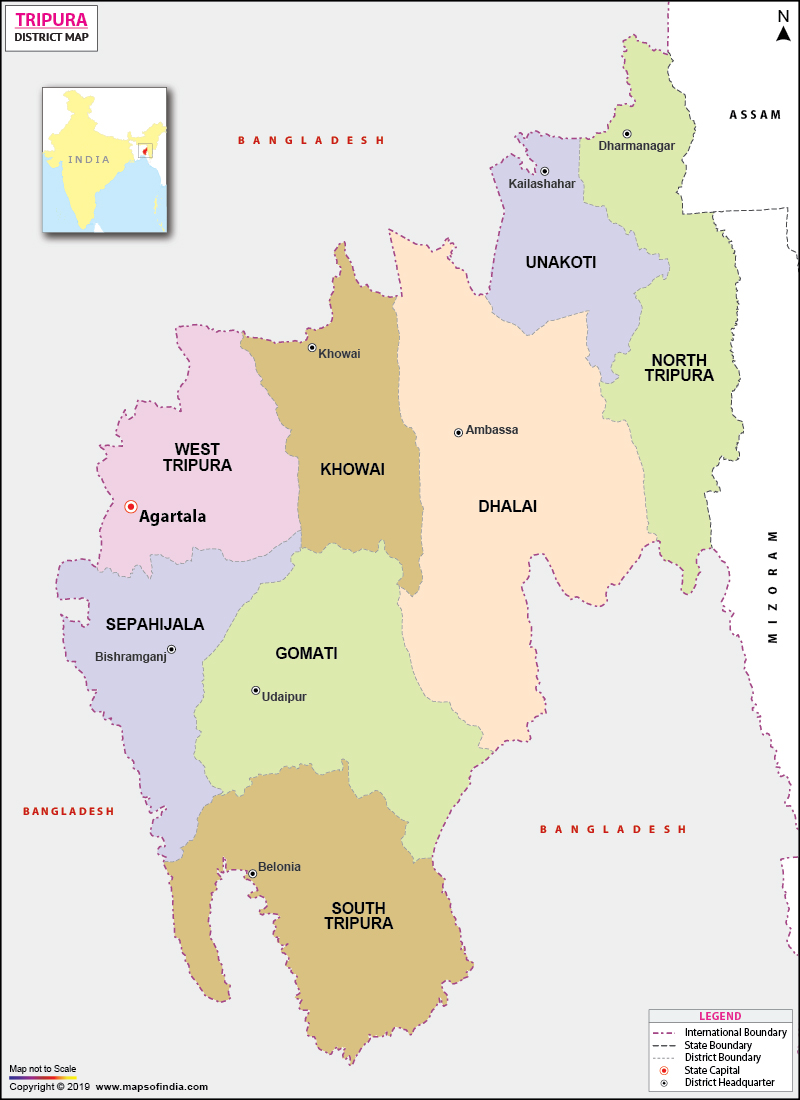
Tripura is divided into a handful of administrative districts, each of which is headed by a district magistrate,
who also serves as the district collector. For administrative purposes, each district contains a few
subdivisions, which are divided into smaller units called tehsils, which in turn embrace a number of villages
and sometimes also a few towns.
Among the major health concerns in Tripura are diarrheal diseases, respiratory diseases, hepatitis, and malaria
and other vector-borne illnesses. Medical treatment is offered through an array of public health facilities,
including district hospitals, subdivisional hospitals, community health centres, public health centres, and
dispensaries. In addition, there are family-planning centres, as well as specialized clinics for the treatment
of leprosy, sexually transmitted diseases, and diseases of the eye, chest, and teeth. The state supports not
only institutions offering allopathic (Western) medicine but also those specializing in Ayurvedic (traditional
Indian) and homeopathic treatments.
Education in Tripura is compulsory and free for children between the ages of 6 and 14 through thousands of public primary and secondary schools. The Umakanta Academy, established in Agartala in the 19th century, is one of the oldest educational institutions in India’s northeastern region. Higher educational facilities include Tripura University (1987) in Suryamaninagar (near Agartala) and numerous general degree colleges, teachers colleges, and professional and technical institutions, including nursing and engineering schools.
Most of the population, adhering to Hinduism and speaking Bengali, shares in the broader cultural traditions of
India, while the Muslim minority is closer in culture to Bangladesh. Traditions of the tribal peoples also are
important elements of Tripura’s cultural life, with each community possessing its own festivals, folklore,
music, and dance.
Two of Tripura’s largest festivals are the Kharchi Puja and the Garia. The Kharchi Puja—also known as the
Festival of the 14 Gods—has its origins in tribal tradition but is now a major temple festival celebrated within
a predominantly Hindu framework by both tribal and nontribal peoples; it takes place in Agartala every July and
honours the deities and the Earth. The Garia celebration is a prominent festival of the indigenous population
and is associated particularly with the Tripuri people. Garia is held each April following the planting of the
fields to pray for a successful agricultural year.