The climate of Uttarakhand is temperate, marked by seasonal variations in temperature but also affected by tropical monsoons. January is the coldest month, with daily high temperatures averaging below freezing in the north and near 70 °F (21 °C) in the southeast. In the north, July is the hottest month, with temperatures typically rising from the mid-40s F (about 7 °C) to about 70 °F daily. In the southeast, May is the warmest month, with daily temperatures normally reaching the low 100s F (about 38 °C) from a low around 80 °F (27 °C). Most of the state’s roughly 60 inches (1,500 mm) of annual precipitation is brought by the southwest monsoon, which blows from July through September. Floods and landslides are problems during the rainy season in the lower stretches of the valleys. In the northern parts of the state, 10 to 15 feet (3 to 5 metres) of snowfall is common between December and March.
Four major forest types are found in the Uttarakhand, including alpine meadows in the extreme north, temperate
forests in the Great Himalayas, tropical deciduous forests in the Lesser Himalayas, and thorn forests in the
Siwalik Range and in parts of the Tarai. According to official statistics, more than 60 percent of Uttarakhand
is under forest cover; in actuality, however, the coverage is much less. The forests provide not only timber and
fuel wood but also extensive grazing land for livestock. Only a small portion of the state’s total land area has
permanent pastures.
Common tree species of the temperate forests include Himalayan cedar (Deodar cedar), Himalayan (blue) pine, oak,
silver fir, spruce, chestnut, elm, poplar, birch, yew, cypress, and rhododendron. Tropical deciduous forests of
sal, teak, and shisham—all hardwoods—occur in the submontane tract. Thorn forests of dhak (a type of flowering
tree), babul (a type of acacia), and various bushes occur in the south.
Uttarakhand has a rich array of animal life. Tigers, leopards, elephants, wild boars, and sloth bears are among
the state’s large mammals. Common birds include pigeons, doves, ducks, partridges, peacocks, jays, quail, and
woodpeckers. Crocodiles are found in some areas. Lions and rhinoceroses have become extinct in the region. A
number of national parks and sanctuaries have been established to preserve Uttarakhand’s wildlife.
Uttarakhand has a multiethnic population spread across two recognized geocultural regions: the Gahrwal, which
corresponds roughly to the northwestern half of the state, and the Kumaun, which spans the southeast. Rajputs
(various clans of landowning rulers and their descendants)—including members of the indigenous Garhwali, Gujjar,
and Kumauni communities, as well as a number of immigrant peoples—constitute a large portion of the population.
Of the total population, nearly one-fifth belongs to the Scheduled Castes (an official designation for those
groups that traditionally have occupied a low position within the Indian caste system); these people are
collectively called Kols or Doms. Scheduled Tribes (an official category embracing indigenous peoples who fall
outside the Indian social system), such as the Raji, who live near the border with Nepal, account for less than
5 percent of the population.
Most of the people of Uttarakhand speak Indo-Aryan languages. Hindi is the official language of the state.
Hindustani, which contains words from both Hindi and Urdu, is the principal spoken language. Other languages
used in Uttarakhand include Garhwali and Kumauni (both Pahari languages), Punjabi, and Nepali.
More than four-fifths of Uttarakhand’s residents are Hindu. Muslims constitute the largest religious minority,
accounting for about one-tenth of the population. Smaller communities of Sikhs, Christians, Buddhists, and Jains
make up most of the remainder of Uttarakhand’s people.
The sparse population of Uttarakhand is unevenly distributed throughout the state. Most people live in rural
settlements, which usually take the form of small linear villages set alongside paths or roads. Typical rural
houses have two stories, with part of the lower level used for keeping animals. Most are built from local stone
with mud used as mortar. Roofs are generally made of slate tiles or corrugated iron sheets. Although such homes
may have few amenities compared with their urban counterparts, the ever-increasing network of paved roads, as
well as the availability of electricity and consumer goods, such as radios and televisions, has drawn much of
Uttarakhand’s rural population into the mainstream of state and national society.
About one-fourth of the total population lives in several dozen urban centres, located primarily in the southern
part of the state. Northern and eastern Uttarakhand have experienced a comparatively slow rate of urbanization.
With the exception of Dehra Dun and several other cities—including Haridwar, Haldwani, Roorkee, Kashipur, and
Rudrapur—most of Uttarakhand’s urban centres are actually large towns, with populations of less than 50,000.
Although roughly three-fifths of the working population of Uttarakhand is engaged in agriculture, less than
one-fifth of the total area of Uttarakhand is cultivable. Steep slopes require careful terracing and irrigation,
with water drained from the upper levels used to irrigate the lower ones. This method of terrace cultivation
allows fields to be sown more than once per year. Wheat is the most widely cultivated crop, followed by rice and
various types of millets, which are planted on the drier leeward slopes. Sugarcane is grown extensively in the
gently rolling foothills of the southern region. Other important crops include pulses (legumes) such as peas and
chickpeas, oilseeds such as soybeans, peanuts, and mustard seeds, and assorted fruits and vegetables.
Many farmers of Uttarakhand practice animal husbandry. The largest concentration of cattle to support dairy
farming is found in the southern foothills. Goats and sheep are more common in the mountainous areas, although
some cattle are kept in every village. The search for flourishing grassland has resulted in a tradition of
transhumance, whereby livestock are led to graze in the mountain pastures during the warmer months but are
transferred to the lower elevations for the winter. Some communities in the Siwalik Range historically have
specialized in such seasonal herding.
Forests in Uttarakhand provide timber for construction, fuel wood, and various manufacturing activities,
including handicrafts. Reforestation programs sponsored by the state government have moderately increased
production, which, in turn, has facilitated development of additional forest-based industries.
Uttarakhand lacks mineral and energy resources sufficient for rapid industrialization. Aside from silica and
limestone, which are the only minerals that are found—and mined—in considerable quantities, there are small
reserves of gypsum, magnesite, phosphorite, and bauxite.
Perennial rivers fed by the perpetual snowfields of the Great Himalaya and the Zaskar ranges carry tremendous
potential for the generation of hydroelectric power. Indeed, many small hydroelectric stations supply a portion
of Uttarakhand’s energy. The Tehri Dam on the Bhagirathi River, conceived in the mid-20th century and begun in
the 1970s, is one of the largest hydroelectric projects in Asia. The project generated considerable controversy,
however, and by the end of the first decade of the 21st century, it had yet to be put into operation.
Consequently, Uttarakhand has continued to rely on the central pool (a national power storage scheme) to meet
its energy needs.
Roads of various descriptions connect nearly all towns of Uttarakhand. Although the central and southern portions of the state are served by several national highways, the northern border zones are not connected by official roads at all; rather, an extensive network of mountain trails links the villages with nearby towns. Several railway tracks extend from the plains of Uttar Pradesh into the valleys of southern and eastern Uttarakhand. Major towns served by these railways include Dehra Dun, Haridwar, Rishikesh, Ramnagar, Kathgodam, and Tanakpur. Airports at Dehra Dun and Pantnagar offer domestic service.
The government of Uttarakhand has invested heavily in the services sector, particularly in the development of the information-technology and tourism industries. In the first decade of the 21st century, the sector already accounted for more than half of the state’s gross product. The tourism industry has shown significant growth, as the state’s snow-capped peaks, glaciers, lush green river valleys, waterfalls, lakes, flora and fauna, wildlife sanctuaries, and pilgrimage sites attract a large number of domestic and international visitors.
The structure of Uttarakhand’s government, like that of other states of India, is determined by the national
constitution of 1950. It is a parliamentary system, consisting of executive, legislative, and judicial branches.
The chief executive is the governor, who is appointed by the president of India. The governor is aided and
advised by the Council of Ministers, which is led by a chief minister. The Legislative Assembly (Vidhan Sabha)
is a unicameral body whose members are elected for a five-year term. The final court in Uttarakhand is the High
Court at Nainital, which is headed by a chief justice. Appeals may be made from the High Court to the Supreme
Court of India. Below the High Court are district, sessions, civil, and magistrates’ courts.
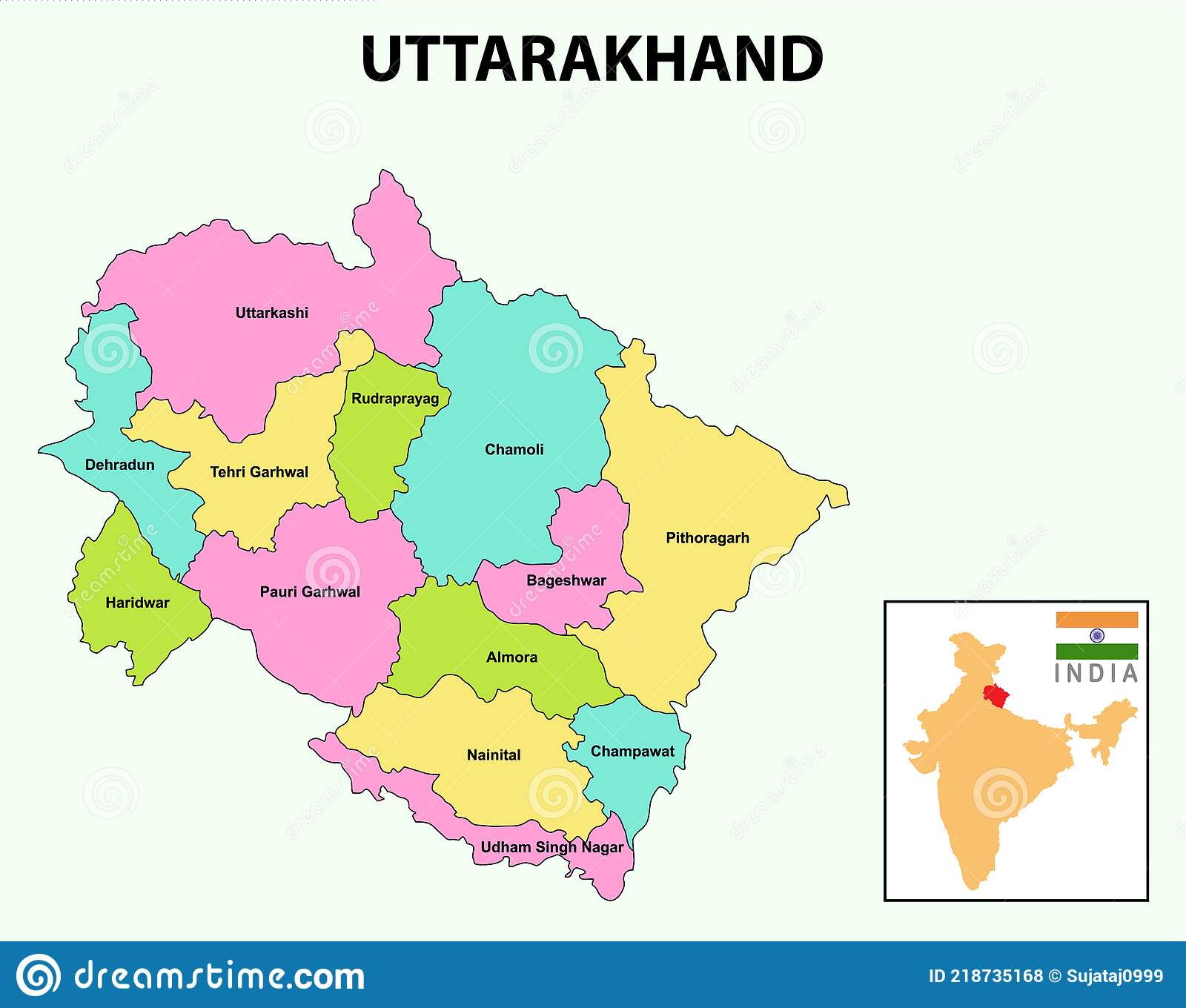
The state is divided into more than one dozen districts, each administered by a district magistrate. Districts
are subdivided into smaller units called tehsils, each of which embraces numerous villages and, in some cases, a
few towns. The towns and villages are grouped into blocks for development purposes.
Health care in the state is provided by a number of district hospitals, several dozen community health centres,
and, in the rural areas, hundreds of primary health centres and subcentres. Treatment is also available from
private practitioners. The government recognizes and supports allopathic (Western), Ayurvedic (traditional
Indian), Unanī (a traditional Muslim system using prescribed herbs and shrubs), and homeopathic medicine. The
state participates in many of the national programs to control (or eradicate) diseases such as leprosy,
tuberculosis, and malaria, as well as HIV/AIDS infection and various vector-borne diseases. It also has joined
countrywide programs for the prevention of blindness and hearing loss.
In the area that now constitutes Uttarakhand, there has been a virtual explosion since the mid-20th century in
the number of schools and students enrolled at all levels. In the first decade of the 21st century, the state’s
literacy rate (more than 70 percent) significantly exceeded the national average. Hindi is the medium of
instruction at the primary school level, although there are several private residential schools where the medium
of teaching is English. Hindi and English are required courses for high school students, and English is
generally the medium of instruction at the university level.
Uttarakhand has a number of government universities, the most prominent of which include, in the southeast, the
Govind Ballabh Pant University of Agriculture and Technology (1960) in Pantnagar and Kumaun University (1973),
with campuses in Nainital and Almora; in the western region, the Indian Institute of Technology (formerly
University of Roorkee; 1847) in Roorkee; and in west-central Uttarakhand, Hemwati Nandan Bahuguna Garhwal
University (formerly Garhwal University; 1973) in Srinagar. There are also a number of smaller colleges
affiliated with these or other government institutions. The University of Petroleum and Energy Studies (2003) in
Dehra Dun is one of the notable private institutions. Other universities and colleges offer specialized training
in such areas as forest research, Sanskrit and other Indian studies, engineering, and various technical fields.
Some of Hinduism’s holiest shrines and temples, which are also pilgrimage centres, are located in the mountains
of Uttarakhand. The Yamnotri temple, in the western part of the Garhwal region, lies at an elevation of about
10,600 feet (3,200 metres). Its chief deity is Yamuna, the Hindu river goddess. The Yamuna River emerges from
the Yamnotri glacier nearby. The shrine of Gangotri, in the northwestern part of the state, is situated in a
cedar- and pine-wooded area at an elevation of nearly 10,000 feet (3,000 metres); submerged in a river at the
site is the natural rock linga (phallic symbol of the god Shiva) where, according to mythology, Shiva sat when
he received the goddess Ganga in his matted locks. At Kedarnath, somewhat to the southeast of Gangotri at an
elevation approaching 12,000 feet (3,500 metres), is a stone temple to Shiva that is considered to be more than
1,000 years old; a large statue of the bull Nandi, one of Shiva’s chief attendants, stands outside the temple
door. The Badrinath temple, located at an elevation of some 10,300 feet (3,100 metres) on the bank of Alaknanda
River, is the abode of the god Vishnu; the temple’s idol of Vishnu, made of black granite, is said to have been
installed by the 8th-century philosopher Shankara.
An important Sikh shrine and pilgrimage site is Hemkund Sahib. Perched at an elevation above 13,000 feet (4,000
metres) in north-central Uttarakhand, the shrine honours the 10th Guru of Sikh religion, Gobind Singh. It marks
the place where the Guru spent years in meditation.
Most of Uttarakhand’s festivals are tied to the Hindu calendar. Among the most popular of these events is
Dussehra, which celebrates the victory of the prince Rama over the demon king Ravana (as recounted in the Indian
epic Ramayana); it is usually held in September or October. Diwali, which takes place in October or November, is
a festival of lights dedicated to Lakshmi, the goddess of wealth. Also important is Shivaratri, a day—normally
in February—that is devoted to the worship of Shiva. Holi, a spring celebration held in February or March, is
perhaps the most colourful of the Hindu festivals.
Most of the major Muslim holidays and observances follow the lunar calendar, meaning that the time of their
celebration shifts from year to year. The holiday of Muḥarram commemorates the martyrdom of the hero al-Ḥusayn
ibn ʿAlī. Ramadan is a month devoted to fasting, the close of which is marked by the canonical festival of ʿĪd
al-Fiṭr. ʿĪd al-Aḍḥā signals the completion of the hajj (pilgrimage to Mecca) and is celebrated by Muslims
worldwide.
Within the Buddhist tradition, Buddha Purnima is a major festival commemorating the birth, enlightenment, and
death of the Buddha; it usually takes place in April or May. Mahavira Jayanti, the principal Jain celebration,
honours the birth of Mahavira, the great reformer of the Jain monastic community. The birthday of Guru Nanak,
founder of Sikhism, is observed by the Sikh population. Christmas is the biggest religious holiday for
Uttarakhand’s Christians. In addition to faith-based festivities, hundreds of smaller-scale fairs and festivals
are held annually across the state; many of these are unique to particular villages.
Uttarakhand is known for its spectacular natural environment. Among the favourite destinations of residents and visitors are the Valley of Flowers and Nanda Devi national parks (together designated a UNESCO World Heritage site in 1988) in the northern Kumaun Himalayas, Rajaji National Park in the western Siwaliks, and Corbett National Park in the Himalayan foothills. Many also enjoy visiting the state’s mountain lakes and glaciers, as well as its forested valleys and bugyals (lush mountain meadows). Mussoorie, Nainital, Ranikhet, Kausani, Almora, and Auli are popular mountain resorts, some of which offer fine slopes for skiing.