West Bengal’s climate is transitional between tropical wet-dry in the southern portions and humid subtropical in
the north. Throughout West Bengal there is a pronounced seasonal disparity in rainfall. For example, Kolkata
averages about 64 inches (1,625 mm) per year, of which an average of 13 inches (330 mm) falls in August and less
than 1 inch (25 mm) in December. The state also is subject to considerable variability from year to year. In the
sub-Himalayan region, rainfall is considerably greater.
The year may be broadly divided into three marked seasons—the hot and dry season (March to early June), with dry
sultry days and frequent thunderstorms; the hot and wet season (mid-June to September), when rain-bearing
monsoon winds blow from the southwest; and the cold (cool) season (October to February), when days are dry and
clear and stable atmospheric conditions prevail. Average high temperatures at Kolkata range from about 80 °F (27
°C) in December and January to nearly 100 °F (38 °C) in April and May.
Forests occupy more than one-tenth of the total land area of the state, and the region as a whole has a rich and
varied plant life. In the sub-Himalayan plains the principal forest trees include sal (Shorea robusta) and
shisham, or Indian rosewood (Dalbergia sissoo); the forests are interspersed with reeds and tall grasses. On the
Himalayan heights vegetation varies according to the elevation, with coniferous belts occurring at higher
levels. The delta of the Hugli constitutes the western end of the dense coastal mangrove forest called the
Sundarbans. A large portion of that unreclaimed and sparsely populated area bordering Bangladesh and the Bay of
Bengal has been set aside as a national park and also (along with the portion in Bangladesh) as a UNESCO World
Heritage site (designated 1987).
The forests are inhabited by tigers, leopards, elephants, gaurs (wild cattle), and rhinoceroses, as well as by
other animals of the Indian plain, large and small. Reptiles and birds include the same species as are common
throughout the Indian subcontinent. In addition to the Sundarbans park, the state has several other protected
natural areas, including Jaldapara Wildlife Sanctuary and a tiger reserve.
The majority of West Bengal’s people live in rural villages. Of those living in urban areas, more than half
reside in greater KolkataOf the different religions, Hinduism claims the adherence of more than three-fourths of
the population. Most of the remainder is Muslim. Throughout the state, Buddhists, Christians, Jains, and Sikhs
constitute small minority communities.
Bengali, the main language of the state, is spoken by much of the population. Other languages include Hindi,
Santali, Urdu (primarily the language of Muslims), and Nepali (spoken largely in the area of Darjiling). A small
number of people speak Kurukh, the language of the Oraon indigenous group. English, together with Bengali, is
the language of administration, and English and Hindi serve as lingua francas at the national level.
Agriculture dominates both the landscape and the economy of West Bengal. Its proportion of agricultural land is among the highest of all the Indian states. Rice, which requires extensive irrigation, is the leading crop in nearly every area. Indeed, despite its relatively small size, West Bengal produces a significant percentage of India’s rice harvest. Other major crops are sugarcane and oilseeds. Jute is especially prominent along the border with Bangladesh and south of the Ganges River. Mangoes, jackfruit, and bananas are widely produced in the southern and central portions of the state. Wheat and potatoes are produced as winter crops throughout the south. The northern areas around Darjiling and Jalpaiguri have long been known for their production of high-quality tea. The Darjiling region also produces oranges, apples, pineapples, ginger, and cardamom.
The state’s most important industrial belt is a corridor extending for a distance north and south of Kolkata,
along the Hugli River. Another significant industrial region is located along the Damodar River. There are steel
plants at Durgapur and Burnpur and a locomotive plant at Chittaranjan. Haldia, the terminus of an oil pipeline
from Assam and the site of a large oil refinery, also has a petrochemical industry. Other important manufactures
include ships, automobiles, chemicals and fertilizers, wagons, electronics, paper, jute, and cotton textiles.
The state has a large number of small-scale and cottage industries as well. In the late 20th and early 21st
centuries, the only mineral resources of West Bengal that sustained nationally significant exploitation were
coal and clay for brickmaking.
Local river transportation was augmented by steam navigation in the 19th century—first introduced between Kolkata, Allahabad (Uttar Pradesh), and Guwahati (Assam). The division of Bengal in 1947 and the ongoing deterioration of river channels have disrupted river transport. Nevertheless, Kolkata and its sister port of Haldia, farther south, still handle international trade. West Bengal saw the inauguration of the railway system in eastern India in 1854, and local railway headquarters are now located in the state. Kolkata was the first Indian city to open an underground railway system. National highways link West Bengal with the rest of India, while state highways provide internal connections. There is an international airport at Kolkata as well as several smaller airfields within the state.
The structure of the government of West Bengal, like that of most Indian states, is determined by the national
constitution of 1950. The head of state is the governor, who is appointed by the president of India. The elected
Council of Ministers, with a chief minister at its head, aids and advises the governor. The chief minister is
appointed by the governor, and the other ministers are appointed by the governor on the advice of the chief
minister. The Council of Ministers is collectively responsible to the state legislature, which consists of a
single house, the Legislative Assembly (Vidhan Sabha). The constitution provides for a High Court; its chief
justice and judges are appointed by the president of India. Other judges are appointed by the governor.
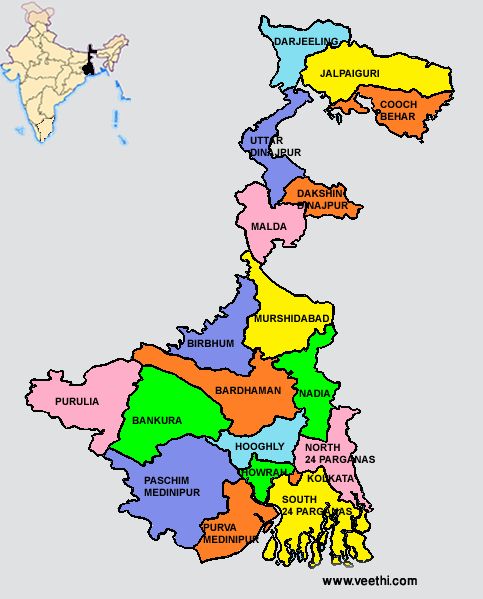
The state is divided administratively into a number of districts. Each district, except that of Kolkata, is
administered by a collector, who is also the district magistrate. Districts, in turn, are divided into
subdivisions, each administered by a subdivisional officer. Units of police jurisdiction vary in area according
to population. Most encompass several mawzas (villages).
With the object of developing rural self-government, mawzas were grouped together under elected local
authorities known as panchayats. Established under the West Bengal Panchayat Act of 1956, panchayats are
entrusted with sanitary and conservation services and with the supervision of the village police and the
development of cottage industries. A three-tiered panchayat system, comprising several thousand village-level
panchayats, several hundred intermediate-level panchayats, and more than a dozen district-level panchayats,
covers the rural area.
Medical facilities include hospitals, clinics, health centres, and dispensaries. Family-planning services are
available in district bureaus, as well as in urban and rural centres. An employees’ state insurance scheme
provides factory workers with health, employment, safety, and maternity insurance and also provides a free
medical service.
A social welfare directorate coordinates various welfare services dealing with orphans, people with mental and
physical disabilities, and the underprivileged. The government’s social-welfare enterprises are supplemented by
private agencies, of which the most prominent are the Ramakrishna Mission, founded by the Hindu reformer and
teacher Vivekananda in 1897, and the Order of the Missionaries of Charity (1948), founded by Mother Teresa,
recipient of the 1979 Nobel Prize for Peace.
West Bengal has more than 10 degree-granting universities, as well as engineering and medical colleges and many
technical institutes. The University of Calcutta (1857) and Jadavpur (1955) and Rabindra Bharati (1962)
universities are all located in Kolkata. The science laboratories of the University of Calcutta, the Indian
Association for the Cultivation of Science, and the Bose Institute have made notable contributions to science.
The Asiatic Society of Bengal, a scholarly organization founded in 1784, is headquartered in Kolkata.
Vishva-Bharati University, in Shantiniketan (now part of Bolpur), is a world-famous centre for the study of
Indology and international cultural relations.
The state has a central library, together with a number of district, area, and rural libraries. More than 5,000
adult education centres aid in literacy training. The state’s literacy rate, which exceeded 75 percent in the
early 21st century, is one of the highest in India, and the disparity in the rate between men and women is lower
than the national average.
Bengalis have long fostered art, literature, music, and drama. The visual arts have, by tradition, been based
mainly on clay modeling, terra-cotta work, and decorative painting. Bengali literature dates to before the 12th
century. The Chaitanya movement, an intensely emotional form of Hinduism inspired by the medieval saint
Chaitanya (1485–1533), shaped the subsequent development of Bengali poetry until the early 19th century, when
contact with the West sparked a vigorous creative synthesis. The modern period has produced, among others, the
Nobel Prize-winning poet Rabindranath Tagore (1861–1941), whose contribution still dominates the Indian literary
scene.
Traditional music takes the form of devotional and cultural songs. Rabindra Sangeet, songs written and composed
by Tagore, draw on the pure Indian classical as well as traditional folk-music sources, including the Baul
singing genre. They exert a powerful influence in Bengali cultural life.
The theatre is popular, and performances—amateur as well as professional—are sophisticated. Yatras (jatras),
traditional open-air performances that may treat mythological and historical topics or contemporary themes, are
popular both in the countryside and in urban areas. The kavi is an impromptu duel in musical verse between
village poets. The kathakata, a religious recital, is another traditional form of rural entertainment, based on
folklore.
The film industry is a well-established modern form of popular entertainment. Bengali films have earned national
and international awards for their delicate handling of Indian themes; the works of the directors Satyajit Ray,
Tapan Sinha, Mrinal Sen, and Aparna Sen are particularly notable.